
Reliable IHUT results depend on recruiting the right participants, delivering products correctly, asking clear questions, and checking responses for quality. Problems at any stage can affect the findings.
This article covers how to maintain research quality throughout running an IHUT, from recruitment to final analysis.
What Determines Research Quality in an IHUT?
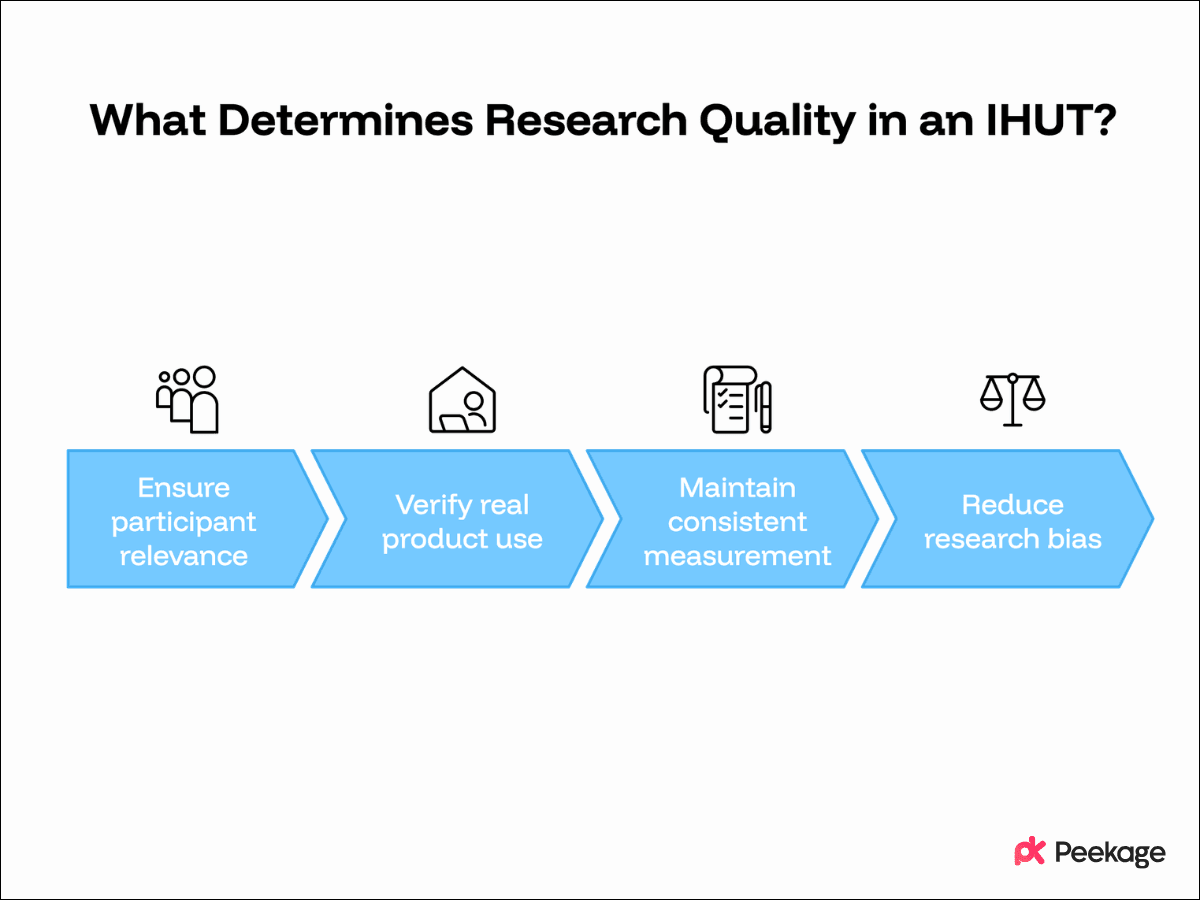
Four factors decide whether an IHUT gives you data you can trust. Each one connects to a different stage of the study.
- Participant relevance: The people testing your product need to match your real target buyer, and you need to know they're genuine. A mismatch between the sample and the target audience can undermine the entire study.
- Real product use: Feedback only counts if participants actually used the product. They also need to use it long enough to get past first-day novelty.
- Consistent measurement: Every participant should get the same questions, in the same way, at the same points in the study. Good survey data has five dimensions: accuracy, consistency, completeness, timeliness, and authenticity.
- Reduced bias: Your findings should reflect the target audience as a whole, not just the most eager or available responders.
Participant quality starts before anyone receives a product. It usually pays to recruit real consumers for IHUT from verified panels instead of open sign-up pages, because verified profiles make screening far more reliable.
How Product Distribution Affects IHUT Research Quality
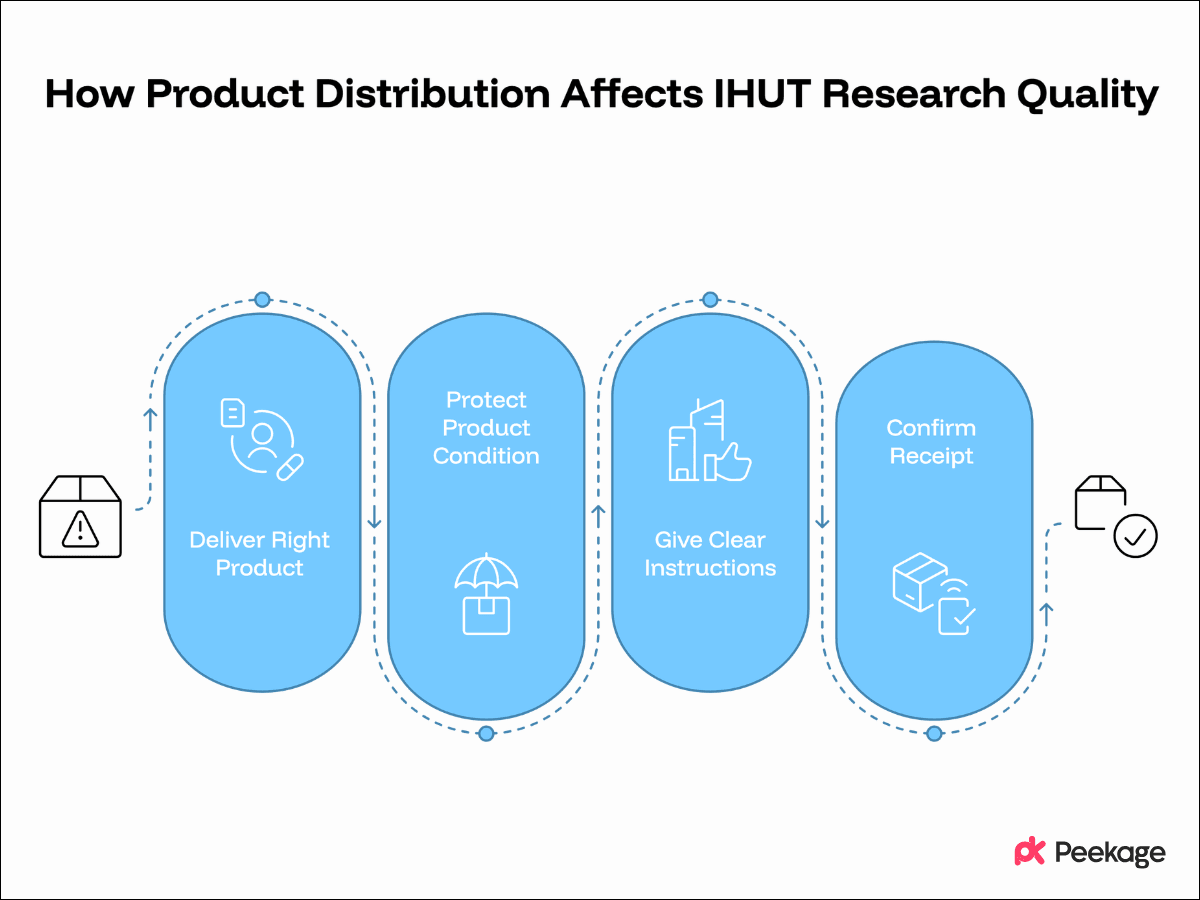
In an IHUT, shipping is part of the research method, not just logistics. Knowing how to send CPG prototypes correctly helps ensure participants receive the right product in good condition and with clear instructions. If a product arrives damaged, incomplete, or with unclear instructions, the feedback you collect may not reflect the product you intended to test.
- Deliver the right product: Match each participant to the correct product and variant. If you're testing more than one product, use neutral codes or colors instead of brand names so labels don't sway opinions.
- Protect product condition: Temperature-sensitive or perishable items need suitable packaging and shipping times. A melted or stale sample gives you feedback on the delivery, not the formula.
- Give clear instructions: Include a printed or digital guide so everyone uses the product the same way.
- Confirm receipt first: Track every delivery and confirm the product arrived before you ask for any feedback.
Physical delivery also gives IHUTs a quality check that generic online surveys or focus groups cannot provide in the same way.
Unlike a CLT, which takes place in a controlled location, IHUTs require products to be shipped to participants' homes. This difference between CLT and IHUT means confirmed delivery can help verify that participants receive the products they are expected to test.
How to Design Surveys That Produce Reliable IHUT Data
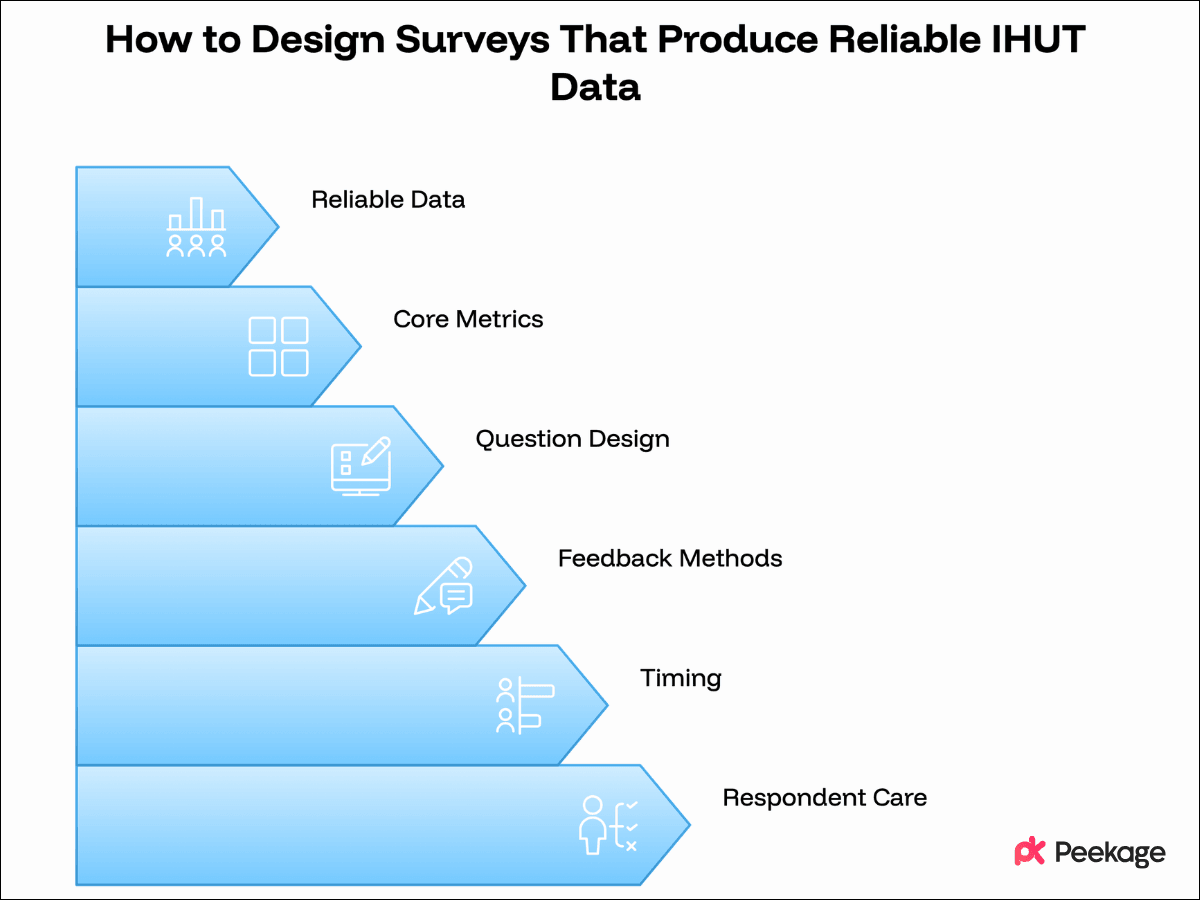
Your survey turns real product experiences into usable data. Even with the right participants and smooth delivery, poorly built questions can blur what people actually think.
How To Ask Clear And Neutral Survey Questions
Ask about one idea per question and use plain, everyday words. Avoid double questions like "How easy and enjoyable was the product?" because you won't know which part people answered. Keep wording balanced. "How satisfied or dissatisfied were you?" works better than "How much did you love it?" These principles matter most when writing effective IHUT survey questions that capture clear, reliable feedback from product testers.
How To Measure Product Satisfaction, Usability, And Repeat Purchase Intent
Cover the core IHUT metrics: overall satisfaction, ease of use, likelihood to recommend, and likelihood to buy again. You can also use acceptor-rejector analysis, which means asking the same key questions before and after use. A drop in acceptance shows you where the product fell short of expectations.
How To Combine Rating Scales With Open-Ended Questions
Rating scales show how much people liked something. Open-ended questions show why, so use both. Open text also helps you spot low-effort or fake answers, since vague, generic, or copy-pasted comments tend to stand out quickly.
How To Collect Feedback At The Right Stages Of Product Use
Send a first-impressions survey after early use and a final survey at the end of the testing period. This shows whether satisfaction holds once the novelty wears off. Fit the timing to your category, because a snack needs less time than a skincare routine.
How To Avoid Leading Questions And Respondent Fatigue
Long, repetitive surveys wear people out, and tired participants give weaker answers. Keep surveys short and use skip logic so people only see questions that apply to them. Avoid large rating grids, which invite straightlining (picking the same answer all the way down a list).
How to Monitor Product Use and Participant Engagement
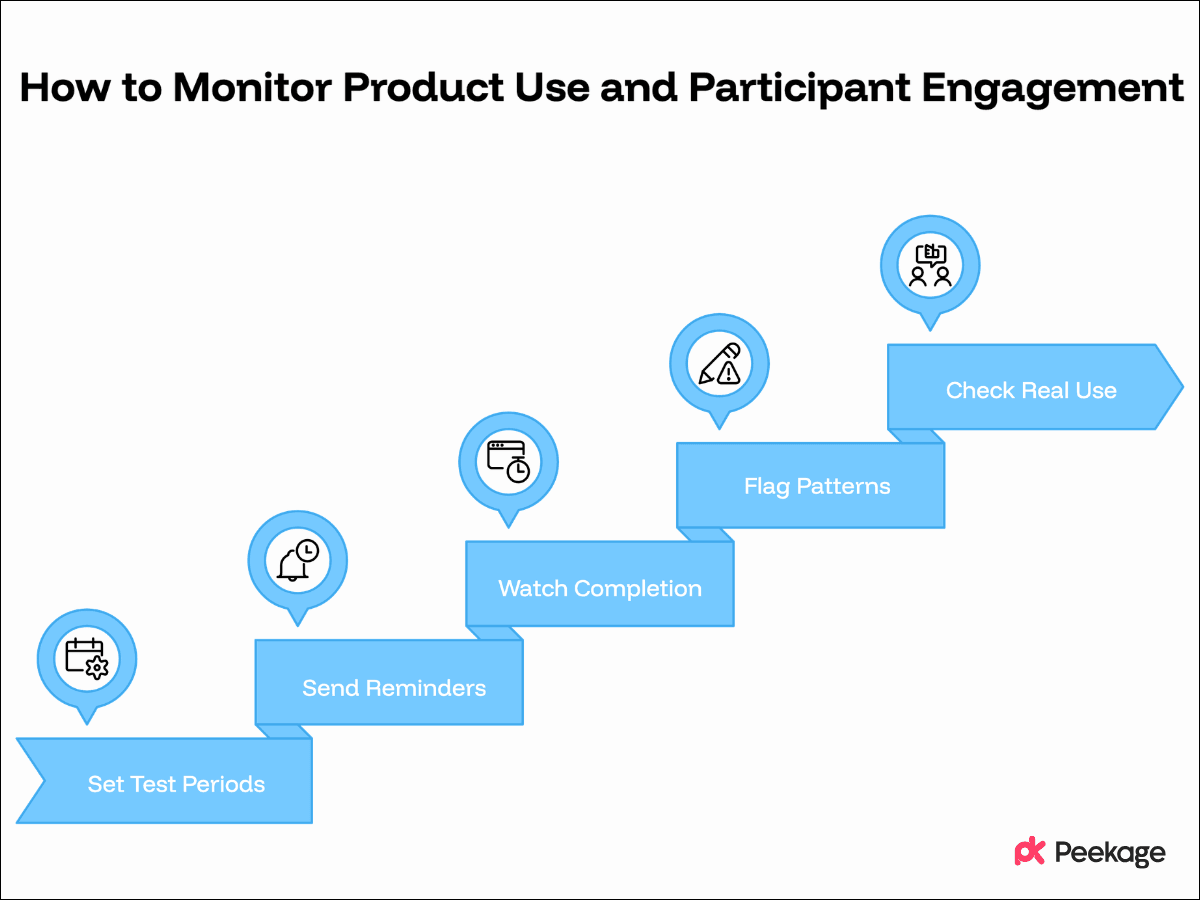
Monitoring keeps participants on track during the test. It also helps you catch quality problems early, while you can still fix them.
- Set realistic test periods: Match the testing period to the product. QuestionPro notes that most IHUTs run one to six weeks, depending on the category. Tell participants up front how often you expect them to use the product.
- Send timely reminders: Remind people when the product ships, when it should arrive, and when each survey opens. A few well-timed messages work better than constant nudges.
- Watch completion and quality: Track drop-offs and rushed answers as responses come in. Compare answer quality near the end of a survey with the start to spot fatigue.
- Flag unusual patterns: Look for straightlining, contradictory answers, and identical open-text comments from different participants.
- Check for real use: Ask specific questions about how and when people used the product. This keeps feedback grounded in actual experience rather than guesses.
How to Analyze IHUT Data for Accurate Consumer Insights
Start by cleaning the data. Remove duplicates, incomplete surveys, and any responses you flagged as suspicious during monitoring. Then compare results across key segments, and compare early feedback with final feedback to see whether satisfaction holds over time.
Read the open-ended comments next, because they explain the reasons behind the scores. Keep a clear line between what the data shows and what it only suggests. A small segment with strong opinions may point to a trend worth testing, but it isn't proof on its own.
AI tools can speed up theme detection when you have hundreds of comments to sort. Human review still matters, especially when results will shape a launch. Before you share findings with your team, get comfortable interpreting IHUT reports so you can explain what each number means.
What Are the Common Factors That Reduce IHUT Research Quality?
Most quality problems in an IHUT come from a small set of avoidable issues. Fraud is one of them, and it's getting harder to catch. A 2025 study in PNAS built an AI respondent that passed 99.8% of standard quality checks, so basic attention checks alone are no longer enough.
The table below shows the most common quality risks and how you can prevent each one.
| Factor | How it hurts quality | How to prevent it |
|---|---|---|
| Wrong participants | Feedback comes from people who would never buy the product | Use precise screening and verified panels |
| Low completion and dropouts | Final results reflect only the most engaged testers | Keep surveys short and send timely reminders |
| Poorly worded or leading questions | Answers reflect the wording, not real opinions | Use neutral, one-idea questions and pilot the survey |
| Inconsistent product use | Participants compare different experiences | Ship clear instructions and confirm usage |
| Small or biased samples | Results don't apply to the wider market | Size and balance the sample to match your target audience |
| Over-reaching conclusions | Teams act on patterns the data can't support | Separate confirmed findings from ideas to test |
Most of these issues start at the design stage, long before the first response comes in. That's why the checks you build into recruitment and survey design matter as much as the checks you run on the final data. Understanding the cost of an IHUT early also helps teams plan a sample size and study design that fits both the research goals and the available budget.
How to Measure the Quality of an IHUT Study for CPG Products
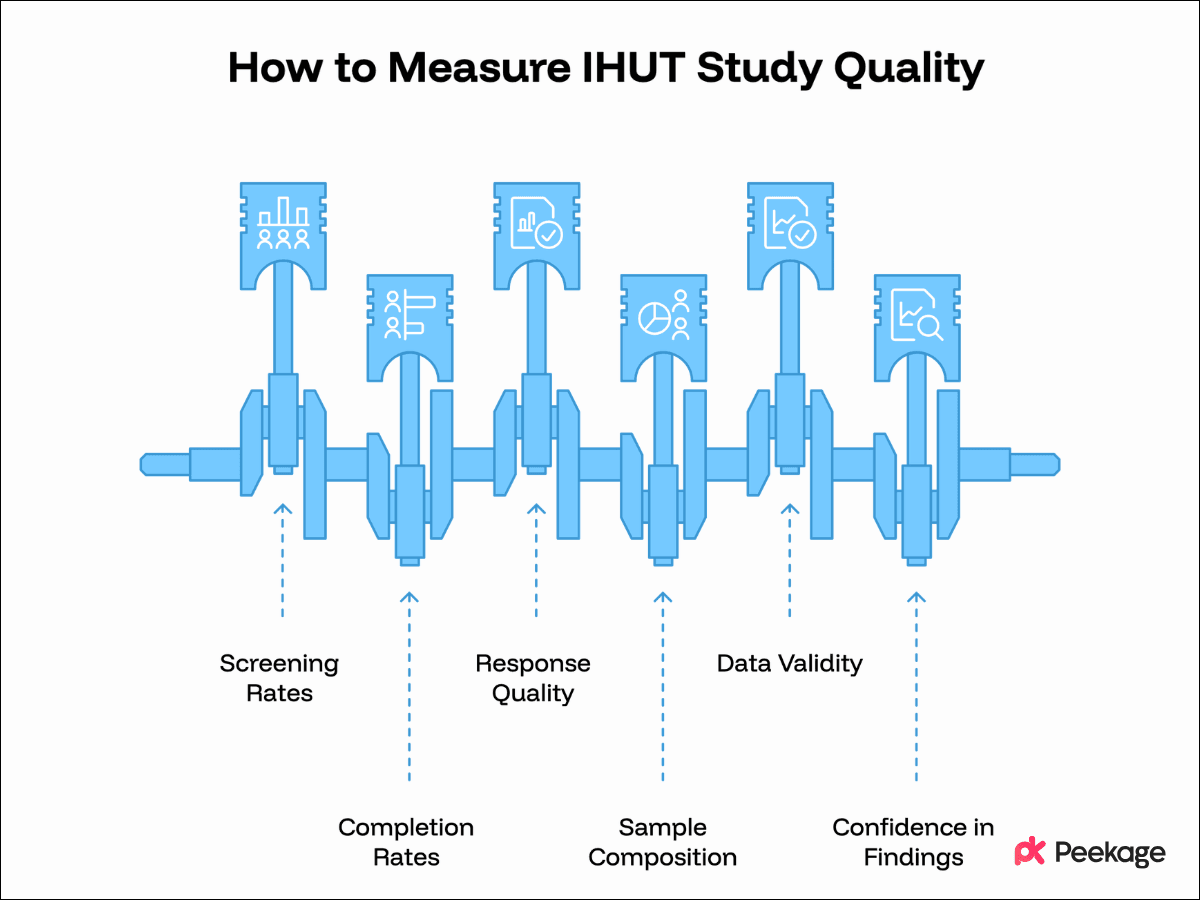
You can measure IHUT quality with a few simple checks. Track them during the study, not only at the end. If you use IHUT product testing services, these metrics can also help you assess how well the study is being managed and whether the results are reliable enough to support product decisions.
What participant screening and eligibility rates reveal
Screening rates show how many applicants matched your criteria and whether you reached the required number of participants for your IHUT. A very high pass rate may mean your screener is too broad and is letting in participants who do not fit your target audience. Review the screening questions against your research goals to make sure they identify the right consumers.
How to track survey completion and dropout rates
Track how many participants finish each survey stage. A sharp drop at one specific question or stage may point to a design or timing problem. For example, participants might abandon a survey because it is too long, a question is confusing, or a follow-up arrives at an inconvenient time.
How to check response completeness and consistency
Check that participants answered all key questions and that their answers are consistent. For example, conflicting responses about a product's ease of use may need a second look before you include them in the analysis. Review these responses in context rather than automatically treating every difference as evidence of poor data quality.
How to confirm sample composition reflects the target audience
Compare your final sample with your target profile on age, region, usage habits, and other key traits. Dropouts can quietly change the sample composition during the study, leaving some audience groups underrepresented. Monitoring these characteristics throughout the test helps you spot gaps before they affect the findings.
How to judge data validity and confidence in the findings
Ask whether the results come from genuine participants, whether responses are consistent across relevant segments, and whether you have enough data to answer your research questions.
Consider the sample size alongside the study design and the level of confidence needed for the decision. If the evidence is limited or inconsistent, treat the findings as preliminary and consider further testing.
How Peekage Helps Brands Improve IHUT Research Quality
A high-quality IHUT has many moving parts, and the gaps between them are where quality usually slips. At Peekage, we bring those parts into one platform, so you have fewer handoffs to manage.
- Targeted recruitment: We draw on a panel of 5 million consumers across the U.S. and Canada, with 200+ attributes for precise targeting.
- One connected workflow: Our platform covers recruitment, product fulfillment, shipping, guided usage, feedback collection, and analysis in one place.
- Careful fulfillment: We handle packaging, shipping, tracking, and coordination, including products with special handling needs.
- Layered quality checks: We use an AI quality engine and multi-layered validation to help screen out low-quality responses.
- AI-supported analysis: Our analysis tools help turn raw feedback into clear themes, which your team can then review and act on.
Every study is different, and results depend on your product, audience, and research goals. If you're planning an IHUT and want more reliable consumer feedback, talk to the Peekage team to discuss your next study.