
Sample size is usually one of the first questions brands ask when planning an in-home usage test. There isn't one number that works for every study. It's because the right sample depends on what you need to learn and how confident you need to be in the results.
Sample size also depends on the goal of your study. A quick packaging check and a study supporting a major purchase decision require very different levels of evidence.
In this guide, we'll cover typical IHUT sample sizes, what can increase or reduce your participant count, how to account for drop-offs, and how sample size affects cost and timing.
Why Does the Number of Participants Matter in IHUT Research?
Participant count affects how confidently you can interpret your IHUT results. With too few people, individual responses can have a larger influence on the findings. With too many, you may spend more on product units, shipping, and incentives without gaining much additional insight.
The right sample size also depends on where your product is in the development process. Early concept testing may only require enough consumers to compare ideas and identify promising directions. While concept testing services can support broader research when you need to evaluate different concepts or consumer groups.
A reformulation or packaging check may also need a broader sample, while a major launch decision may require enough participants to identify meaningful differences between consumer groups.
Once you know how many participants you need, the next challenge is finding enough people who actually match your target audience. A consumer product testing platform can help brands recruit participants based on specific consumer profiles and fill the sample without relying on broad, untargeted recruitment.
What Is a Good Sample Size for an IHUT Needed for CPG Brands?
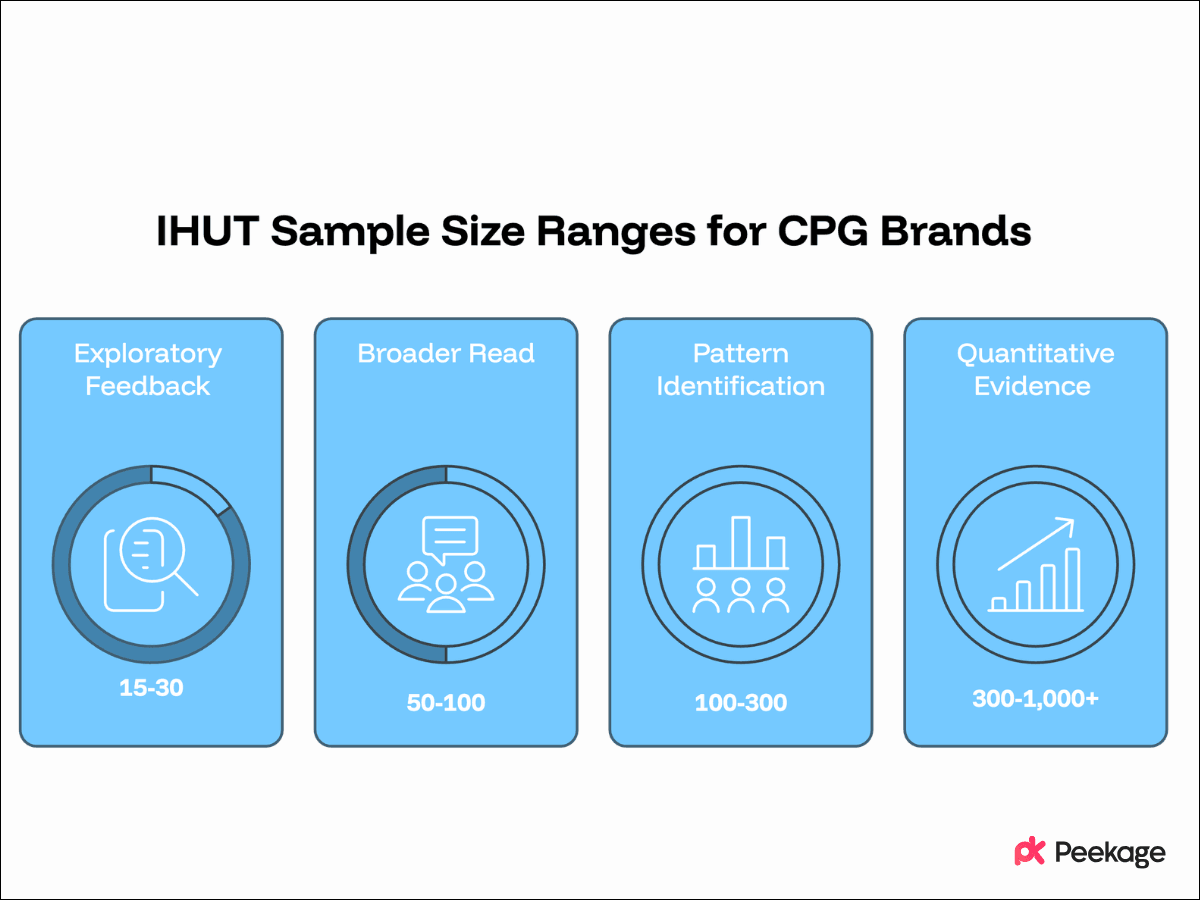
There is no single sample size that works for every study. Understanding how IHUT testing works can help you choose a sample based on your research goal. As a practical guide, CPG studies often fall into three ranges depending on whether the goal is exploratory feedback, segment comparison, or more robust validation.
Small IHUT Studies: 50–100 Participants
Small studies are useful when you need directional feedback rather than statistically precise results. Some IHUT testing services use as few as 15–30 participants to identify obvious issues such as difficult packaging, an unpleasant scent, or confusing instructions.
A sample of 50–100 participants can provide a broader read while keeping product, shipping, and incentive costs manageable. This range can work well for early product, packaging, or first-use testing.
Medium IHUT Studies: 100–300 Participants
A sample of 100–300 participants gives you more responses to identify patterns and compare key consumer groups. This range works well when you want to understand how a product performs across different demographics, usage behaviors, or other target segments.
Large IHUT Studies: 300–1,000+ Participants
Larger studies can make sense when you need stronger quantitative evidence, detailed subgroup comparisons, or head-to-head benchmarking. For these types of studies, brands may choose samples in the 300–500+ range, depending on the number of groups being compared and the level of confidence required.
For reference, a standard sample-size calculation for a large population uses 385 respondents at a 95% confidence level and 5% margin of error when assuming a 50% response distribution.
More participants do not automatically produce better research. Your sample should be large enough to answer the research question and support the decisions you need to make.
What Factors Decide the Right Number of Participants Needed for IHUT?
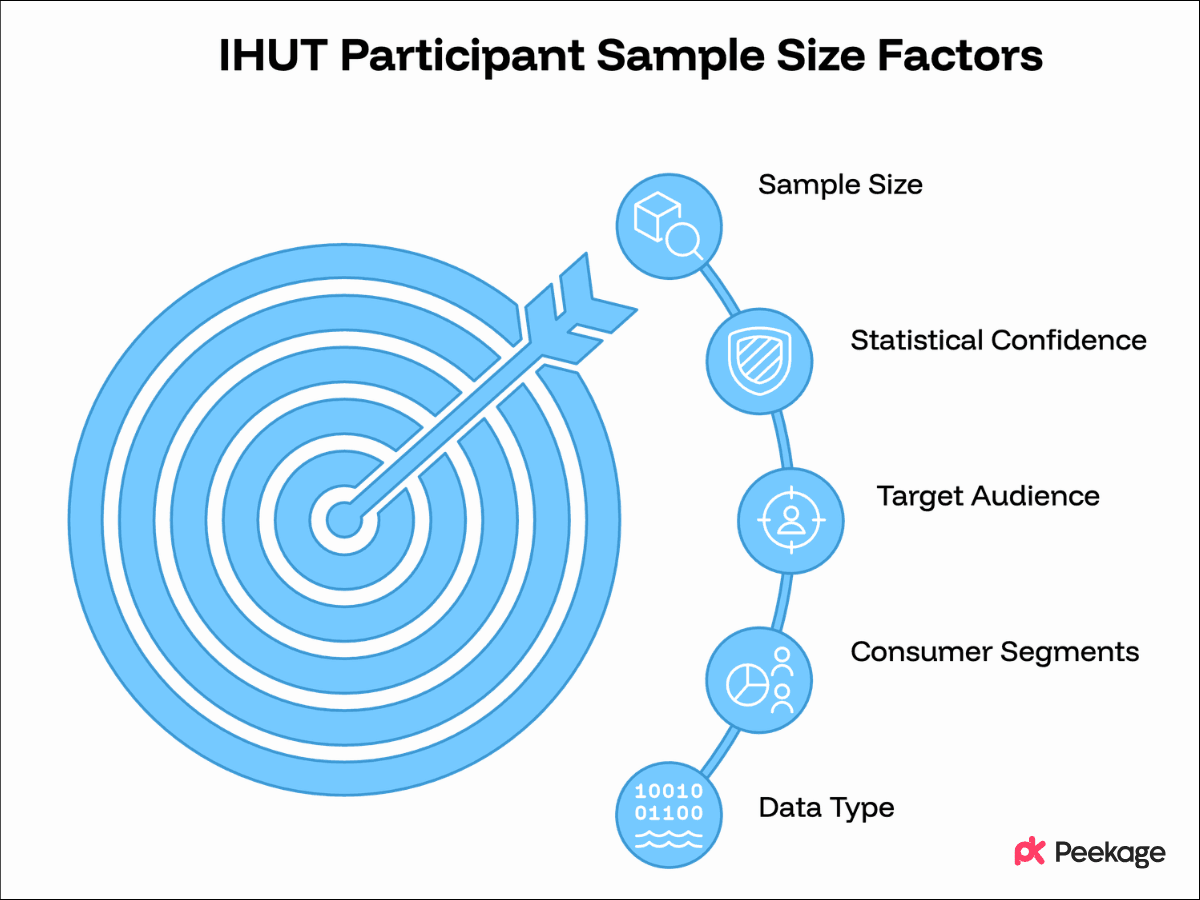
Several factors affect how many participants you need for an IHUT. The most important are your research objective, the type of data you want, the number of segments you need to compare, your target audience, and the required level of statistical confidence.
- Your research objective. Exploratory research can work with a smaller sample, while a launch decision or advertising claim usually requires more participants. The higher the cost of getting the decision wrong, the stronger your evidence should be.
- The type of data you want. Qualitative feedback, such as open-ended responses or video diaries, can provide useful insights from a smaller group. Quantitative measures such as satisfaction and purchase intent generally require a larger sample for reliable analysis.
- The number of consumer segments you compare. Each group you want to analyze separately needs enough participants to produce meaningful results. For example, if you want to compare four segments with 100 participants each, you'll need a 400-person sample.
- The size and diversity of your target audience. A broad audience with different ages, incomes, locations, and household types may require a larger sample to represent those differences. A more narrowly defined audience may need fewer participants.
- Your required level of statistical confidence. If your study needs statistically reliable results, your confidence level and margin of error will affect the required sample size. Higher confidence and a smaller margin of error generally require more participants, which also increases the budget and timeline.
How Many Participants Do You Need for Different IHUT Research Goals?
The right sample size depends on what you need to learn. As a practical starting point, these ranges can help you scope an IHUT before adjusting for your specific research design.
| IHUT research goal | Suggested starting sample |
|---|---|
| Early product and concept feedback | 15–50 participants |
| Product performance and usage testing | 75–150 participants |
| Comparing two product versions | 100+ participants per version |
| Comparing consumer segments | 100+ participants per segment |
| Measuring product preference and purchase intent | 300–500+ participants |
These are starting ranges, not fixed requirements. Your final sample may need to be larger if you are comparing several products or consumer segments, or if you need a higher level of statistical confidence.
Once you know how many participants you need, you also need to know how to recruit participants for an IHUT test. Your recruitment approach should help you reach the required sample while keeping participants aligned with your target audience.
For exploratory research, a smaller sample may be enough to identify product issues, while larger samples are more appropriate for major launch, positioning, or product decisions.
What Are the Common Mistakes Brands Make When Choosing IHUT Sample Size?
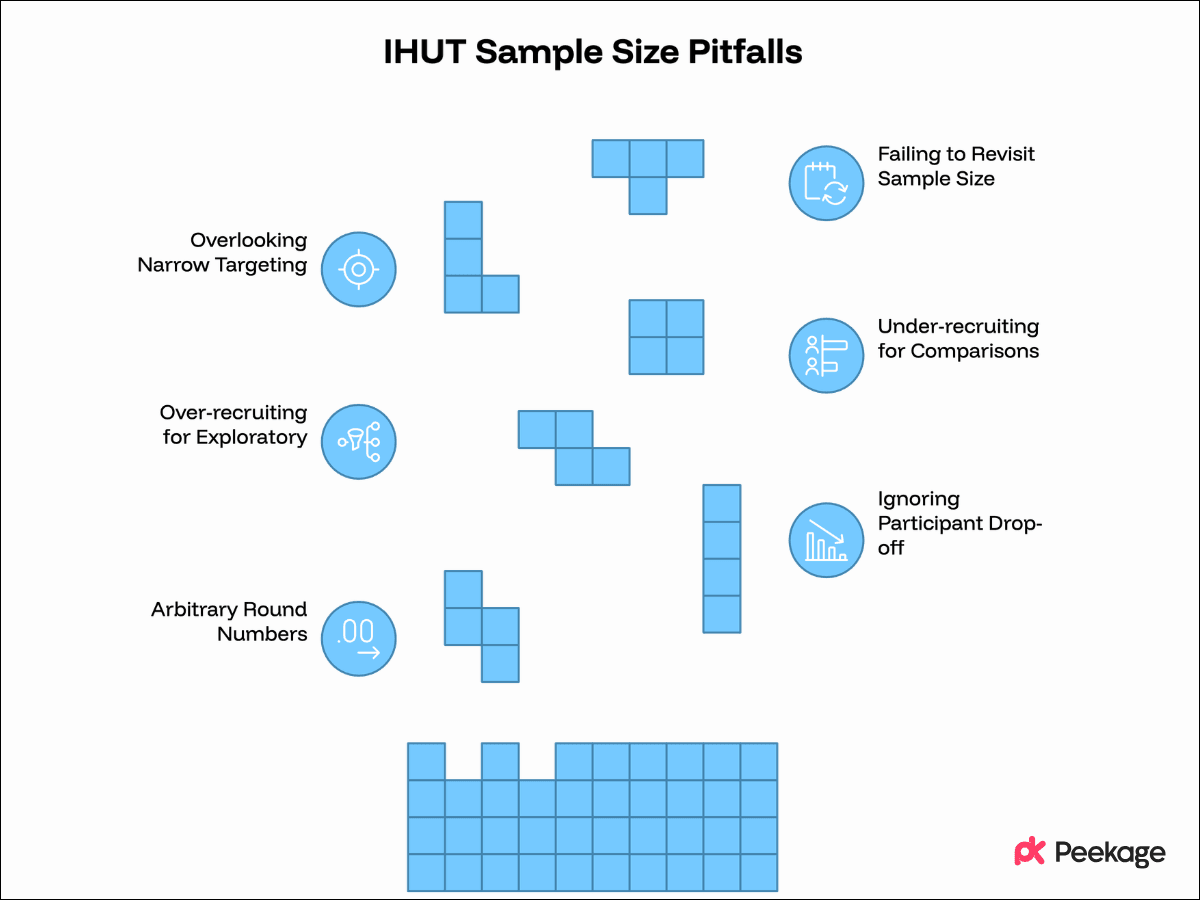
Choosing an IHUT sample based on convenience rather than the research goal can leave you with either too little data or unnecessary costs. These are some of the most common mistakes to avoid:
- Picking a round number. Choosing 100 participants because it feels like a standard sample does not mean it is right for your study. Start with the decision you need the research to support.
- Ignoring participant drop-off. Not everyone who joins an IHUT will complete it. Recruit enough additional participants to account for expected drop-off.
- Over-recruiting for exploratory research. Early-stage testing often needs directional feedback rather than a large quantitative sample. Save larger studies for decisions that require stronger evidence.
- Under-recruiting for segment comparisons. If you need to compare several consumer groups, make sure each group has enough participants to support the comparison.
- Overlooking narrow targeting. Strict demographic or behavioral criteria can reduce your eligible pool, making recruitment slower and more expensive.
- Failing to revisit sample size. Your research objectives can change as the product develops. Review the sample size when the decision or study design changes.
How Participant Numbers Affect IHUT Cost and Study Timeline
Participant count affects both the cost and timeline of an IHUT. Each additional participant usually means another product unit, shipment, incentive, and response set to process.
A larger sample is not always better, either. Once you have enough participants to answer your research question reliably, adding more can increase costs and extend the timeline without adding much useful insight.
How Sample Size Affects IHUT Cost
| Cost factor | What happens as sample size increases |
|---|---|
| Product units | More products need to be prepared |
| Shipping | More packages need to be delivered |
| Incentives | More participants need to be rewarded |
| Data processing | More responses need to be reviewed and analyzed |
Targeting can affect costs too. The more specific your audience criteria, the smaller your eligible pool may be, which can make recruitment slower and more expensive. IHUTs can still be cost-efficient because they do not require a research facility or participant travel.
How Sample Size Affects IHUT Timeline
Larger samples can take longer to recruit and may require more time to manage. Build in a buffer for participant drop-off so you still reach your target number of completed tests.
| IHUT type | Typical usage period |
|---|---|
| Packaging or first-impression testing | A few days |
| Food, beverage, beauty, and household products | 2–4 weeks |
| Longer-term or more complex products | 4+ weeks |
How Peekage Recruits IHUT Participants for Your Campaign
Peekage starts with your target consumer profile and builds the sample around the criteria that matter to your study, including demographics, category usage, household role, and location. With access to 5+ million consumers across 200+ attributes, brands can target specific audiences and set quotas before recruitment begins.
For example, an eco-friendly cleaner study recruited 200 consumers across different ages, genders, and locations, while a competitive benchmarking study recruited 500 U.S. consumers for blind product testing. The sample size in each case reflected the research objective and the comparisons the brands needed to make.
Peekage supports the process from recruitment and quota management through product distribution, feedback collection, and participant follow-up. This helps brands reach their target number of completed tests without managing recruitment and study logistics across multiple tools.
If you're unsure how many participants your IHUT needs, talk to Peekage about your research goal and target audience.