Choosing the right research method starts with knowing what you need to learn. Focus groups help you explore why consumers think or feel a certain way. Surveys show how many people share a view. IHUTs show how consumers actually use a product at home.
That choice matters when launching a new CPG product, with around 85% of new consumer products failing to gain market success, according to Nielsen. Working with a consumer product testing company can help you match the research method to your product, target audience, and launch decision.
In this guide, we'll compare focus groups, surveys, and IHUTs to help you choose the right method for your research objective, budget, and timeline.
What's the Difference Between Focus Groups vs Surveys vs IHUT?
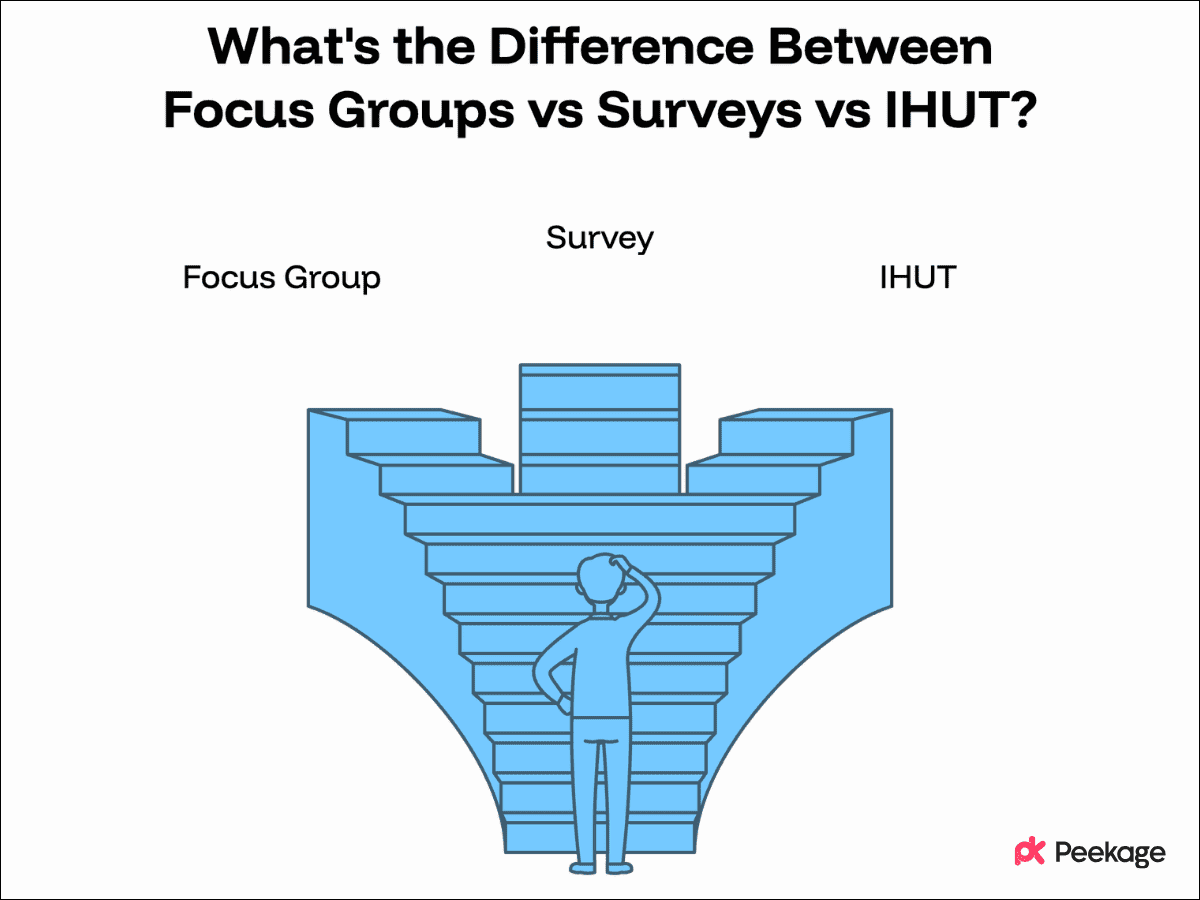
Start with the research objective, not the method. Define the decision you need to make and the information you need to support it. From there, you can choose the research method that best fits the question.
For example, if you need to understand why consumers dislike a product concept, a focus group may be the best fit. If you need to measure how many consumers prefer that concept, a survey can give you the scale you need. If you need to see how consumers actually use the product at home, an IHUT is more appropriate.
| Research Objective | Best Method |
|---|---|
| Explore consumer opinions | Focus groups |
| Test an early product concept | Focus groups |
| Measure preferences at scale | Surveys |
| Quantify purchase intent | Surveys |
| Evaluate real product use | IHUT |
| Test product experience over time | IHUT |
| Understand packaging reactions | Focus groups or surveys |
| Compare consumer segments | Surveys |
| Identify gaps between stated and actual behavior | IHUT |
When Should CPG Brands Use Focus Groups?
A focus group typically brings 6 to 12 consumers together in person or online, with a trained moderator guiding the discussion. It is a qualitative method, so the goal is to understand consumer opinions, motivations, and reactions rather than produce statistically representative results.
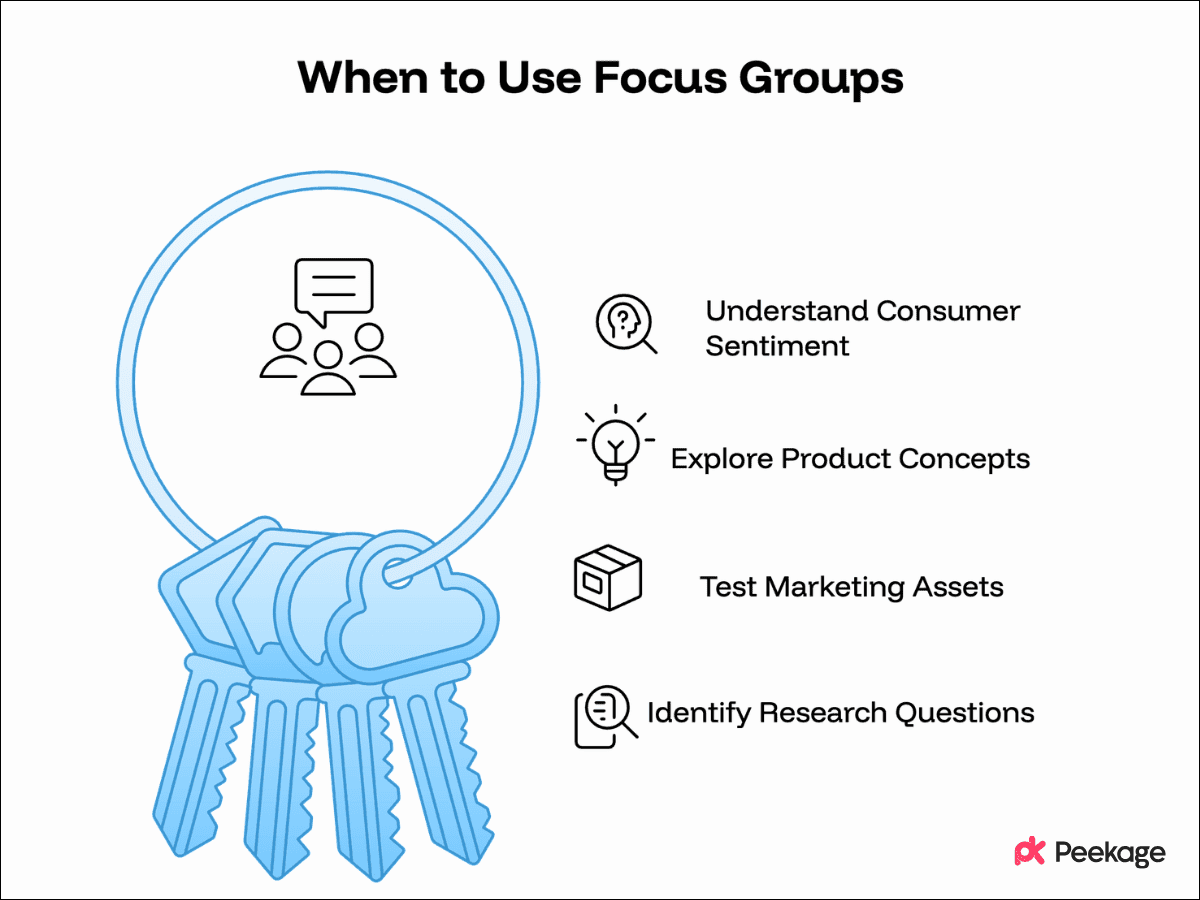
Use focus groups when you need to:
- Understand why consumers think or feel something: A survey might show that 62% of consumers prefer one option. A focus group can help explain why, such as finding the packaging more familiar or easier to understand.
- Explore reactions to new product concepts: Participants can point out confusing names, unclear benefits, or assumptions about what the product does before you invest heavily in development.
- Test packaging, messaging, and positioning: Show consumers different options and listen to their spontaneous reactions to see what feels clear, appealing, confusing, or memorable.
- Identify questions for quantitative research: If several participants mention that a package is difficult to open, you can take that finding into a survey or IHUT and measure how common the problem is.
When Not to Use Focus Groups
Don't use them for statistical claims. Twelve people cannot represent a national population, no matter how careful the screener.
Group settings also carry a built-in distortion. A 2019 Qualitative Health Research study by Bergen and Labonté documented social desirability bias, where participants shape answers to sound acceptable to the room. Add dominant voices and quiet agreement, and positive scores drift upward.
When Should CPG Brands Use Surveys?
Surveys are one of the most common tools for quantitative consumer research. They can collect responses from large samples quickly and make it easy to measure preferences, purchase intent, and differences between consumer groups.
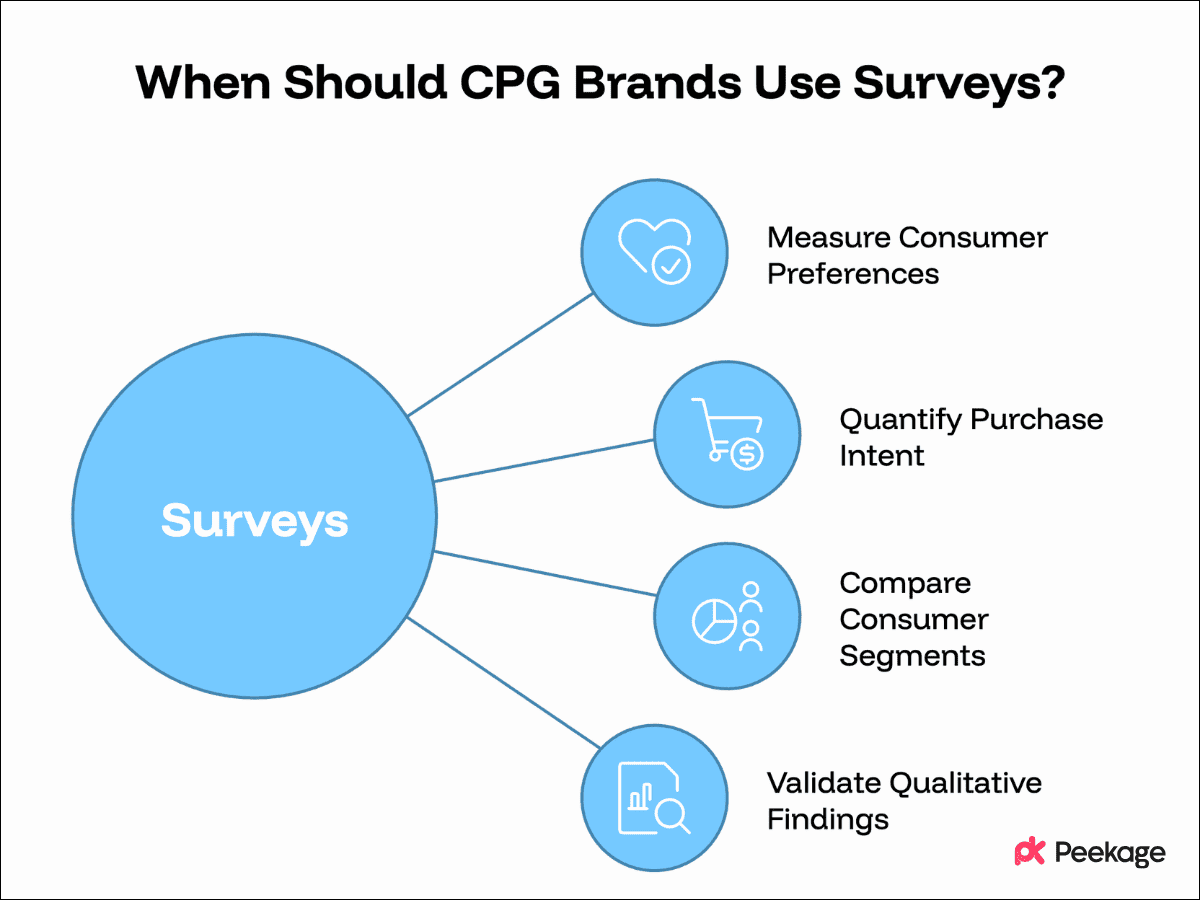
Use surveys when you need to:
- Measure consumer preferences across a larger sample: Surveys let you collect structured feedback from hundreds or thousands of consumers and quantify how opinions vary across your target audience.
- Quantify purchase intent and product preferences: Measure which flavor consumers prefer, how likely they are to buy a product, or how price changes purchase intent.
- Compare consumer segments: Compare responses across groups such as parents and non-parents, frequent and occasional category buyers, or different regions using the same dataset.
- Validate qualitative findings: If a focus group reveals that consumers find a package difficult to open, a survey can help determine how widespread that issue is among your target market.
When Not to Use Surveys
Surveys measure what consumers say, not necessarily what they do. They are less useful when you need to evaluate actual product use, sensory experiences, or how a product fits into someone's daily routine.
If you need consumers to taste, use, store, or interact with a physical product, an IHUT can provide evidence that a survey cannot.
When Should CPG Brands Use IHUT?
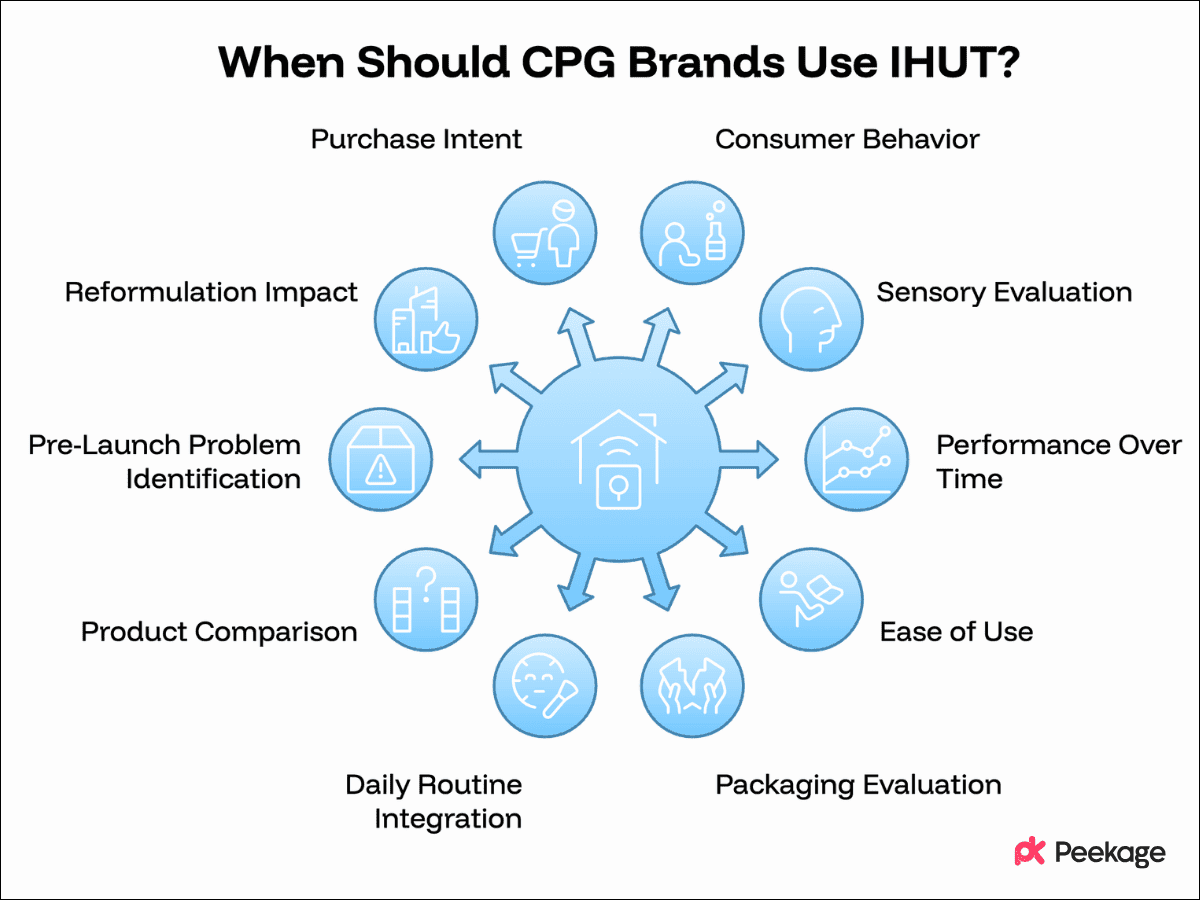
An in-home usage test (IHUT) gives real consumers a physical product to use in their own homes, usually over several days or weeks. Participants provide feedback through surveys, usage diaries, photos, or follow-up interviews.
Knowing how IHUT testing works helps brands understand what goes into recruiting participants, delivering products, collecting feedback, and analyzing results. With an IHUT testing service, brands can manage these steps through one platform, from participant recruitment to final results.
Use an IHUT when you need to:
- See how consumers use a product at home: Consumers may store, prepare, or use a product differently from what you expect. An IHUT captures these real-world behaviors.
- Evaluate taste, texture, smell, or other sensory attributes: Consumers can experience the actual product in realistic conditions rather than reacting to a description, image, or concept.
- Measure performance over repeated use: A product may perform well the first time but reveal issues after several uses. Longer studies can uncover problems such as flavor fatigue, scent buildup, irritation, or packaging wear.
- Test ease of use and convenience: See whether consumers can open, prepare, apply, clean, store, or use the product without difficulty in their normal routines.
- Evaluate packaging in real conditions: Consumers can test whether packaging is easy to open, close, store, pour, dispense, or reseal during everyday use.
- Understand how the product fits into daily routines: An IHUT can show when, where, and how often people use the product and what gets in the way of regular use.
- Compare products or formulations: Blind IHUTs can reduce the influence of brand familiarity when comparing your product with a competitor or testing a reformulation.
- Identify problems before launch: Real-world use can uncover product, packaging, instruction, or usability issues that controlled testing may miss.
- Measure changes after a reformulation: Compare the new version with the current product to see whether consumers notice and prefer the changes.
- Connect product experience with purchase intent: After using the product, participants can report whether they would buy it, recommend it, or replace their current product with it.
When Not to Use IHUT
IHUTs aren't the best choice for early concept testing when there is no physical product to ship. They also take longer and cost more to manage than surveys or focus groups, so they may not be suitable when you only need quick directional feedback.
- If you need to understand why consumers react to an idea, start with a focus group.
- If you need to measure how many consumers share an opinion, use a survey.
- If you need to know how consumers actually experience and use the product, an IHUT is usually the better fit.
How Do Focus Groups, Surveys, and IHUTs Compare on Cost and Timeline?
Cost and timing vary by sample size, audience, product, and research design. As a general guide:
- Focus groups: Usually take 1 to 3 weeks to recruit, schedule, run, and analyze. Costs are driven by the moderator, facility or virtual setup, participant incentives, and analysis. Because each session includes a small group, the cost per participant can be relatively high.
- Surveys: Can often be fielded within a few days, especially when using a pre-profiled panel. Costs usually depend on sample size, audience targeting, survey length, and incentive requirements. There are no product shipping or testing logistics.
- IHUTs: Usually take 1 to 4 weeks or longer, depending on how long consumers need to use the product. Costs include participant recruitment, product units, packaging, shipping, incentives, survey or diary collection, and analysis.
For IHUTs, the field period is the biggest factor in the timeline. If you need consumers to use a product repeatedly over two weeks, the study cannot produce reliable repeat-use results in two days.
| Dimension | Survey | Focus Group | IHUT |
|---|---|---|---|
| Sample size | 200–15,000+ | 6–12 per session | 50–300+ |
| Duration | 24–72 hrs | 1–3 weeks | 1–4 weeks |
| Physical product required | No | Sometimes | Yes |
| Per-unit cost | $5–$30/complete | $4,000–$12,000/session | Scales per participant |
| Moderator required | No | Yes | No (platform-managed) |
What Consumer Data Does Each Method Give You?
Each method produces a different type of consumer data:
- Focus groups give you qualitative insights: You learn the language consumers use, the reasons behind their opinions, emotional reactions, and ideas for improving positioning or messaging.
- Surveys give you quantitative data: You get percentages, preference scores, purchase intent, and comparisons between consumer segments that you can measure across a larger sample.
- IHUTs give you real-world usage data: You see how consumers actually use the product, how often they use it, what problems they encounter, and how their experience changes over repeated use.
In simple terms, focus groups explain why, surveys measure how many, and IHUTs show what happens when consumers actually use the product.
Can CPG Brands Combine Focus Groups, Surveys, and IHUTs?
Yes. Combining methods can give you a more complete view of the consumer, especially when you're making a high-stakes product decision.
A common research sequence is:
- Focus groups: Explore consumer reactions and identify the questions or problems worth investigating.
- Surveys: Test those findings with a larger sample and measure how widespread they are.
- IHUT: Give consumers the actual product to use at home and see whether their real experience matches what they said in earlier research.
You don't always need all three. Choose the methods that match your research objective, timeline, and budget. Combining them makes the most sense when you need both consumer opinions and real-world product experience.
How to Choose the Right CPG Research Method
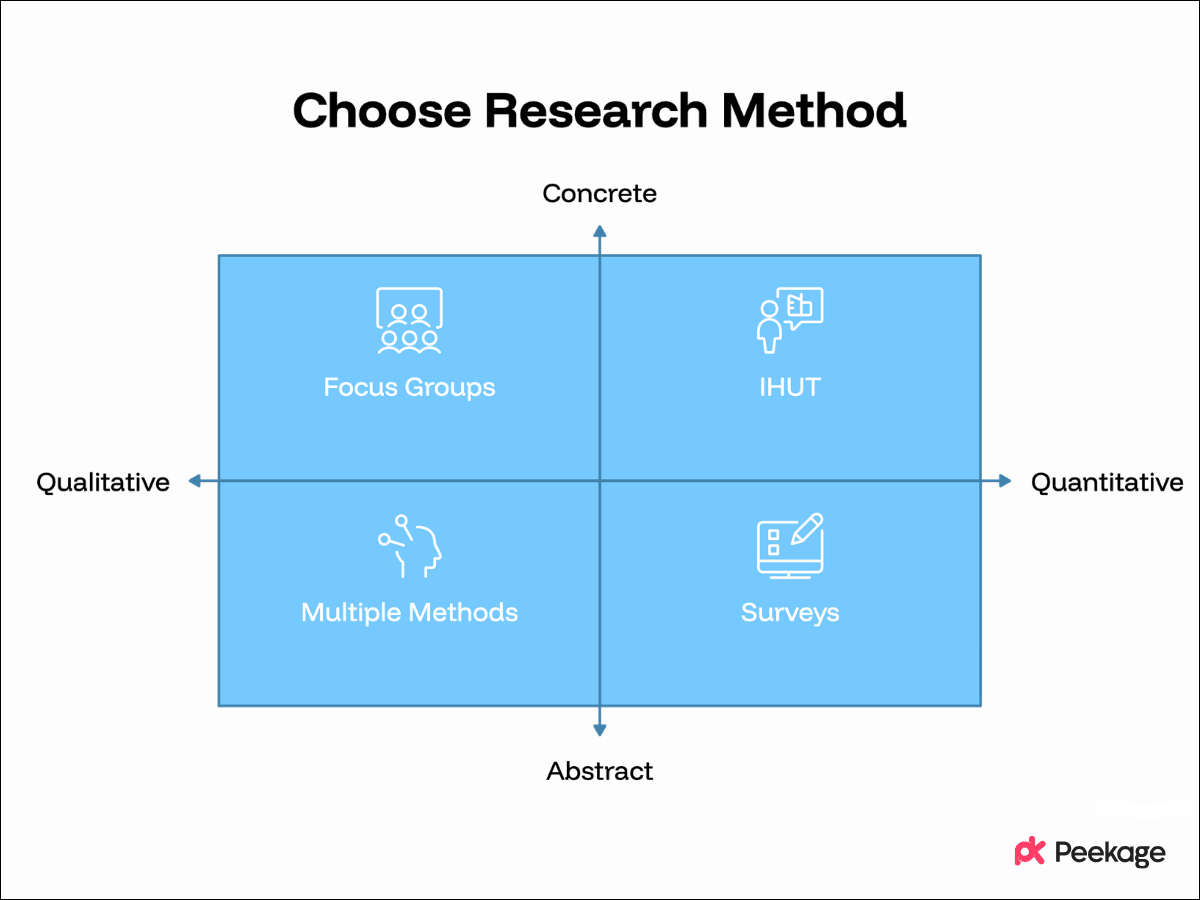
Choose your research method based on the decision you need to make:
- Choose focus groups when you need to understand "why": Use them to explore consumer reactions, motivations, confusion, and reasons behind a preference or rejection.
- Choose surveys when you need to measure "how many": Use them to quantify preferences, purchase intent, satisfaction, or differences between consumer segments.
- Choose IHUT when you need to see what happens with the product: Use it when the physical product exists, and you need to evaluate real-world use, performance, sensory experience, or repeated use.
- Choose multiple methods when one study can't answer the full question: Combine methods when you need both qualitative and quantitative insights or want to validate what consumers say against their actual product experience.
The best method is the one that matches your research objective, decision, timeline, and budget.
How Peekage Helps CPG Brands Run Consumer Research and IHUTs
Finding the right consumers is one of the most important parts of an IHUT. Peekage gives CPG brands access to:
- 5M+ consumers: A large consumer pool that makes it easier to recruit participants across different categories, demographics, and markets.
- 200+ targeting attributes: Filter consumers by factors such as age, location, income, household characteristics, shopping behavior, dietary preferences, and lifestyle.
- Custom screening questions: Add your own questions when the existing 200+ attributes don't cover a requirement specific to your study.
For example, if you're testing a new protein snack, you can target consumers based on their age, location, dietary preferences, and category purchase behavior. You can then add a custom question such as, "Which protein snacks have you purchased in the past 30 days?" to identify the specific consumers you need.
Once you've built your target audience, Peekage can support the rest of the IHUT workflow, including participant recruitment, study setup, product distribution, surveys, feedback collection, and results analysis.
This lets you move from finding the right consumers to collecting real product feedback within one research workflow.
Want to find the right consumers for your next IHUT? Contact our team to discuss your target audience and see how you can build your study.