Around 30,000 new CPG products hit U.S. shelves every year, but only about 15% remain commercially viable after 24 months, according to Nielsen Breakthrough data. With so many products failing after launch, testing the right product with the right consumers before going to market matters.
That makes choosing the right testing method important. A Central Location Test (CLT) lets you evaluate a product in a controlled setting, while an In-Home Usage Test (IHUT) shows how consumers experience and use it in their normal environment. A product testing platform can help brands manage recruitment, screening, product testing, and feedback collection across both approaches.
In this guide, we'll compare CLT and IHUT across what they measure, recruitment, cost, timeline, and the types of CPG products and research questions each method suits best.
What Is the Difference Between a CLT and an IHUT?
A Central Location Test (CLT) brings consumers to a controlled location, such as a test kitchen, research facility, or mall-based testing space. Participants evaluate the product in one session under standardized conditions.
In-Home Usage Test (IHUT) services send the product to consumers so they can use it in their own homes over several days or weeks. This gives you a better view of how the product performs in everyday conditions.
The simplest distinction is: CLT gives you control, while IHUT gives you real-world context.
| Dimension | Central Location Test (CLT) | In-Home Usage Test (IHUT) |
|---|---|---|
| Testing location | Test kitchen, research facility, lab, or mall suite. | Participant's home. |
| Testing period | One session. | Several days to weeks. |
| Environmental control | High and standardized. | Lower, with natural household conditions. |
| Moderator | Live moderator can guide and probe. | Participants complete surveys, diaries, or prompts remotely. |
| Best for | Taste, sensory testing, packaging, and first impressions. | Product use, performance, convenience, and repeated use. |
| Geographic reach | Usually limited to the testing location. | Can reach consumers across multiple locations. |
| Speed to data | Often days to around two weeks. | Usually several weeks, depending on the usage period. |
| Observation | Direct observation during the session. | Self-reported feedback and usage data. |
| Common limitations | Artificial setting and group or moderator influence. | Dropouts, recall issues, and less control over usage conditions. |
When Should CPG Brands Choose a Central Location Test?
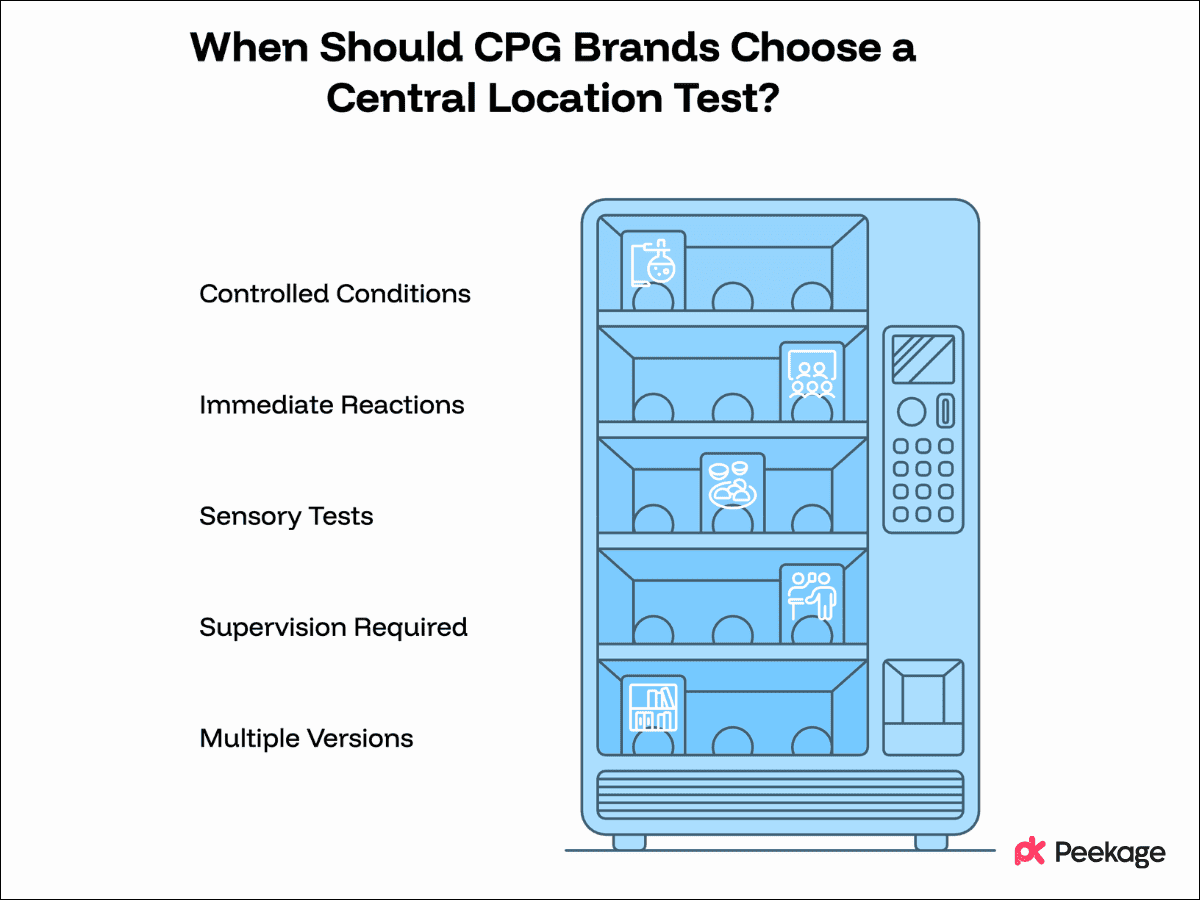
Choose a Central Location Test (CLT) when you need controlled conditions, immediate reactions, or direct observation of how consumers respond to a product.
A CLT is especially useful when you need to:
- Compare products under the same conditions: Keep factors such as serving temperature, portion size, lighting, and presentation consistent so you can make a cleaner comparison between products or formulations.
- Run controlled sensory and taste tests: Participants can sample products under standardized conditions, making CLTs useful for comparing flavor, aroma, texture, appearance, and other sensory attributes.
- Get immediate consumer reactions: A moderator can ask follow-up questions and observe reactions during the session, helping you understand why participants respond positively or negatively.
- Test products that require supervision: Products that need specific preparation, controlled serving conditions, or researcher guidance are often better suited to a supervised testing environment.
- Compare multiple product versions in one session: You can present several formulations, flavors, or packaging options under the same conditions and collect direct feedback on each.
When Is a CLT the Wrong Choice?
A CLT may not be the best option when your research depends on how consumers use a product in their normal environment. The controlled setting can influence behavior and may not reflect how the product performs at home.
If you need to understand repeated use, daily routines, storage, convenience, or long-term product experience, an IHUT can provide more relevant real-world feedback.
When Should CPG Brands Choose an IHUT?
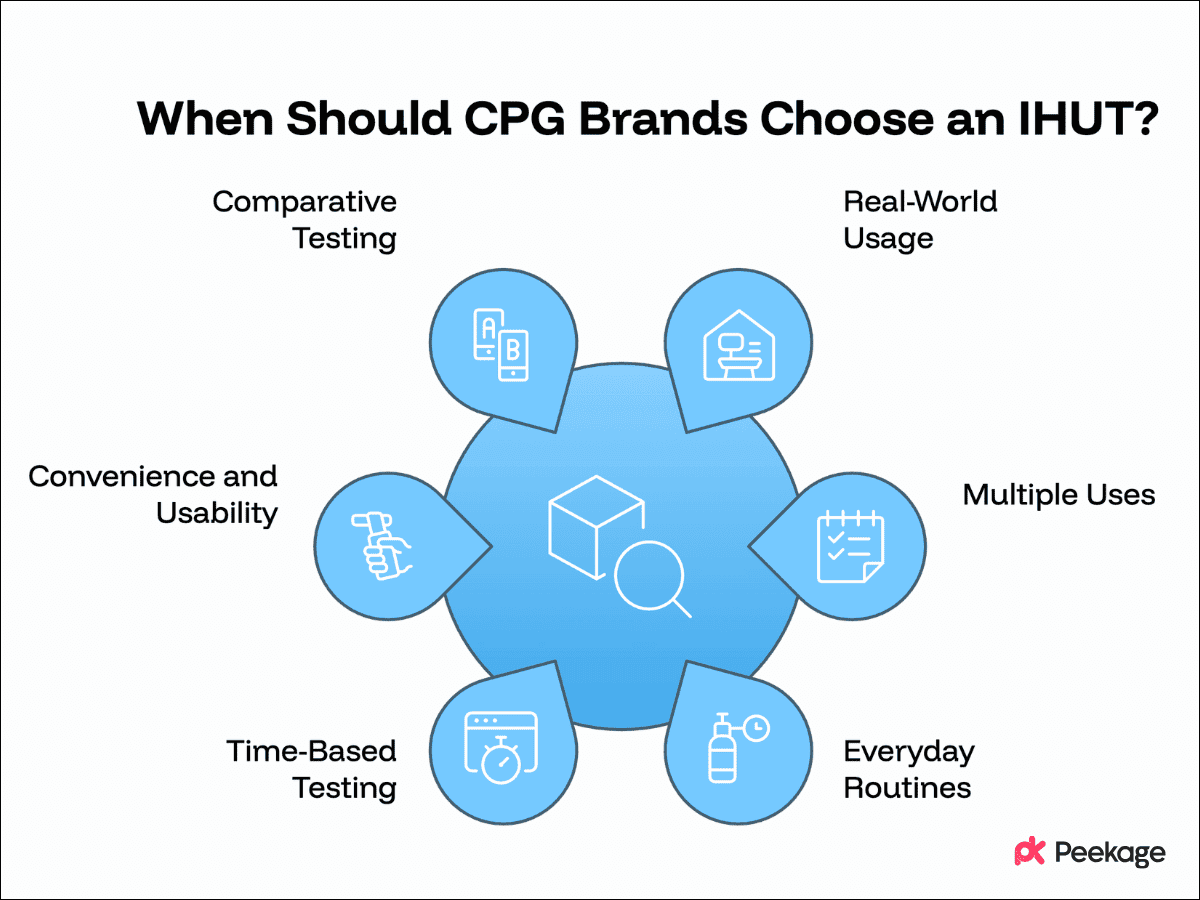
Choose an In-Home Usage Test (IHUT) when you need to understand how consumers experience and use a product in their normal environment, especially over multiple uses.
An IHUT is especially useful when you need to:
- See how consumers use the product at home: A real home can reveal practical issues that a controlled setting may miss, such as whether a bottle drips, a cap is difficult to open, or packaging is easy to store.
- Understand product experience over multiple uses: Repeated use can reveal changes in taste, scent, performance, or satisfaction that don't appear during a single session.
- Capture feedback in everyday routines: See when, where, and how consumers use the product and whether it fits naturally into their existing habits.
- Test products that need time to experience properly: Skincare, household products, and other products may require several days or weeks of use before consumers can give meaningful feedback on performance.
- Evaluate convenience and usability: Consumers can report on preparation, application, storage, cleaning, or other practical aspects of using the product in their normal environment.
- Compare real-world product experiences: A blind IHUT can help compare your product with a competitor or reformulation while reducing the influence of brand familiarity.
When Is IHUT Not the Best Choice?
An IHUT may not be suitable when you need immediate results or when the product requires strict testing conditions. It also relies more heavily on participant reporting, although surveys, usage diaries, photos, and timed check-ins can help capture feedback throughout the study.
If you need controlled sensory comparisons or immediate reactions from consumers, a CLT may be the better choice.
CLT vs IHUT: How Different Testing Environments Affect Your Results
The testing environment can change what consumers notice and how they evaluate a product.
| Testing factor | CLT | IHUT |
|---|---|---|
| Environment | Controlled testing location. | Consumer's own home. |
| Level of control | High. Temperature, serving size, lighting, and presentation can be standardized. | Lower. Consumers use the product under their normal conditions. |
| Consumer behavior | Researchers can guide and observe the session. | Consumers use the product independently. |
| Product use | Usually one session. | Multiple uses over days or weeks. |
| Sensory comparison | Strong fit for side-by-side product comparisons. | Better for sensory experience over repeated use. |
| Real-world conditions | Limited | High |
| Researcher observation | Direct, with immediate follow-up questions. | Indirect, through surveys, diaries, photos, or check-ins. |
| Best suited to | Controlled taste tests, product comparisons, and first impressions. | Product performance, usability, routines, and repeated use. |
CLT Gives Researchers More Control
Because testing takes place in one location, researchers can keep important conditions consistent. This makes CLTs useful when you need to compare several products or formulations under the same conditions. Designs such as sequential or paired comparisons are also easier to manage in a single session.
IHUT Captures the Conditions Consumers Actually Experience
An IHUT allows consumers to use the product in their own environment. Differences in water, storage, household routines, preparation, and frequency of use may affect the experience. In an IHUT, those differences become part of the research rather than variables you remove.
Which Testing Environment Is Better?
Neither method is automatically more accurate. Research has found that results can differ between central-location and home testing, but the effect varies by product and study design.
The answer depends on whether you need to control the testing environment or understand the product in the environment where consumers will actually use it.
The main practical differences between CLT and IHUT come down to where you can recruit, how many consumers you can reach, what drives the cost, and how long the study takes. Knowing how to recruit consumers for IHUT is especially important when you need participants who match specific target criteria and can complete the test at home over the required period.
| Factor | Central Location Test (CLT) | In-Home Usage Test (IHUT) |
|---|---|---|
| Recruitment | Usually recruits consumers near the testing location | Can recruit consumers across wider geographic areas |
| Reach | Best for audiences concentrated near the test facility | Better for national or geographically distributed audiences |
| Sample size | Limited by local audience availability and venue capacity | Can scale based on panel availability and screening criteria |
| Niche audiences | Can be harder to reach in one location | Easier to reach specific audiences when the panel has the right targeting attributes |
| Main cost drivers | Venue, moderator, recruitment, equipment, and incentives | Product units, packaging, shipping, recruitment, and incentives |
| Testing period | Usually one session | Usually several days to four weeks |
| Overall timeline | Often around 1 to 2 weeks | Often around 3 to 7 weeks, including recruitment and shipping |
In short: Choose a CLT when you need fast, controlled testing with consumers in one location. Choose an IHUT when you need broader recruitment and want to understand how the product performs in consumers' real homes.
What Kind of Consumer Feedback Does CLT vs IHUT Produce?
CLT and IHUT don't produce better or worse data. They answer different questions about the consumer experience.
| Feedback type | CLT | IHUT |
|---|---|---|
| First impressions | Strong | Less focused on immediate reactions |
| Sensory feedback | Strong, under controlled conditions | Captures sensory experience in normal use |
| Product comparison | Strong for comparing multiple products or formulations | Useful for comparing products after repeated use |
| Repeated use | Limited to a single session | Strong, with feedback collected over days or weeks |
| Daily routines | Not captured | Shows how the product fits into everyday life |
| Usability issues | Can identify immediate problems | Can uncover problems that appear after repeated use |
| Long-term satisfaction | Limited | Stronger |
| Typical data | Liking scores, sensory ratings, immediate reactions, observations | Usage feedback, satisfaction over time, diaries, repeat surveys, and purchase intent |
In short: A CLT shows what consumers notice and think in the moment, while an IHUT shows how their experience develops as they actually use the product over time.
CLT vs IHUT: Which Method Is Right for Your CPG Research?
The right method depends on what you need to learn, how the product is used, and how quickly you need results.
| If you need to... | Choose | Why? |
|---|---|---|
| Compare formulations under identical conditions. | CLT | Keeps serving conditions, presentation, and environment consistent. |
| Get fast sensory feedback. | CLT | Consumers can evaluate the product in a single session. |
| Compare taste, aroma, texture, or appearance. | CLT | Works well for controlled sensory testing. |
| See how consumers use the product at home. | IHUT | Captures real household conditions and routines. |
| Evaluate repeated use over days or weeks. | IHUT | Shows how experience changes over time. |
| Test handling, storage, or convenience. | IHUT | Reveals practical issues that may not appear in a testing facility. |
| Validate a product before launch. | IHUT | Shows how the product performs in real-world use. |
| Need both controlled and real-world feedback. | CLT + IHUT | CLT can narrow down the strongest options before an IHUT tests them at home. |
Choose CLT for control and speed, IHUT for real-world use and repeated experience, or combine both when the decision requires both types of evidence.
How Peekage Supports CPG Brands With IHUT Research
Peekage helps CPG brands recruit consumers and manage IHUT research through one platform. Peekage provides you:
- 5M+ consumers: Access a large participant pool so you can recruit across different categories, demographics, locations, and consumer profiles.
- 200+ targeting attributes: Filter participants based on factors such as age, income, location, household composition, dietary preferences, shopping behavior, and product usage.
- Custom screening questions: Add your own questions when the available targeting attributes don't cover a specific requirement. For example, you can ask whether someone purchased a competitor in the past 30 days or currently uses a particular type of product.
- Product distribution: Manage product packaging and shipping so participants receive the products they need for the study.
- Centralized study management: Collect participant feedback through surveys and other study activities in one workflow.
- Live results and AI-assisted analysis: Monitor responses as they come in and identify patterns without waiting until the end of the study for a static report.
This makes Peekage useful when your research depends on finding a specific consumer audience and seeing how that audience experiences your product at home.
Ready to run your next IHUT? Contact the Peekage team to discuss your target audience and research goals.