An in-home usage test (IHUT) works by letting brands see how consumers use a product in their own homes and collect feedback during real use. But you can structure the IHUT study in different ways, depending on what you want to learn.
Some studies test one product at a time, while others compare multiple products or test different versions with different consumer groups. The right method depends on your research goal, product, and the type of feedback you need.
In this guide, we cover the main IHUT methods, how they work, and when to use each one.
What Are the Main Methods of IHUT?
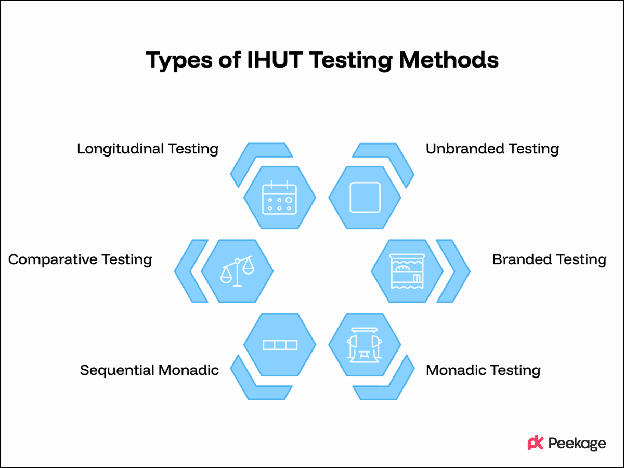
When learning how to test CPG products with real consumers, the right IHUT method depends on what you want to learn. Some methods are better for measuring a product without brand influence, while others are useful for competitive comparisons, branded experiences, or changes in behavior over time.
| Method | Products tested | Brand visible? | Main use | Study length | Best for |
|---|---|---|---|---|---|
| Blind IHUT Test | 1 or more | No | Product evaluation | Short or repeated | Product performance and reformulation |
| Branded IHUT Test | 1 or more | Yes | Full product experience | Short or repeated | Launch, packaging, and positioning |
| Monadic IHUT Test | 1 per participant | Depends | Independent evaluation | Short or repeated | Standalone product scores |
| Sequential monadic IHUT Test | 2+ per participant | Depends | Separate evaluation of multiple products | Short or repeated | Comparing several products without direct comparison |
| Comparative IHUT Test | 2+ per participant | Depends | Direct comparison | Usually short | Preference and competitive benchmarking |
| Longitudinal IHUT Test | 1 or more | Depends | Repeated use | Days to weeks or longer | Effectiveness, habit, and change over time |
1. Unbranded or Blind Product Testing
Brands can run IHUT tests for CPG products without revealing the brand identity to participants. During a blind IHUT study, the brand name, logo, packaging, and other cues that could influence how participants evaluate the product are removed.
Participants receive the product without knowing which brand made it. They use it at home and rate the attributes that matter for the study.
- What it can test: Taste, texture, scent, performance, effectiveness, usability, and overall liking. It can also measure purchase intent and other outcome metrics.
- Best for: Product development, reformulation, prototype testing, and comparing product versions without brand influence.
- What you learn: Whether the product performs well on its own and which attributes are driving positive or negative responses.
- Key consideration: Because participants don't know the brand, the results don't show how branding, packaging, or existing brand perceptions affect the product experience.
2. Branded Product Testing
In a branded IHUT study, you can test the product with its normal branding and packaging.
Participants know which brand they are using and experience the product as they would after buying it. They can provide feedback throughout the testing period.
- What it can test: Product experience, packaging, brand expectations, ease of use, perceived quality, value, purchase intent, and whether the product delivers on its brand promise.
- Best for: Pre-launch research, packaging testing, positioning, claims testing, and understanding the complete branded experience.
- What you learn: Whether consumers respond positively to the product in the context in which they will actually encounter it.
- Key consideration: Brand familiarity and expectations can influence responses, so branded results may differ from those of a blind test.
3. Monadic IHUT Testing
In monadic IHUT testing, you give each participant one product to evaluate.
Participants use one product and answer questions about it without evaluating another product during the same study. Different participant groups can test different products or variants.
- What it can test: Product performance, sensory attributes, satisfaction, purchase intent, perceived value, packaging, and other product measures.
- Best for: Getting an independent read on a product or comparing several products without asking the same participant to evaluate them.
- What you learn: How consumers respond to each product on its own, without a second product affecting their ratings.
- Key consideration: Each product generally needs its own participant group, so comparing several products can require a larger total sample.
4. Sequential Monadic IHUT Testing
During a sequential monadic IHUT study, participants test two or more products one after another.
A participant completes the full evaluation for the first product before moving on to the next. The order can be randomized across participants to reduce order effects.
- What it can test: Satisfaction, sensory attributes, performance, purchase intent, and other measures for multiple products within the same study.
- Best for: Comparing several products or variants when you want each product to receive a full evaluation rather than asking participants to compare them directly.
- What you learn: How each product performs when evaluated separately, while using the same overall participant pool.
- Key consideration: The experience of the first product can influence how participants respond to later products. Order effects should be considered when designing the study.
5. Comparative IHUT Testing
When you use the comparative IHUT testing method, you ask participants to evaluate two or more products in relation to each other. A consumer product testing platform can present the products and collect feedback on specific attributes.
Participants may rate each product, choose a preferred option, or identify which performs better on particular measures.
- What it can test: Relative performance, preference, sensory differences, purchase intent, value, and competitive strengths and weaknesses.
- Best for: Competitive benchmarking, reformulation comparisons, and deciding which of several product versions performs better.
- What you learn: Where your product wins or loses against another product and which differences matter most to consumers.
- Key consideration: Seeing or using another product can influence how participants evaluate the products, so comparative results should not be treated as identical to standalone monadic results.
6. Longitudinal In-Home Testing
A longitudinal IHUT follows the same participants over multiple days or weeks instead of collecting all feedback after one use.
Participants use the product repeatedly and provide feedback at set points during the study. This can include recurring surveys, usage diaries, photos, or videos.
- What it can test: Product effectiveness over time, repeat usage, changes in satisfaction, habit formation, ease of use, and whether the product continues to meet expectations after the first use.
- Best for: Skincare, supplements, household products, appliances, and other products where repeated use affects the experience or results.
- What you learn: Whether consumer perceptions and behavior stay consistent, improve, or decline over the testing period.
- Key consideration: Longer studies require more participant engagement and careful follow-up, but they can reveal changes that a single-use test would miss.
How Do Different IHUT Methods Compare?
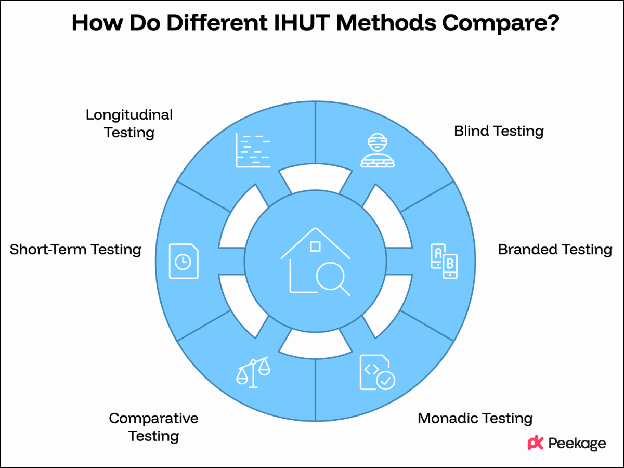
Each IHUT method answers a slightly different research question. The best choice depends on whether you want to remove brand influence, compare products directly, or understand how the experience changes with repeated use.
Blind vs. Branded IHUT Study
When deciding how to test a CPG product, brands can use focus groups, surveys, or IHUTs depending on what they want to learn. If the research involves an IHUT, the next question is whether consumers should know which brand they are testing.
Blind testing shows how consumers respond to the product without knowing the brand. Branded testing shows how they respond when they see the brand and packaging.
- Choose blind IHUT testing when you want to focus on product performance, sensory attributes, or differences between formulas.
- Choose branded IHUT testing when you want to understand the full consumer experience, including packaging, brand expectations, and product positioning.
You can also use both approaches in the same research program. Comparing blind and branded results can show whether brand perceptions change how consumers evaluate the product.
Monadic vs. Comparative IHUT Study
Monadic testing evaluates each product separately, while comparative testing asks consumers to evaluate two or more products in relation to each other.
- Choose monadic IHUT testing when you need an independent read on each product and want to avoid one product influencing the evaluation of another.
- Choose comparative IHUT testing when the main question is which product consumers prefer or where one product performs better than another.
Monadic studies may require separate participant groups for different products, while comparative designs can evaluate multiple products within the same participant group. The right choice depends on the research goal, sample requirements, and study design.
Short-Term vs. Longitudinal IHUT Study
Short-term IHUTs collect feedback after one or a small number of uses. They work well when the product experience can be evaluated quickly, such as taste, scent, packaging, or ease of use.
Longitudinal IHUTs follow participants over a longer period and collect feedback at multiple points. They are more useful when results depend on repeated use, such as skincare effectiveness, supplement routines, product durability, or habit formation.
- Choose a short-term IHUT when you need a quick read on the product experience or want to evaluate a specific usage occasion.
- Choose a longitudinal IHUT when you need to measure changes over time, repeated use, or results that cannot be seen after one use.
Which IHUT Method Should You Choose?
The best IHUT method depends on what you need to learn. Our IHUT testing services can help you choose the right setup based on your research question, product, and testing goals. Use the guide below to compare the main options.
| Your research question | Recommended method | Why |
|---|---|---|
| Does the formula perform well without brand influence? | Blind IHUT study + monadic IHUT test | Removes brand cues and gives each product an independent evaluation. |
| How does the product perform in its normal branded context? | Branded IHUT test | Captures the effect of packaging, brand expectations, and the full product experience. |
| Which product or version performs better? | Comparative IHUT study | Lets consumers evaluate products directly against each other. |
| How does each product perform on its own? | Monadic IHUT or sequential monadic IHUT tests | Provides separate evaluations without requiring a direct comparison. |
| How does the product perform after repeated use? | Longitudinal IHUT test | Tracks consumer experience and results across multiple time points. |
| Do we want both independent scores and a direct preference result? | Protomonadic IHUT test | Combines individual product evaluations with a comparison stage. |
Other Factors to Consider
- Product type: Products with strong flavors, fragrances, or other sensory characteristics may need careful study design to reduce carryover between products.
- Sample size: Monadic studies may require separate participant groups for each product, while some comparative designs allow the same participants to evaluate multiple products.
- Testing period: Products that deliver an immediate experience can often be tested over a shorter period. Products that require repeated use or take time to show results may need a longitudinal design.
If you are unsure which method fits your research question, talk to the Peekage team about in-home product testing.
Which IHUT Methods Work Best for Different CPG Products?
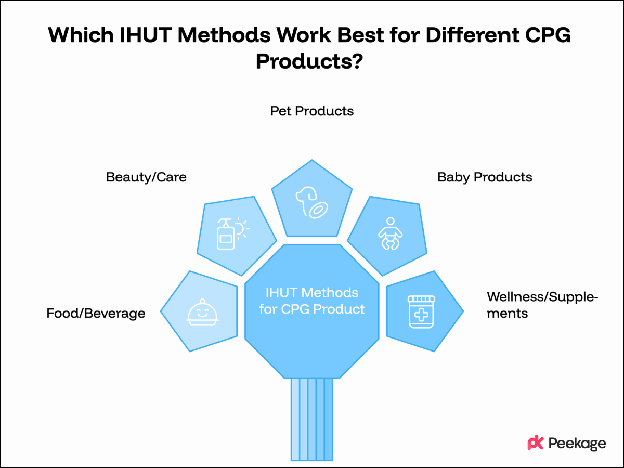
The right IHUT method depends on how consumers experience the product, how quickly they can evaluate it, and whether its benefits appear after one use or over time.
Food and Beverage Products
- What matters: Taste, flavor, texture, aroma, freshness, aftertaste, overall liking, and purchase intent.
- Recommended methods: Blind, monadic, sequential monadic, or comparative testing can all work well. Blind testing is particularly useful when you want to evaluate the product without brand influence.
- Why: Food and beverage products can often be evaluated after one or a few uses, making shorter IHUTs suitable for many studies. JAR scales can also help measure attributes such as sweetness, saltiness, or flavor intensity.
Beauty and Personal Care Products
- What matters: Scent, texture, absorption, ease of use, visible results, satisfaction, and purchase intent.
- Recommended methods: Use a short-term IHUT for first impressions and sensory experience. Choose a longitudinal design when the product's effectiveness takes time to assess.
- Why: A shampoo, moisturizer, or cleanser can be evaluated during normal use, while products that claim visible changes may need repeated use over several weeks. Blind testing can help evaluate the formula, while branded testing can assess the complete product experience.
Pet Products
- What matters: Pet acceptance, consumption, refusal, usage behavior, owner satisfaction, ease of use, and perceived quality.
- Recommended methods: Longitudinal testing works well for pet food, treats, and products where acceptance can change with repeated use. Diaries or recurring surveys can capture changes throughout the study.
- Why: The owner provides the feedback, but the pet's behavior is an important part of the product experience. Repeated observation can provide more useful information than a single evaluation.
Baby Products
- What matters: Comfort, fit, ease of use, materials, performance, safety perceptions, and caregiver satisfaction.
- Recommended methods: Branded testing can capture the full caregiver experience, while longitudinal testing is useful for products that are used repeatedly.
- Why: Parents and caregivers can evaluate how easily a product fits into their routines and whether problems appear after repeated use. The appropriate testing period depends on the product and research goal.
Wellness and Supplements
- What matters: Ease of use, taste and format, routine fit, perceived results, satisfaction, and purchase intent.
- Recommended methods: Longitudinal testing is useful when the product is intended for regular use or when consumers need time to assess the experience.
- Why: Repeated feedback can show whether consumers continue using the product, how it fits into their routines, and whether their perception changes during the testing period. Comparative testing can also be useful when the goal is to evaluate a product against another option.
Common Mistakes When Choosing an IHUT Method
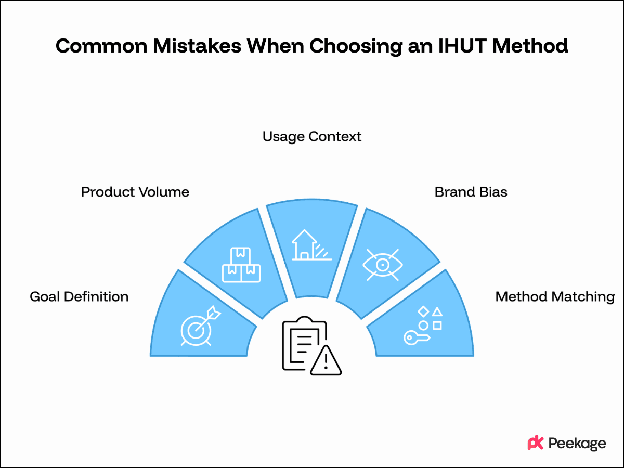
Avoid these common mistakes when planning an IHUT:
- Choosing the method before defining the research goal: Start with what you need to learn, then consider CLT vs IHUT testing. A CLT can be useful when you need controlled testing conditions, while an IHUT is better suited to understanding how consumers respond to a product in their normal home environment.
- Testing too many products at once: Multiple products can increase fatigue and order effects, especially in sequential testing.
- Ignoring the normal usage context: Give participants instructions that reflect when, where, and how the product is normally used.
- Failing to account for brand bias: Use blind testing when you need to isolate product performance from brand expectations. Branded testing can then show the response to the full product experience.
- Using the same method for every product: Match the design to the product, usage cycle, and research goal. A snack may need a short test, while skincare may require repeated use over several weeks.
How Peekage Helps Brands Run Different IHUT Methods
Peekage supports different IHUT methods from participant recruitment to reporting. Brands can recruit specific consumer groups from our 5M+ panel using 200+ targeting attributes and custom screening questions based on demographics, location, lifestyle, shopping habits, and product usage.
From there, Peekage supports blind, branded, monadic, sequential monadic, comparative, and longitudinal testing. We can manage product packaging, shipping, and delivery tracking, including frozen, refrigerated, and blind label products. Surveys can collect ratings, open-ended feedback, photos, and other responses throughout the test.
Once the data is collected, brands can monitor results, explore the findings, and use AI analytics to identify patterns and areas for improvement. This brings recruitment, testing, feedback collection, and analysis into one workflow.
Talk to the Peekage team to plan your next IHUT.