
Many product teams assume that showing people multiple concepts at once leads to better insights. In practice, it often does the opposite. When respondents compare several options side by side, they’re forced to choose between them in a situation that doesn’t reflect how people usually discover or evaluate products.
During monadic concept testing, each person sees only one product concept. There’s nothing to compare it to, so feedback is based on how useful and appealing that single idea feels.
In this guide, we’ll explain how monadic testing works, when it makes sense to use it, and how to create a study that leads to clear decisions.
What is Monadic Testing?
Monadic testing is a research method where each person evaluates a single product concept on its own. There are no comparisons, which leads to more natural and honest feedback.
For example, if you’re testing three snack flavors, you split your audience into three groups. Each group sees only one flavor and answers the same questions. Then you compare results across groups to see which concept performs best.
This concept testing method removes comparison bias and lets people focus on the concept itself rather than how it compares to alternatives.
To run this type of test properly, you need to make sure each respondent sees only one concept, that groups are evenly split, and that everyone answers the same questions. This is where concept testing services and concept testing tools become very helpful.
As one of the best concept testing tools, Peekage supports monadic testing by handling audience splits, assigning respondents to the right group, and keeping the test organized from start to finish. That way, your team spends less time managing the setup and more time reviewing what people actually said.
When to Use Monadic Testing to Identify Winning Product Concepts
Monadic testing works best when you need clear and unbiased feedback on a single concept. The method you choose depends on what you want to learn and how you will use the results.
It is ideal for early-stage product development. When your idea is new, there is nothing to compare it to. You need to know if it has real appeal on its own before worrying about how it measures up to other options.
Monadic testing is especially useful in these situations:
- Complex concepts: Products or services with multiple features are easier to evaluate when respondents focus on one thing at a time. Testing several complex ideas at once can cause fatigue and shallow feedback.
- High-stakes decisions: Big launches, brand repositioning, or major research and development investments need reliable insights. Monadic testing highlights weak concepts before you invest heavily.
- Packaging and design: Visual elements need to stand on their own. You want to know if a design communicates clearly, not just if it looks better than alternatives.
- Pricing research: Testing prices individually avoids comparison bias. Showing multiple price points together can make the middle option seem reasonable, while monadic testing reveals what people actually perceive as fair.
What are the Benefits of Monadic Testing for Verifying Product Concepts?
Faster Decision-Making
Monadic testing provides clear and actionable feedback from each respondent, which helps teams make decisions quickly without the need to analyze complicated comparison data.
Cost-Effective for Iterations
Testing one concept at a time allows you to refine ideas in stages. You can focus resources on improving a single concept before testing the next, this reduces wasted effort on weak ideas.
Better Targeted Insights
Because each concept can be tested with specific audience segments, you learn how different groups react. This helps customize products, messaging, or features to the right market.
Supports Benchmarking Over Time
Monadic testing makes it easier to track a concept’s performance across different rounds or updates. You can measure progress and improvements objectively without interference from other concepts.
Ideal for Complex Concepts
For products with multiple features, services with detailed offerings, or layered messaging, monadic testing lets respondents focus deeply and give richer and more thoughtful feedback.
Monadic Testing vs Sequential Monadic Testing: What’s the Difference between the Two Methods?
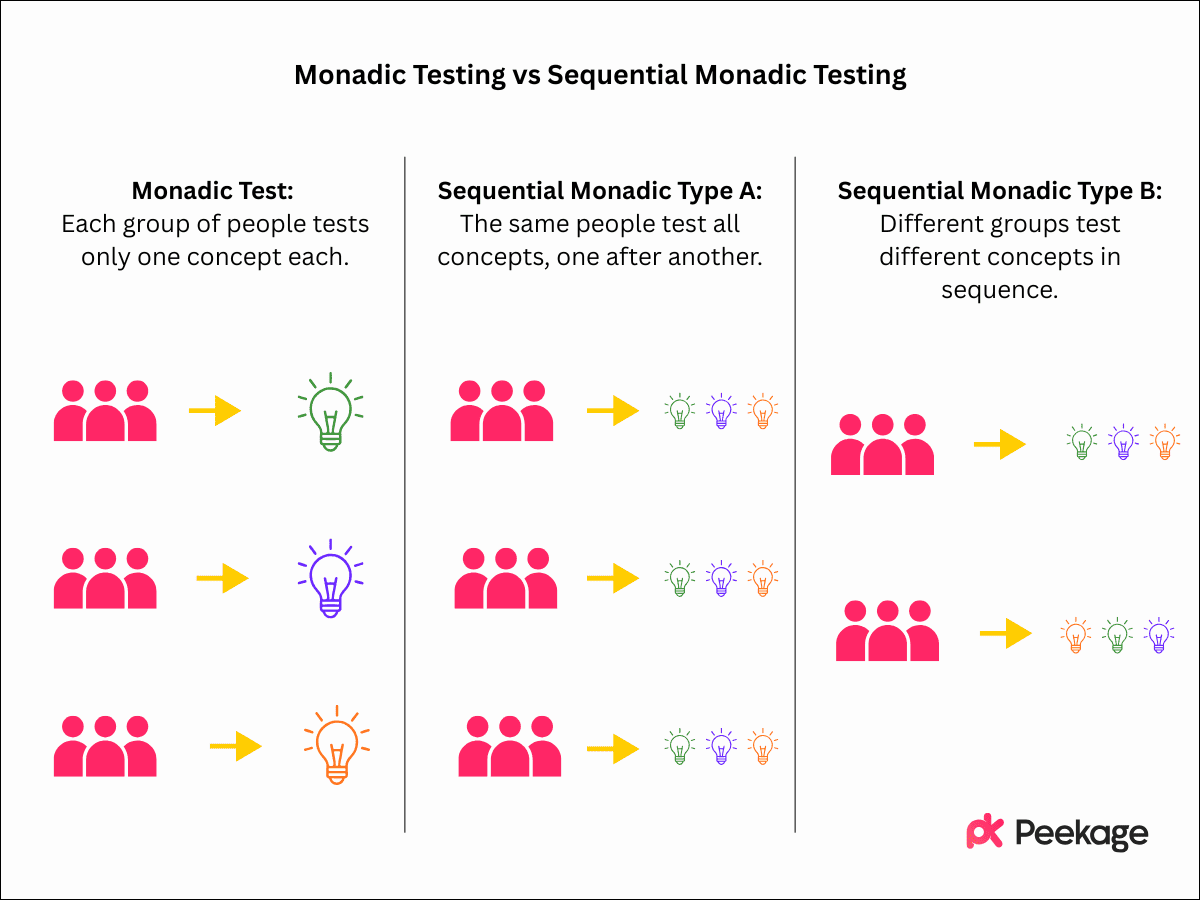
This is the decision most product teams face. Both approaches are valid, but each suits different situations.
| Factor | Pure Monadic | Sequential Monadic |
|---|---|---|
| Concepts per Person | 1 | 2-4 |
| Total Sample Size | Large (50-150 per product and 240-450 for 3 products) | Small (50-150 for any number of products) |
| Cost | Higher | Lower |
| Survey Length | Short (5-8 min) | Long (12-20 min) |
| Bias Level | Minimal | Moderate |
| Data Predictiveness | High | Moderate |
Choose pure monadic when:
- Budget allows for larger samples
- You're testing radically different concepts
- The decision carries significant business risk
- Concepts require extensive evaluation
- Your target audience is broadly available
Choose sequential monadic when:
- Budget is constrained
- You're testing similar variations
- Your audience is niche or hard to recruit
- You need faster turnaround
- Direct comparison adds analytical value
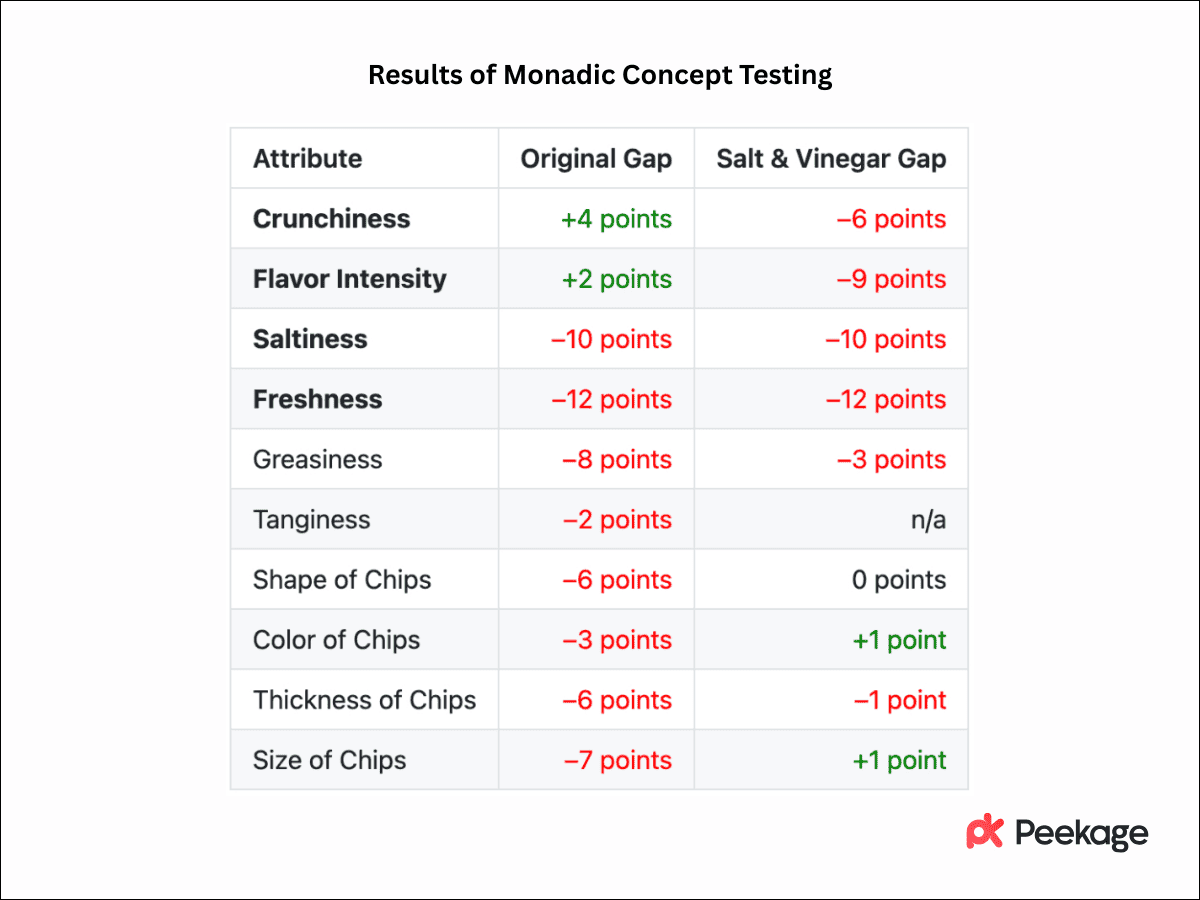
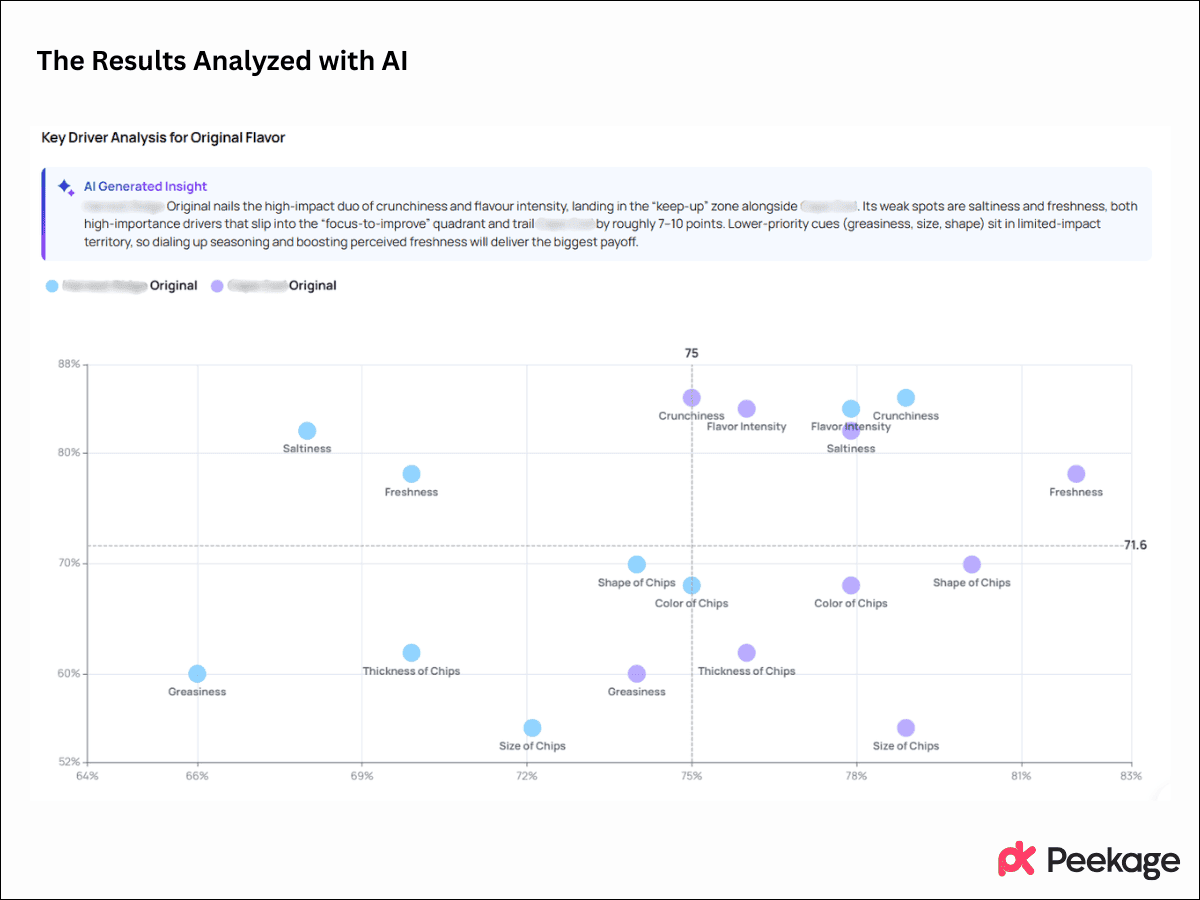
Here's a practical example: For our client, we tested two flavors, Original and Salt & Vinegar, by giving each person just one to try so they could test and rate each one without comparing them side by side.
We measured taste, texture, freshness, overall satisfaction, purchase intent, price expectations, and emotions. Original taste was liked for crunch and flavor intensity but scored lower on freshness and saltiness. Whereas the Salt & Vinegar underperformed on nearly all key taste factors, and only matched competitors on lower-priority attributes like shape and color.
By testing each flavor separately, we clearly saw strengths, weaknesses, and which customer groups and occasions were most promising. Peekage took care of everything from finding the right people to analyzing the results with AI, and delivered recommendations the client could easily act on.
How to Create a Monadic Test: From Defining Objectives to Survey Setup and Launch with Peekage
Setting up a monadic test follows a clear sequence. Here's the process from start to finish.
Step 1: Define Your Research Objectives
Get specific about what you're testing and what decisions the data will inform. Are you validating a concept before development? Choosing between packaging options? Testing messaging for a launch campaign? The objective shapes everything else.
Step 2: Create Your Concepts
Develop concept boards that communicate clearly. The level of polish depends on the stage: rough sketches work for early ideation, while later-stage testing benefits from more finished designs. Include enough context for respondents to understand what they're evaluating.
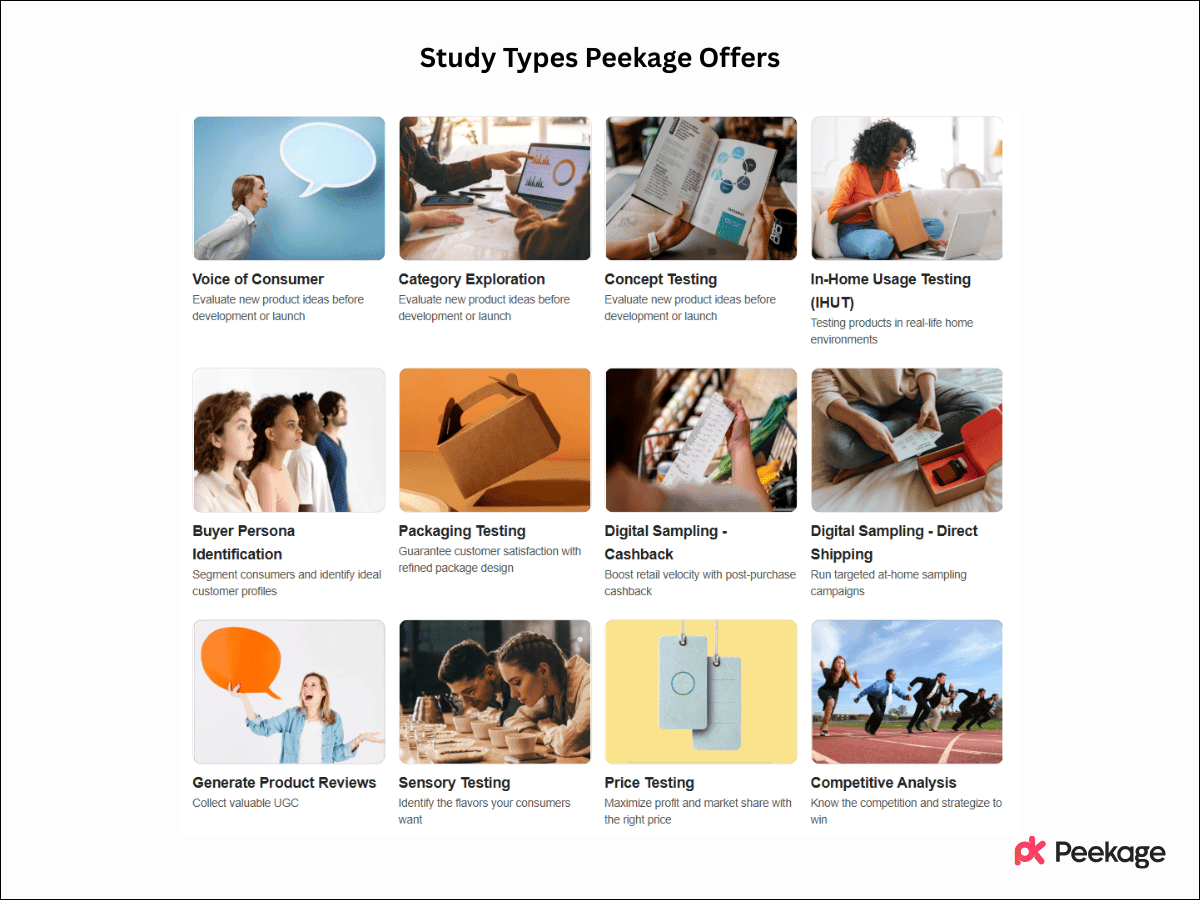
Step 3: Pick Your Study Type in Peekage
The first step in setting up your survey on Peekage is choosing your study type. Do you want to run a Concept Test, Packaging Test, or a Price Test? Each study type serves a different research goal, so selecting the right one is key to gathering meaningful insights.
Step 3: Build Your Panel Using 200 Attributes
Peekage allows you to define precise demographic criteria, behavioral targeting, and geographic parameters to ensure your study reaches the right audience. Determine your sample size, typically 100-250 respondents per concept for statistical reliability. Sample size determination depends on how precise you need your estimates to be.
Peekage's panel includes over 200 targeting attributes, from shopping habits to dietary preferences. Geo-targeting enables regional testing before national rollout. Aside from the available attributes, you can use the pre-screening feature to further narrow down your panel and build a highly targeted panel.
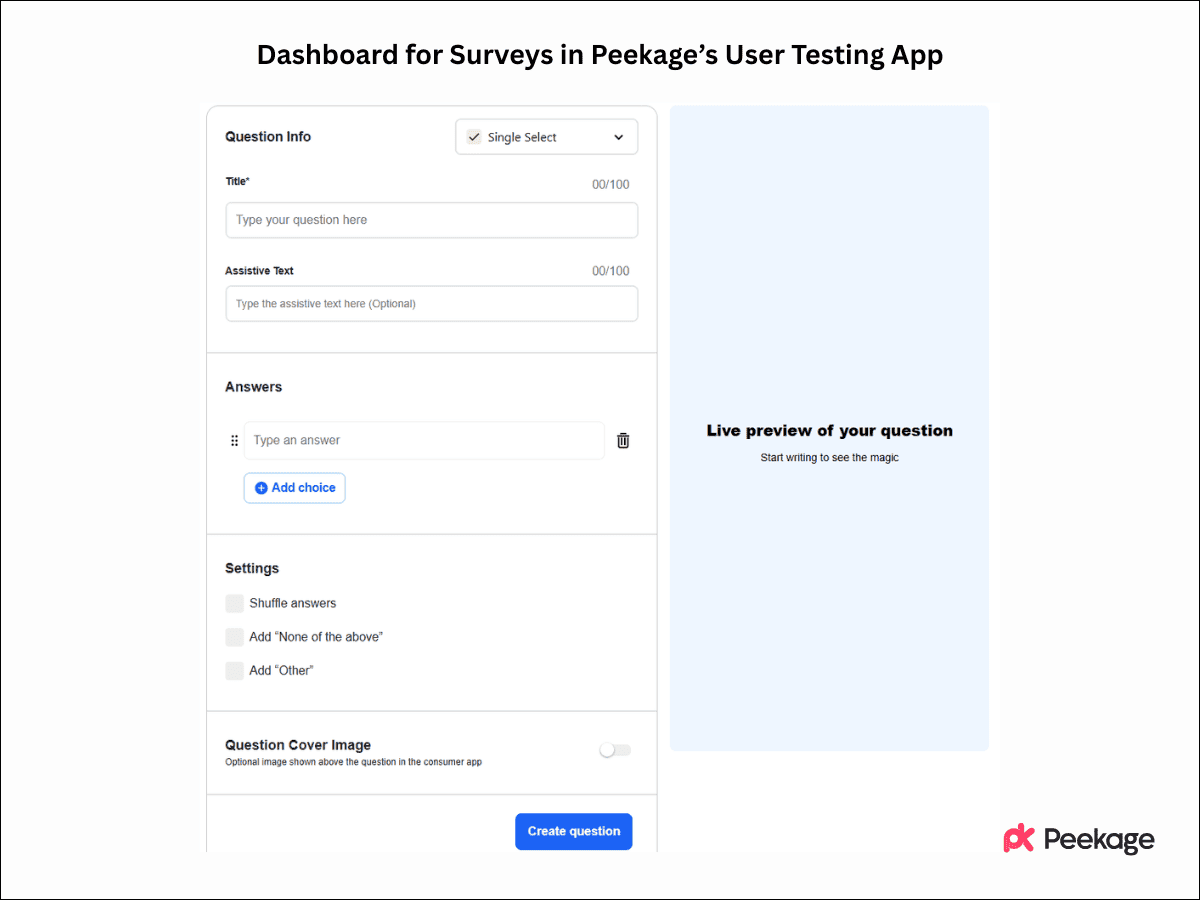
Step 4: Design Your Survey or Review the One Built by AI
Standard monadic metrics include overall appeal (typically a 1-10 scale), purchase intent (5-point scale), uniqueness, brand fit, and value perception. Add open-ended questions for qualitative depth. Keep the survey concise, around 8-12 questions maximum.
Instead of creating your survey from scratch, you can use Peekage’s pre-built templates, designed for different testing needs, to save time and maintain consistency. If you choose to use Peekage’s AI to design your survey, make sure to review the results before launching to ensure the survey meets your goals and objectives.
Step 5: Send for Peekage Review and Launch Your Campaign
After you submit your survey, Peekage AI will review it for potential issues and verify that it’s set up correctly to collect accurate data based on your study objectives. If flagged for additional review, a human research expert will also review the study. Upon final review and approval, your study will be launched.
When you launch your study, the Peekage execution AI agent starts the recruitment and data collection process. The quality agent works in tandem with the execution agent to flag any issues and ensure high-quality responses.
The data explorer on the live dashboard shows responses instantly as they are coming in.
The typical turnaround time to run a study is 2-5 days.
Step 6: Analyze Results
Compare performance across concepts using statistical significance testing. Identify winners and opportunities for refinement. Extract themes from open-ended responses. Peekage provides AI automated analysis, side-by-side comparison views, and exportable reports for stakeholders.
Step 7: Take Action Based on Data
Move forward with winning concepts. Re-test refined versions. Combine with in-home product testing for next-phase validation. Connect to product sampling campaigns for launch support.
Traditional agencies typically quote 4-8 weeks and $30,000+ for this type of research. Peekage compresses the timeline to days while maintaining research quality.
Ready to validate your product concepts? Schedule a demo to see how Peekage's monadic testing platform works.
Best Practices for Monadic Testing for Finding Winning Product Concepts
Plan Your Survey Carefully
Every question should give useful insight about your concept, like how appealing it is, how it solves a problem, or whether people would buy it. Avoid adding extra questions that don’t help your decisions.
If you want to learn more about creating the right questions, check out the guide on the concept testing questions.
Use a Mix of Question Types
Use both rating scales and open-ended questions. Scales give you measurable patterns, like which concept people like most. Open-ended questions explain why they feel that way, giving details you can act on. Together, they show both the numbers and the story behind them.
Keep Concepts Consistent
Present all concepts in the same way. If one concept uses an image or description, make sure the others match in format and detail. This prevents bias from differences in presentation and makes the results fair and comparable.
Focus on Meaningful Metrics
Don’t just look at averages. Top-box (most positive responses) and bottom-box (most negative responses) reveal strong opinions that averages can hide. Always combine metrics with qualitative feedback to get a full understanding of how people feel.
Keep Surveys Short and Simple
Short surveys get better responses. Long or complicated surveys tire participants, which can make their answers unreliable. Aim for under 10 minutes and write questions in plain and easy-to-understand language.
Look for Patterns in the Data
Break results down by groups, occasions, or demographics. Some concepts may appeal strongly to certain segments even if the overall average seems low. These patterns reveal hidden opportunities.
Use Insights to Improve Your Concept
Take the feedback and refine your idea before launch. Monadic testing helps you see what works, what doesn’t, and what changes could make your product stronger. Use this knowledge to reduce risk and improve your concept’s chances of success.