A baby bottle may pass every lab test but still frustrate a parent trying to open it with one hand at 2 a.m. An in-home usage test (IHUT) helps uncover these real-world issues by letting caregivers use a product at home and share their feedback.
Baby product testing comes with specific challenges. Caregivers have limited time, babies' needs change as they grow, and several family members may use the same product.
In this article, we'll cover which baby products to test, how to plan an IHUT from recruitment to feedback, which metrics and questions to use, and how Peekage can help manage the process.
Why Is Testing Baby Products in Real Homes Before Launch Important?
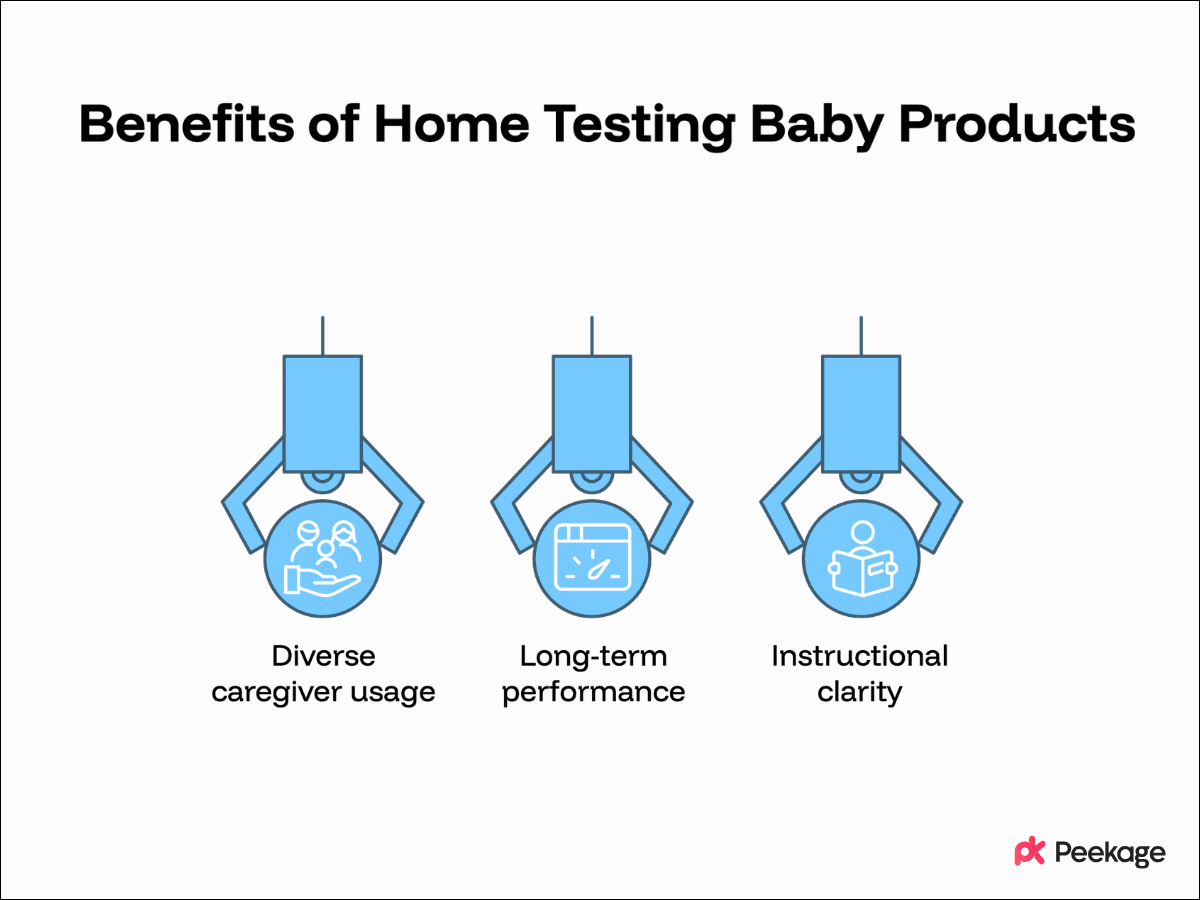
Real homes reveal how a baby product performs during everyday routines. A lab can check whether a bottle seals, but home testing shows whether it still seals after repeated washing or is easy to open while holding a baby.
Home testing can uncover issues that controlled settings often miss:
- Different caregivers use products differently. Parents, grandparents, and nannies may all use the same stroller, bottle, or sippy cup, each with their own habits.
- Problems emerge over time. A product may impress on the first day but become frustrating after a week of regular use. Testing it over several days gives parents time to identify issues that a single use might miss.
- Instructions and packaging cause confusion. An IHUT can reveal whether instructions are easy to follow, the product works as expected, and the packaging affects the user experience.
These findings matter in a competitive market. Ken Research valued the global baby products market at about USD 288 billion in 2025 and projected it to reach around USD 426 billion by 2032. With so many products competing for parents' attention, usability problems or unclear sizing information can hurt a launch.
One important distinction: an IHUT measures how caregivers experience a product in everyday use. It does not certify product safety or replace required safety testing.
What Types of Baby Products Can You Test With an IHUT?
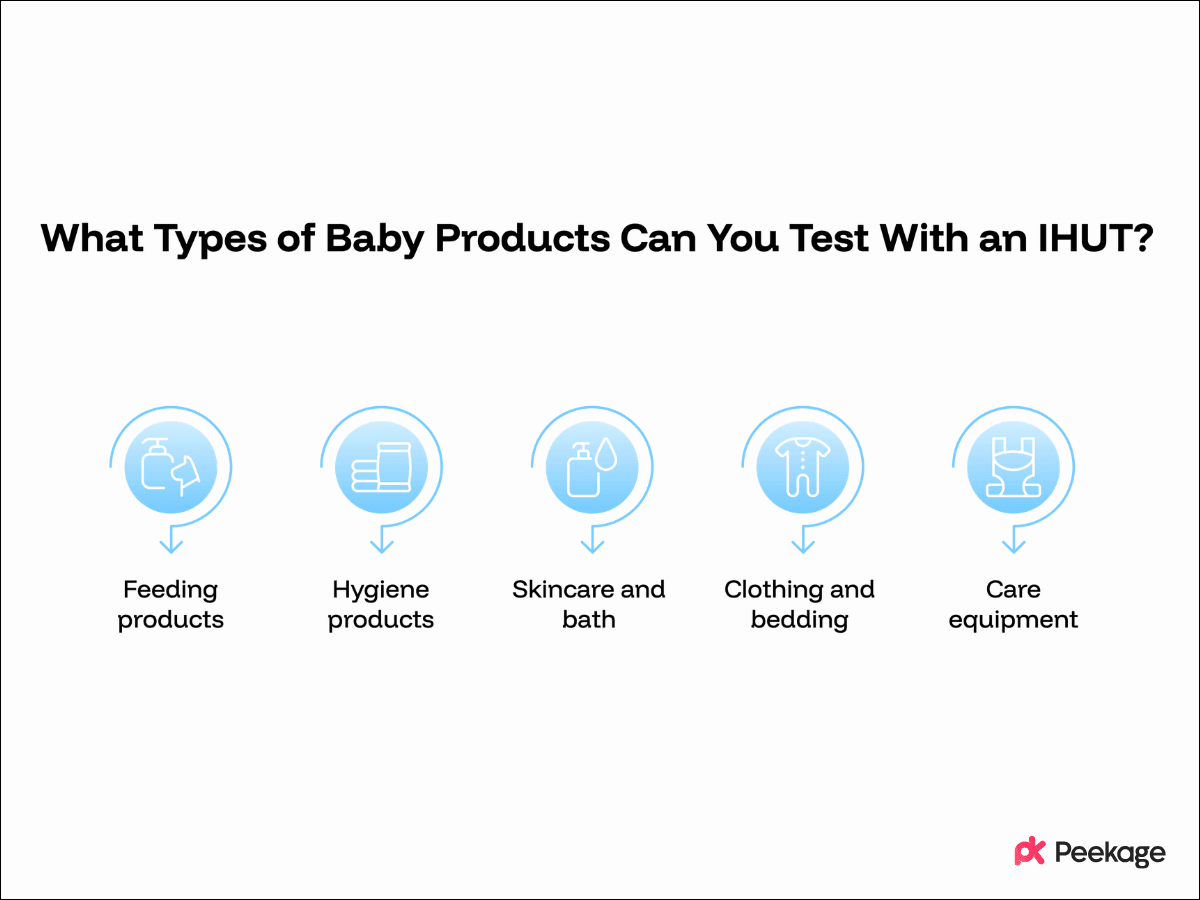
Almost any baby product that a family uses again and again at home is a good fit for an IHUT. Here's how the main categories break down:
- Baby food and feeding products: Bottles, pouches, formula, and purees show their quirks over several days of feedings. Chilled items can be tested too. Cold-chain shipping, which means refrigerated delivery from warehouse to doorstep, keeps purees and fresh foods at the right temperature.
- Diapers and baby hygiene products: Diapers and wipes are classic IHUT candidates, used multiple times daily and easy to evaluate for fit, absorbency, and comfort across different babies and caregivers.
- Baby skincare and bath products: Lotions, washes, and shampoos take longer to judge. A testing window of at least 30 days for skincare products gives participants enough time to assess performance before collecting final feedback.
- Baby clothing, bedding, and accessories: Fit, softness, and wash durability only show up with real wear. A onesie that feels soft out of the bag may pill after five washes.
- Baby care equipment and everyday essentials: Parents judge carriers, monitors, sleep products, and travel gear on setup time, daily convenience, and how well each item fits their space.
From what we've seen, the strongest IHUT candidates share one trait: the product's real test happens over days, not minutes.
How Do You Run an IHUT for Baby Products in 6 Steps?
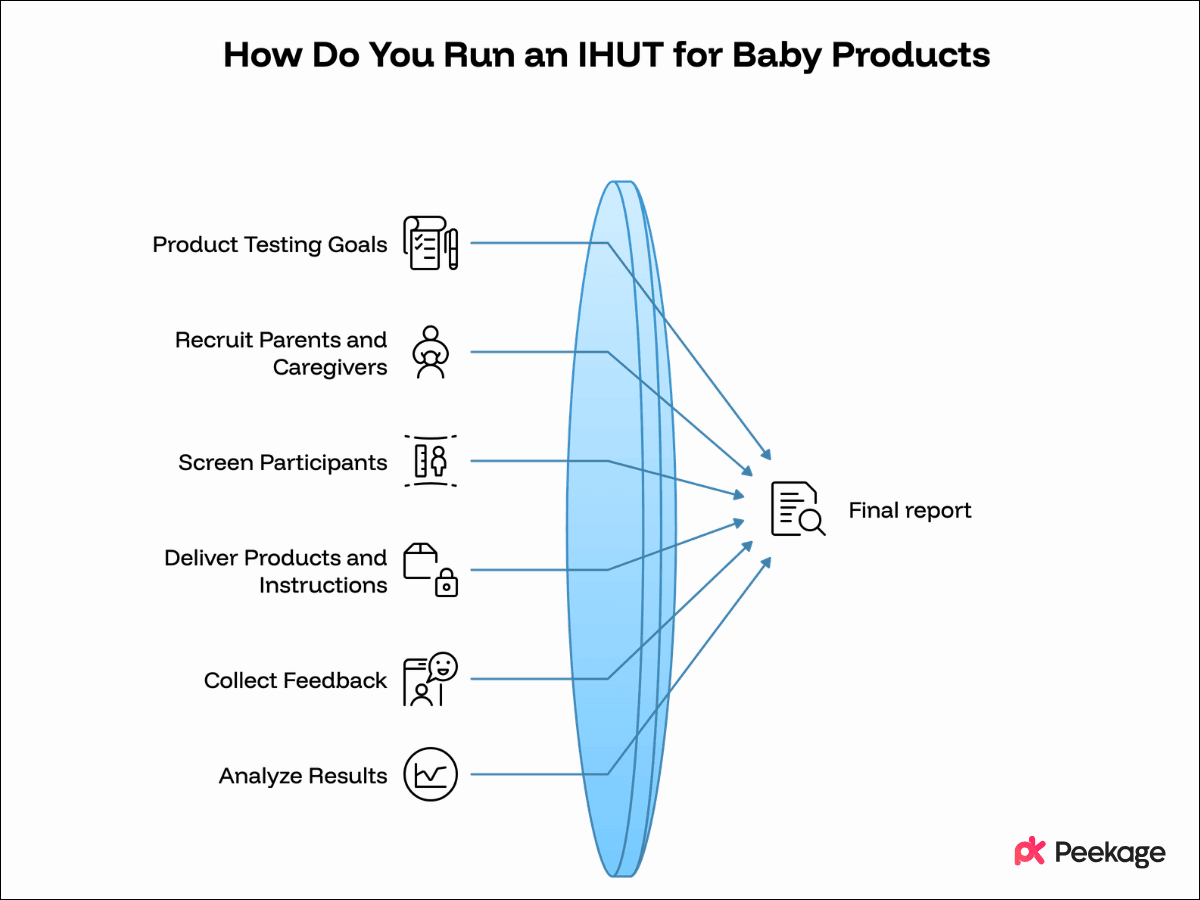
Here's the six-step process for running an IHUT for baby products, from the first planning call to the final report.
1. Define the Product Testing Goals
Start with two or three questions the test needs to answer. Decide what success looks like before sending products to parents.
For example, a baby bottle test might ask whether parents prefer a new nipple shape to their current bottle. A diaper test might focus on fit, absorbency, and leakage, while a baby lotion test could assess texture, ease of application, and packaging.
The goals should also reflect the product's stage. A consumer product testing platform can help brands evaluate prototypes, confirm reformulations meet parents' expectations, and assess readiness before launch.
2. Recruit Parents and Caregivers Who Match Your Target Audience
Define your audience carefully. A mismatch between testers and real buyers weakens the whole study. For baby products, the audience is rarely just "moms." If a grandparent handles weekday pickups or a nanny gives most bottles, the grandparent and the nanny belong in the sample.
Recruitment usually runs through online panels, phone outreach, or social media ads. For example, parents of a 4-month-old are hard to find on a generic list, so recruiting real consumers through a targeted panel can make it easier to reach the right participants.
3. Screen Participants Based on Their Baby's Age and Product Needs
Screening helps recruit caregivers whose babies match the product's intended users. This is especially important for baby products because needs change quickly as babies grow. A product suitable for a 3-month-old may not meet the needs of a 9-month-old.
Use screening questions to check:
- Baby's age and size, including diaper or clothing size where relevant.
- Feeding stage, such as breast milk, formula, or solid foods.
- Skin sensitivities for skincare and bath products.
- Brand currently used.
- Who makes purchasing decisions for the household.
Set quotas to recruit enough participants from each target group. For example, you could recruit 30 parents of babies under 6 months and 30 parents of babies aged 6 to 12 months.
Keep eligibility criteria aligned with the product's intended age range and manufacturer guidance. Include newborns or premature infants only when the product is intended for them, and the study has appropriate clinical and safety oversight.
4. Deliver Products and Provide Usage Instructions
A clear, well-organized kit helps caregivers start the test correctly and follow the study instructions. Include the product in its original packaging, an introduction letter with contact details, and a simple FAQ or instruction sheet.
Each kit should contain:
- The product, packed securely for delivery.
- Step-by-step usage instructions that follow the manufacturer's guidance.
- A short task list with a timeline, such as first use on Day 1 and a check-in survey on Day 3.
- Contact details for someone who can answer questions during the test.
If parents are testing multiple products, randomize the order of use to reduce the risk that one product benefits from being tested first. For blind tests, use neutral labels instead of brand names where appropriate.
Check every kit before shipping. Missing instructions or unclear timelines can delay participation and leave gaps in the feedback.
5. Collect Feedback During and After Product Use
Collect feedback at several points during the test rather than waiting until the end. An initial survey captures parents' first impressions, while follow-up surveys show how the product performs with regular use.
The choice between a focus group and an IHUT depends on what you need to learn. Focus groups help you explore parents' opinions, concerns, and expectations through group discussions. IHUTs let parents use a product at home and report on their experience over time, making them more suitable for assessing everyday use.
Short daily diaries can help parents record issues as they happen. Optional photos or videos can provide additional context, but obtain clear parental consent before collecting images or videos that show a baby.
Keep surveys short enough for busy caregivers to complete. Aim for around 5 to 7 minutes, send occasional reminders by email or text, and recruit extra participants to account for dropouts.
6. Analyze Results and Identify Areas for Improvement
Start by comparing initial impressions with feedback collected after regular use. Ask the same key questions at both stages to see whether satisfaction changes. For example, parents may initially rate a bottle highly but report leaks after several days of use.
Next, compare results across relevant groups, such as baby age, caregiver type, and current brand. A product may work well for one group but create difficulties for another.
Use the findings to prioritize improvements:
- Must fix: Problems that prevent proper use or undermine trust.
- Should fix: Issues that make everyday use less convenient or may discourage repeat purchases.
- Nice to have: Smaller improvements to consider in a future version.
If you're new to interpreting an IHUT report, start with the executive summary, key satisfaction scores, and recurring complaints. These findings can help your team decide which changes to make before launch.
What Metrics Can You Measure With a Baby Product IHUT?
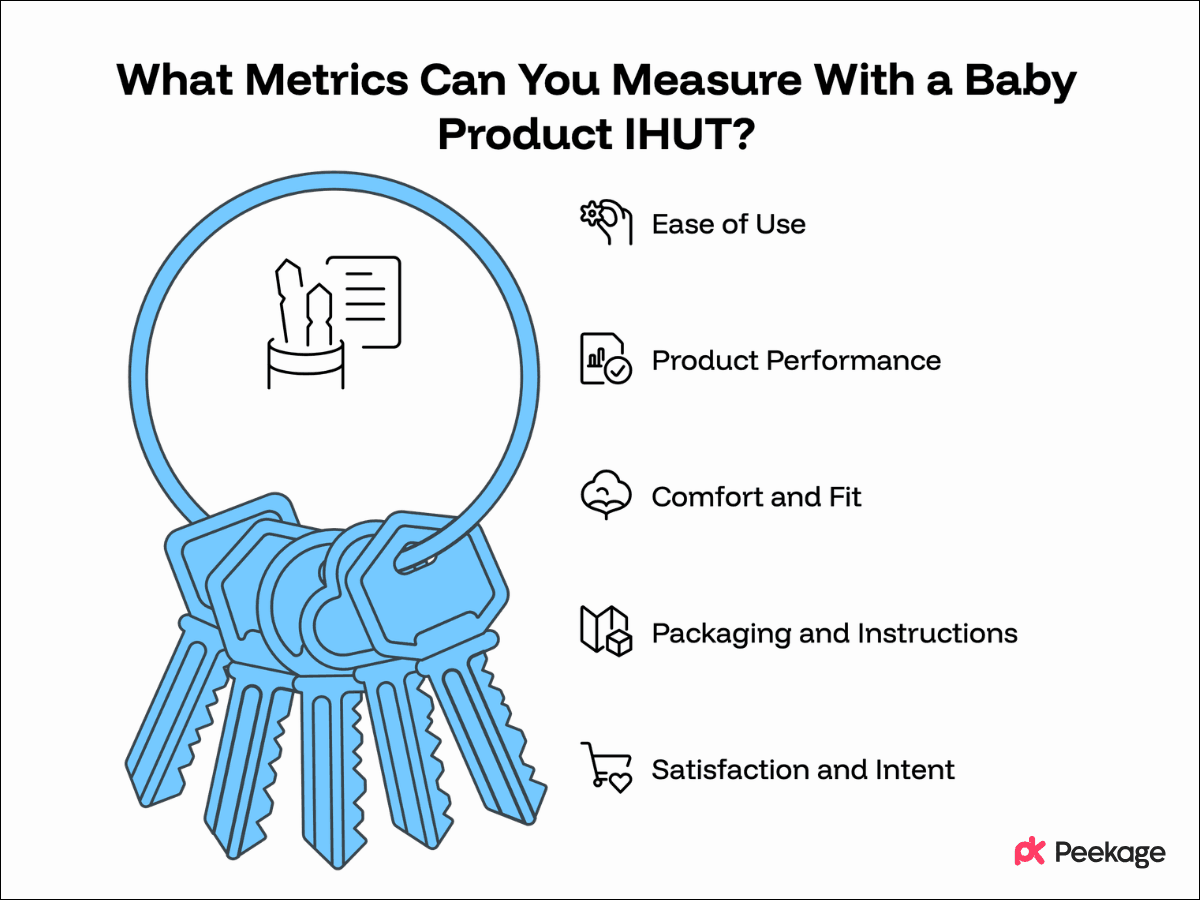
A baby product IHUT can measure five key areas, from ease of use to parents' purchase intent. Choose specific metrics for each area so you can compare feedback and identify what needs improvement.
- Ease of use and convenience: Measure setup time, one-handed operation, and cleaning effort. Ask parents to rate ease of use on a 1-to-5 scale after the first use and again at the end of the test.
- Product performance and functionality: Check whether the product performs as expected. For diapers, track reported leaks. For a bottle warmer, measure the time needed to reach the target temperature. For a soother, ask caregivers how often they observed it calming the baby.
- Comfort, fit, and usability: Ask parents to rate softness, fit, and comfort, and record their observations of the baby's response. For diapers, you can assess softness, material, thickness, and comfort.
- Packaging and instructions: Check whether packaging is easy to open, instructions are clear, and sizing information is easy to follow. This can reveal problems that affect product use or lead to returns.
- Parent satisfaction and purchase intent: Measure overall satisfaction, likelihood to buy, likelihood to recommend, and perceived value compared with the current brand.
Keep any potential marketing claims separate from the research findings. For example, if 80% of participants rate a product as easy to use, that result does not automatically support a claim for the product's packaging or advertising. Have your legal team review claims from IHUT results before publishing them.
What Questions Should You Ask Parents in a Baby Product IHUT?
Use a mix of open-ended questions, which let parents answer in their own words, and closed questions, which use rating scales or predefined answers. Ask questions at three stages of the test to capture first impressions, experiences during use, and overall satisfaction.
First impressions
- What was your first reaction when you opened the product?
- Were the packaging and instructions easy to understand?
During use
- Was anything difficult or confusing the first time you used the product?
- How did your baby respond to the product?
- Have you noticed any problems during regular use?
Final feedback
- How does the product compare with the one you currently use?
- What would you change about it?
- How likely are you to buy it?
- How likely are you to recommend it to another parent?
Keep questions neutral and concise. For example, ask "How would you describe the fabric?" rather than "How much did you love the soft fabric?" The first question allows for positive, negative, or mixed feedback without suggesting a preferred answer.
Avoid making surveys too long. Busy parents are more likely to complete a short, focused questionnaire than one with too many questions.
Finally, don't ask parents to assess product safety or diagnose health problems. If a participant reports a rash or another health concern, follow the study's reporting protocol and direct them to an appropriate healthcare professional when needed. Flag the report for review by the relevant safety or compliance team.
How Does Peekage Help Brands Run IHUT Studies for Baby Products?
Peekage provides in-home product testing services for CPG brands. We help with the entire process from participant recruitment and product distribution to feedback collection and analysis. Our panel includes 5 million consumers across the U.S. and Canada, with more than 200 attributes to help brands find participants who match their target audience.
For baby product IHUTs, Peekage supports several stages of the process:
- Participant recruitment and screening: Target parents and caregivers based on relevant consumer attributes, then use screening questions to check whether their babies match the product's intended age group and needs.
- Product delivery: Coordinate product distribution and track deliveries so participants receive their test products and can begin on schedule.
- Feedback collection: Collect survey responses throughout the test to capture first impressions and experiences with regular use.
- Analysis and reporting: Use AI-supported analysis and reporting to identify patterns in feedback, compare responses, and highlight areas for improvement.
For example, baby feeding brand Ronini used Peekage to test its premium glass baby bottle before committing to production. The company ran a 7-day IHUT with parents of babies aged 0 to 6 months, who tested the bottle in two configurations. The study collected feedback on product performance and usability, along with purchase intent, willingness to pay, and brand perception.
Peekage's analysis identified design improvements Ronini could make before production, helping the company avoid costly changes later. According to the case study, the project saved more than $150,000 in production costs and identified a product issue that could have jeopardized the launch.
If you're preparing to test a baby product before launch, talk to the Peekage team to discuss your study requirements.