
Most CPG products don't fail because the formula is bad. They fail because the message on the front of the pack doesn't land.
Claims testing is how you figure out whether your product's promises actually connect with real people before you spend millions on a launch. Many consumers are skeptical of product claims, especially in categories like wellness and health. Here, people often doubt that benefits are real or scientifically proven.
This article walks through what claims testing is, the methods that work, the regulatory side you can't ignore, and how to run a claims test step by step using Peekage.
What Is Claims Testing and Why Is It Important?
Claims testing is about seeing how real people react to your product messages, whether on packaging, in ads, or online. It's a way to check your message before it hits the shelf.
CPG brands typically test 6 types of claims:
- Performance/efficacy
- Sensory
- Ingredient/formula
- Competitive
- Health/wellness
- Sustainability
Claims are how you connect what your product does with what people believe it does. Testing them first makes it more likely that people will try your product and come back for more.
Regulators like the FTC and FDA expect proof for claims, especially for health or supplement products. Since 2022, the FTC covers all health-related claims, not just supplements.
Brands are also responsible for how people interpret their messages, including images and product names. The Pepsi Challenge is a classic example of testing that made a big impact, and that kind of care still matters today.
How Can Claims Be Tested?
There's no single right method for claims testing. The right choice depends on how many claims you're working with, what stage of development you're in, and whether you need the kind of evidence that holds up with regulators. Here are the 4 main approaches.
Monadic Testing
In a monadic test, each person sees only one claim or product concept. There is no comparison, which makes it closer to a real shopping experience.
The main benefit is clean data. There is no bias from comparing options, and each result stands on its own. The downside is that you need a larger sample size since each person evaluates only one thing.
This method is often used when strong proof is needed, especially for health or performance claims. A variation called sequential monadic shows multiple claims to the same person, but it introduces some bias and makes the results less reliable.
MaxDiff Analysis
MaxDiff analysis works by showing small sets of claims and asking people to choose the best and worst in each set. After several rounds, you get a clear ranking from most to least preferred.
This approach avoids a common issue with rating scales, where everything scores in the middle. It forces people to make real choices and works well when you have a long list of claims.
It is often used as a first step to narrow down options before moving into deeper testing.
TURF Analysis
TURF helps you find the best combination of claims that reaches the widest audience.
A single claim might perform well on its own, but it could appeal to the same group as another top claim. TURF identifies the mix that covers more people without overlap.
It is usually used after ranking methods like MaxDiff. It is especially helpful when you have limited space and need to choose only a few claims.
Qualitative Research
Qualitative methods like interviews or focus groups explain the reasons behind the results.
They show why people trust certain claims, what feels unclear or exaggerated, and how different messages make them feel.
This type of research works best at the beginning to shape ideas and at the end to understand results. On its own, it is not enough for regulatory proof, but it adds important context to quantitative data.
How to Choose the Right Testing Method?
Start with a few simple questions:
- How many claims are you testing?
- What stage are you in?
- Do you need strong proof for regulators?
- What is your budget?
Many brands follow a sequence. They start with MaxDiff to rank options, use TURF to find the best combination, then run monadic tests on the top claims for stronger validation. Qualitative research is used alongside this to understand the results more deeply.
For health or performance claims where scrutiny is higher, monadic testing is usually the most reliable option.
How to Run a Claims Test: From Defining Your Objectives to Test Setup and Launch with Peekage?
Now that the methods are clear, here's how to put them into practice. Peekage is a consumer insight platform built for CPG brands of all sizes. It gives you access to 5M+ consumers across North America, targetable by 200+ shopper attributes, with results delivered in days.
Define Your Objectives and Claims
Start with a clear business question: what decision will this research inform? Are you choosing between claims for a product launch? Validating believability before a packaging refresh? Identifying which message resonates with a new segment? The objective shapes everything else.
Write down the claims you want to test, and cap the list at a manageable number based on your chosen method. Set your diagnostic metrics upfront: believability, relevance, uniqueness, and purchase intent. Get your marketing, legal, and R&D teams to agree on what a "winning" claim looks like before data collection starts.
Build Your Panel using 200 Attributes
Who you test with is the most important part of any claims study. A claim that works for health-conscious millennials may not work for parents of young children even if it is about the same product.
Make sure you separate your audience by things like age, lifestyle, shopping habits, past product use, and brand preferences. If you have different groups, test them separately because the best claim may be different for each group.
Choosing the right panel helps you see how real consumers will respond and gives you confidence in your messaging before launch.
Peekage provides access to its network of 5M+ users and allows you to target them using over 200 attributes grouped into the following categories: demographics, geographics, food preferences, grocery shopping behavior, and more. If multiple segments matter, run separate cells for each. The winning claim may differ by group.
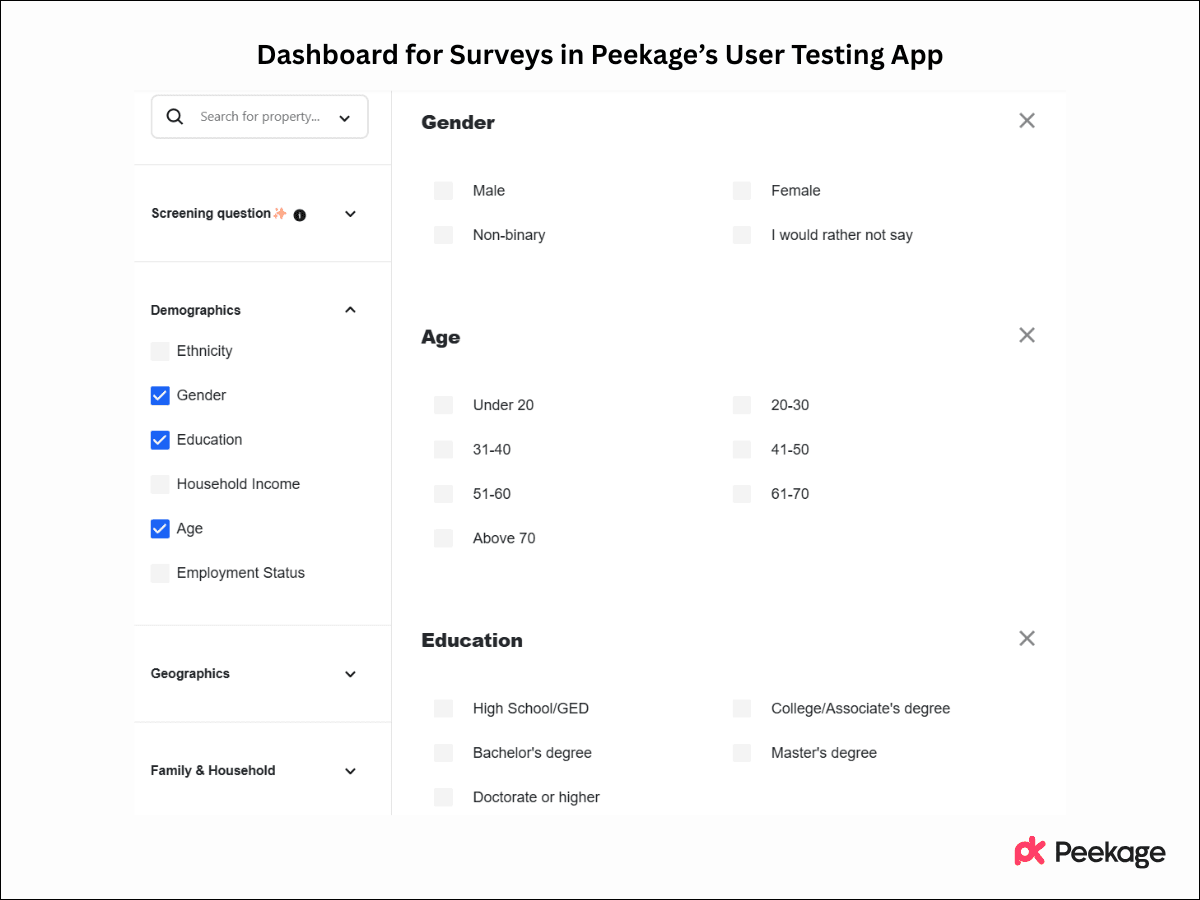
Design Your Survey
Next, you need to create a survey that measures how people respond to your claims. Keep it short and focused, around 8 to 12 questions. Ask people to rate overall appeal, whether they would buy the product, how unique the claim feels, how well it fits your brand, and the value it provides. Include a few open-ended questions so respondents can explain their thoughts in their own words.
You don't have to start from scratch. You can use pre-made templates or AI tools to help build your survey. Just make sure to review the survey before sending it out to check that it captures what you really want to learn.
Submit Your Survey to Peekage for Review
Before you launch your survey, send it to the Peekage for review. The review makes sure your questions are clear and set up to collect accurate answers. This usually takes a day or two.
Once it's approved, your study can go live. Respondents are recruited and start answering right away, and you can watch the results come in on a live dashboard. Most studies finish in 2 to 5 days, giving you fast insights to act on.
Launch and Monitor the Campaign
Once your study is launched, the Peekage execution AI agent begins the recruitment and data collection process. The quality agent operates alongside the execution agent to identify potential issues and ensure the responses are of high quality.
The live dashboard's data explorer displays responses in real-time as they are received.
Typically, the turnaround time for completing a study is between 2 to 5 days.
Analyze the Feedback and Make Optimizations
Peekage compiles results into a report covering claim performance scores, open-end language and associations consumers used, and segment breakdowns showing how different groups reacted to different claims.
From there, you can choose the best claims for your packaging and retail materials. If a claim feels relevant but not fully believable, you can adjust the wording and test it again. Peekage also lets you go back to the same group of testers, so you can improve your claims step by step with consistent feedback.
Best Practices for Validating Claims: How to Ensure Accurate and Actionable Results
Before choosing a method, it helps to set up the process correctly. From working with CPG brands, we've seen a few things make the difference between useful insights and wasted budget.
- First, get your teams aligned early. Marketing wants compelling language, legal wants defensible language, and R&D wants accurate language. If these groups don't agree on what makes a "winning" claim before the study starts, you'll end up reworking everything later, which is costly and slow.
- Second, test claims in the context of the actual product. Digital-only exercises where consumers pick their favorite phrase from a list can be misleading. A claim like "ultra-moisturizing" means more when someone has actually used the lotion for a week. So you need to pay attention to context.
- Third, define your success metrics upfront. Are you measuring believability, relevance, uniqueness, or purchase intent? Each of these tells you something different, and knowing what matters most will shape your study.
- Fourth, test early and test often. Waiting until pre-launch is a common mistake. Iterative testing at multiple stages helps catch problems when they are cheaper and easier to fix.
- Fifth, benchmark against competitors. Your claim doesn't exist in a vacuum. If a competitor's "cleans 2x faster" scores higher than your "deep cleans in seconds," you want to know before printing your packaging.
- Sixth, keep your audience consistent across test groups. If one group skews younger or more health-conscious, your results will be misleading. Compare apples to apples.
How to Create Powerful, Accurate, and Persuasive Claims
Not all claims work the same way. If a claim is too vague, it will not give people a reason to buy. If it sounds too bold, people may not trust it. The goal is to find the balance. You need claims that are true, meaningful to your audience, and clearly different from what competitors are saying.
A good place to start is with real consumer language. Talk to your customers. Look at interviews, surveys, or open-ended feedback. Pay attention to how they describe their needs and frustrations. You will often find that the words they use feel more natural and convincing than anything we come up with internally.
Once you have a few claim ideas, step back and sanity-check them:
- Is it believable? Even if something is true, people need to believe it. If it feels like too much, trust drops quickly.
- Is it relevant? Does this actually matter to your audience? If it does not solve a real need, it will not make an impact.
- Is it unique? If everyone else is saying the same thing, why should someone choose you?
- Is it supported? For some claims, especially around health or performance, you will need real proof. It is better to think about this early, not later.
One last thing to keep in mind: alignment. Marketing, legal, and R&D often look at claims differently. We have seen that getting everyone on the same page early saves a lot of time and back and forth later.
3 Real-World Examples of Successful Claims Testing
It's easier to understand claims testing when you see how it works in real situations. Here are 3 simple examples of how brands use different methods to choose the right messaging.
1. Keeping a Claim That Already Works
A CPG brand wanted to review its packaging claims and see how it compared to competitors. They tested several options with consumers using the MaxDiff method.
The result was unexpected. The claim they were already using came out on top.
They then ran a TURF analysis to see if adding another claim would help. It did not. The current claim has already reached most consumers. In the end, they kept their existing message, but now they had the data to back it up and share with retail partners.
2. Testing a Stronger Claim for a Skincare Product
A skincare brand was getting ready to launch a new serum and wanted to test a key claim.
They used a monadic test, where each person saw only one version of the claim. One was more specific, while the other was softer. The more specific claim performed better. People found it more believable and were more likely to buy the product.
This gave the team confidence to move forward, along with the proof they needed for internal and regulatory review.
3. Finding the Right Mix of Claims
A snack brand had many claim ideas but limited space on packaging. They needed to choose carefully.
First, they used MaxDiff to rank all their claims. Then, they used TURF to find the best combination of two claims that would appeal to the most people. This helped them choose the final messaging and align the whole team around a clear, data-backed direction.
Conclusion
Claims testing brings together strong marketing and regulatory requirements. There is no single best method. The most effective approach is to use a mix of methods based on your goals and where you are in the process.
Brands that test their claims before launch are more likely to stand out on the shelf, perform better in advertising, and build stronger relationships with retail partners. Peekage makes this process easier for CPG brands of all sizes, offering a faster and more affordable way to get reliable insights.
If you want to see how this could work for your product, you can talk to our expert and explore the best approach for your needs.