
We often see brands send out a survey asking people to rate 15 product features, and when the results come back, everything scores a 4 or 5 out of 5. Everybody says everything matters, and now you're sitting there with a pretty spreadsheet that tells you absolutely nothing about what to do next. This is exactly why MaxDiff analysis is used.
Instead of letting people say "yes, I like everything," MaxDiff makes them choose: “Pick your favorite from this group,” and “Now pick your least favorite”. Do that a few times, and suddenly you see what people actually care about versus what they just think sounds nice in a survey.
In this guide, we break down what MaxDiff is, when you should use it, what works (and what doesn't), and how to run one from start to finish.
What Is MaxDiff Analysis and How Can It Help You Understand Customer Preferences?
MaxDiff analysis (or Maximum Difference Scaling or Best-Worst Scaling) is a survey method where you show people a small group of options (usually 4 to 6 things) and ask them to pick the best one and the worst one. You repeat this with different combinations of items, and at the end, you get a clear ranking based on real choices instead of inflated ratings.
We've watched this method help CPG brands figure out which features to put on their packaging, which claims to use in their ads, and which flavors to actually put on store shelves.
For instance, traditional rating scales don't force real decisions. By this, we mean that when people can rate everything, they usually give high scores across the board. That makes it hard to see what actually matters.
With MaxDiff, every choice creates a trade-off. You ask people to choose what matters most and least from a small set of options. If someone picks Feature A as the most important, they're clearly saying it matters more than the other options shown. After that you can analyze those choices to measure which is truly important.
When Should You Actually Use MaxDiff?
MaxDiff isn't right for every situation. Here's where it really works and where you should probably use something else.
- Building a new product: You usually start with a long list of features. Some feel important, others not so much. MaxDiff helps you put them in order. We've seen teams come in with 15 or 20 benefits in mind, and after running MaxDiff, we narrowed that list down to the few that customers actually cared about, before they spent time or money building the rest.
- Testing marketing messages: Your team probably has 10 or 15 different things you could say about your product. MaxDiff tells you which 3 or 4 will actually get people to buy.
- Designing packaging: What should go on the front of the box? Which benefits should you call out? Which ones can go on the back? MaxDiff answers these questions.
- Fixing customer experience issues: Let's say you can only fix 3 problems this quarter. MaxDiff tells you which 3 matter most to your customers so that you can focus your resources on fixing them.
- Choosing which products to launch: Sometimes you have more ideas than you can realistically launch. If you can only roll out a few new products, features, or flavors, MaxDiff helps you pick the ones your customers are most likely to care about first.
We typically run MaxDiff studies for our clients when they're testing early concepts with our consumer community, when they're about to launch and need to validate their positioning, or after launch when they want to optimize based on real feedback from people using their product at home.
What Are the Pros and Cons of MaxDiff Analysis for CPG Brands?
| Pros | Cons |
|---|---|
| Forces real choices and separates close options | Results are relative to the items you test |
| Easier and faster for people to answer | Doesn't explain why people choose something |
| Avoids rating-scale bias | Requires careful selection of attributes |
| Lets you test many features without long surveys | Not always the right method for every question |
| Strong data for advanced analysis and segmentation | May need follow-up research for context |
How to Run a MaxDiff Study: From Selecting Your Options to Survey Setup and Launch with Peekage
Running a MaxDiff study sounds complicated, but it's actually pretty straightforward once you break it down. Here's how we do it.
Step 1: Define Your Research Objectives
Get specific about what you're prioritizing and which study it fits into. MaxDiff is a technique for ranking a list of options by importance, appeal, or preference, and it slots into packaging tests, price tests, claim tests, feature prioritization, and more. Are you figuring out which pack design wins against five alternatives? Which price message resonates most? Which product claims to lead with? The objective shapes both the study type you'll run and the items you'll compare.
Step 2: Build Your List of Concepts
Create the list of options respondents will compare. Keep each item short, clearly worded, and at a similar level of abstraction. If you mix broad ideas with specific ones, the comparisons won't be fair. Images work well for packaging or flavor studies, but keep their style consistent so nothing wins on polish alone.
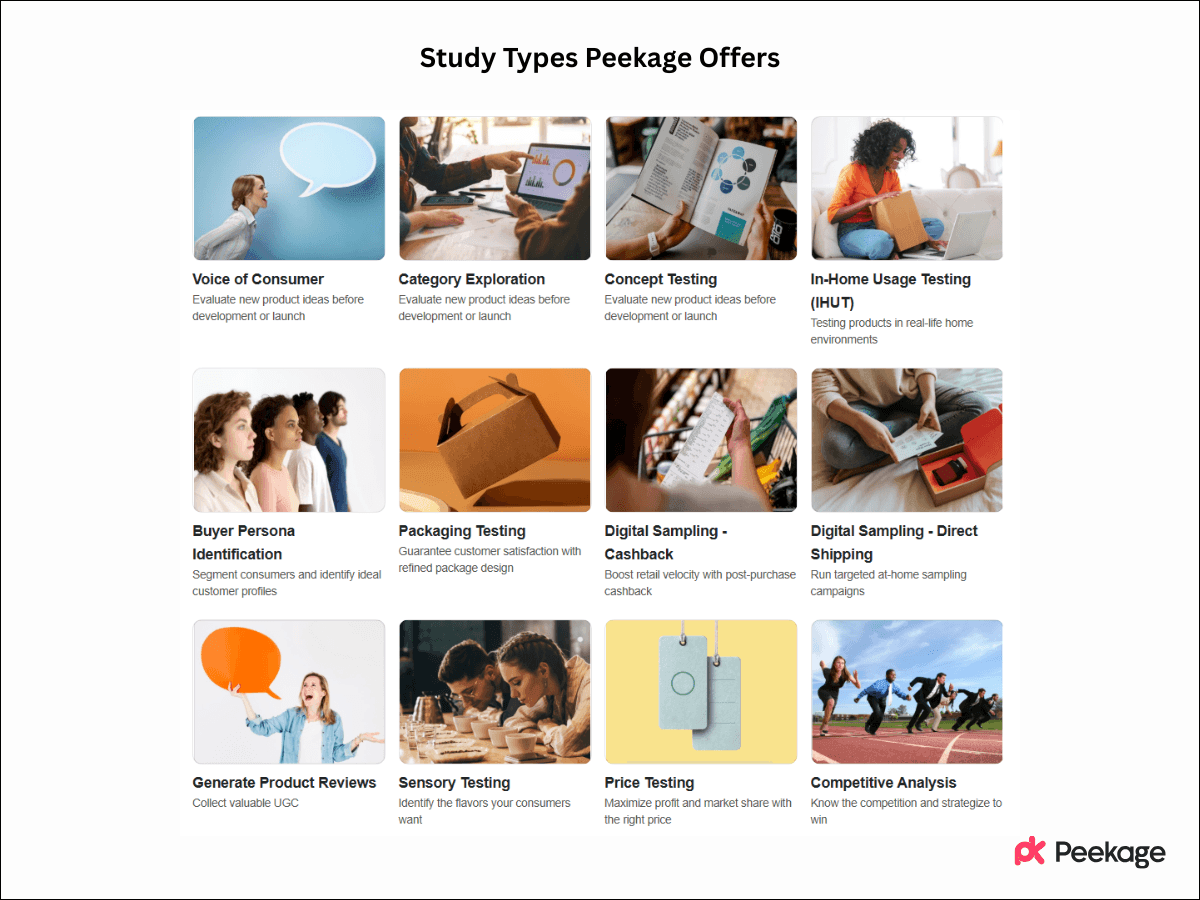
Step 3: Pick Your Study Type in Peekage
Choose the study type that matches your objective, then apply MaxDiff as the technique inside it. The study type sets the context, and MaxDiff handles the how (forcing trade-offs to rank your items). Framing the question matters here because it shapes what respondents answer on each screen.
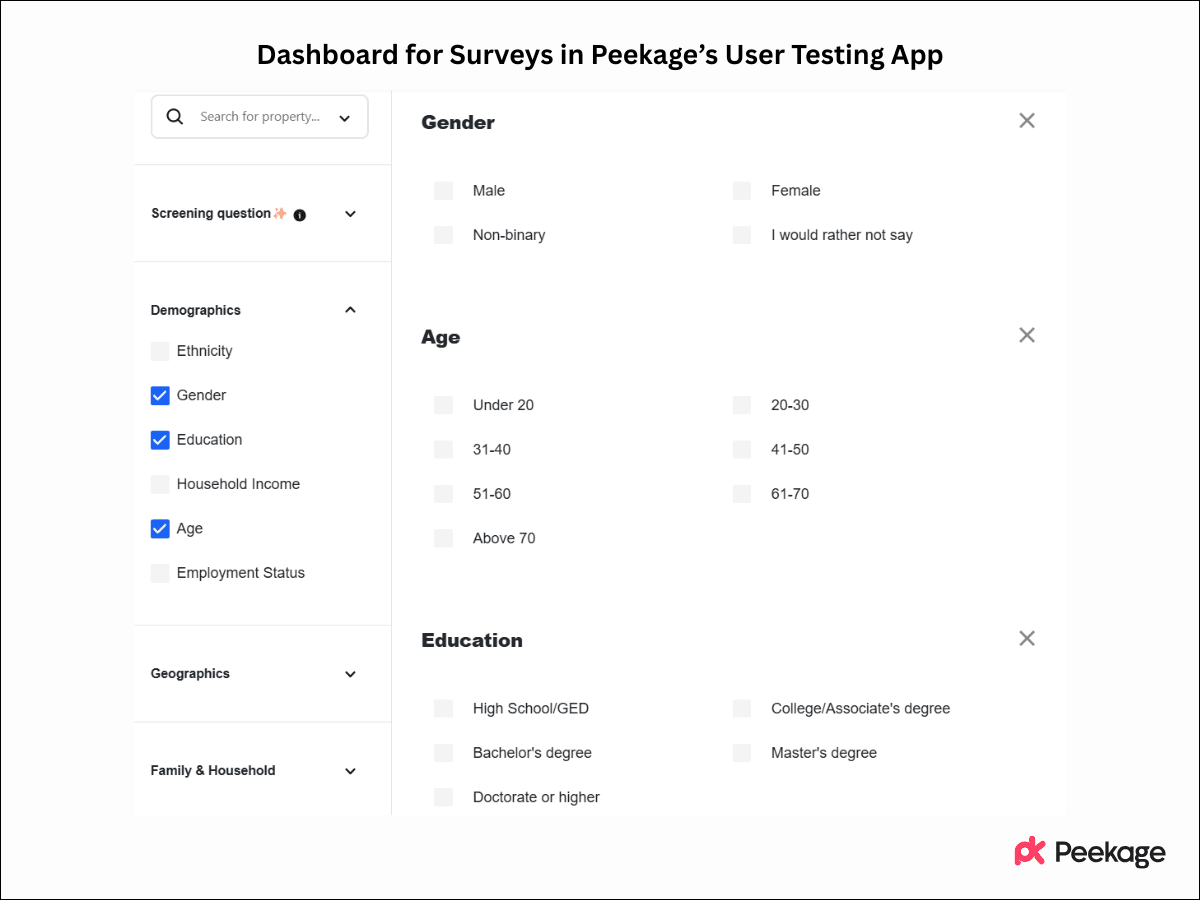
Step 4: Build Your Panel Using 200+ Attributes
Peekage lets you define demographic criteria, behavioral targeting, and geographic parameters so your study reaches the right audience. Sample size works differently for MaxDiff than for monadic testing: you generally want 200–400 respondents total (not per item), since each respondent evaluates many items across several screens.
Peekage's panel includes over 200 targeting attributes, from shopping habits to dietary preferences, and geo-targeting lets you run regional studies before a national rollout. If you need to go further, the pre-screening feature lets you layer on extra criteria to build a highly targeted panel.
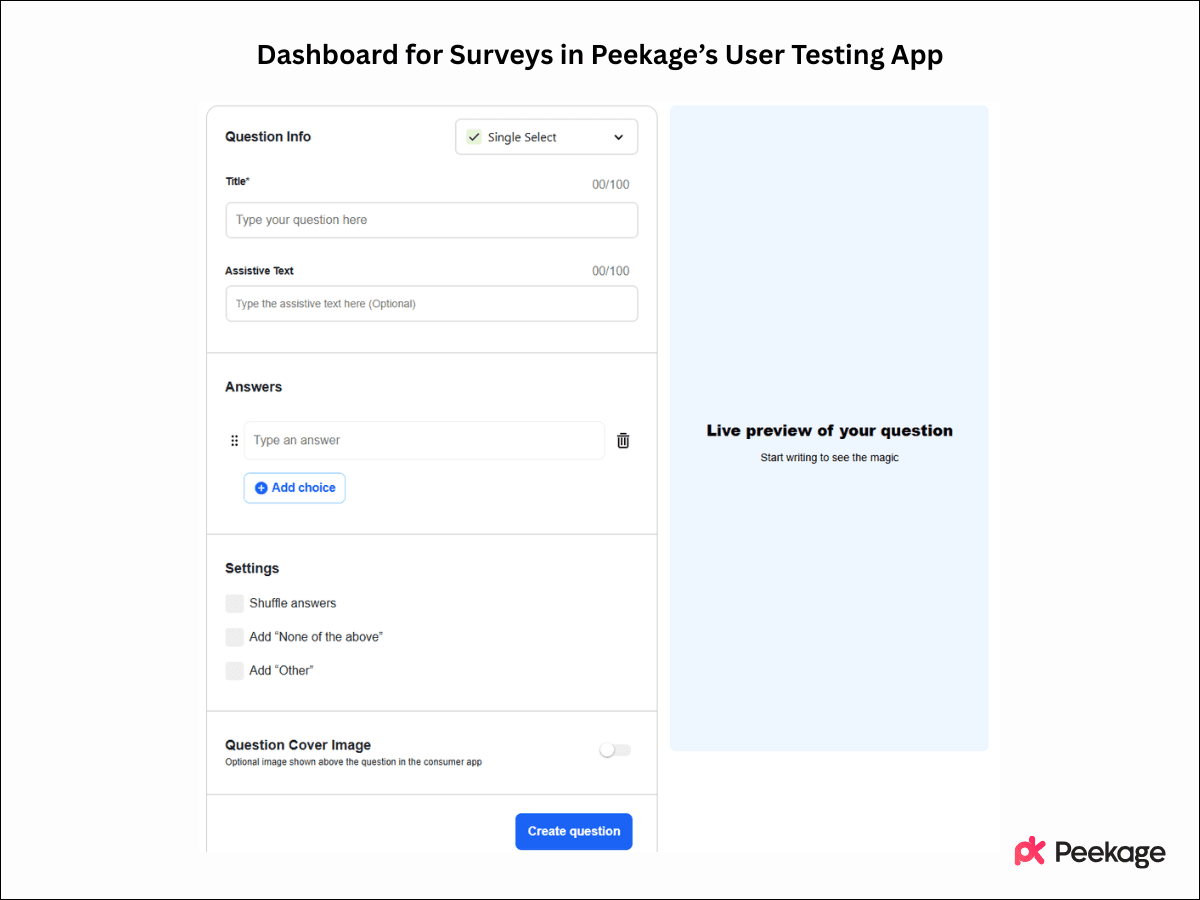
Step 5: Design Your Survey or Review the One Built by AI
A MaxDiff survey has a few settings that shape the quality of your results: how many items appear per screen, how many screens each respondent sees, and the attribute you're asking them to judge. Add a handful of follow-up questions for context, demographics, usage, or an open-end to capture reasoning, but keep things tight so respondents stay focused.
Instead of building from scratch, you can start from one of Peekage's pre-built templates to save time and keep the structure consistent. If you let Peekage's AI design the survey for you, review it before launching to make sure the items, screen counts, and attribute wording actually match your objective.
Step 6: Send for Peekage Review and Launch Your Campaign
Before launching, send your survey to Peekage for review. Our team checks the design, flags anything off, and makes sure it's set up to produce reliable utility scores. Review takes 1–2 days, and once approved you're ready to launch.
When you launch, the Peekage execution AI agent kicks off recruitment and data collection. The quality agent runs alongside it to catch bad responses and keep the data clean. The live dashboard shows responses coming in as they happen, and the typical turnaround is 2–5 days.
Step 7: Analyze Results and Take Action
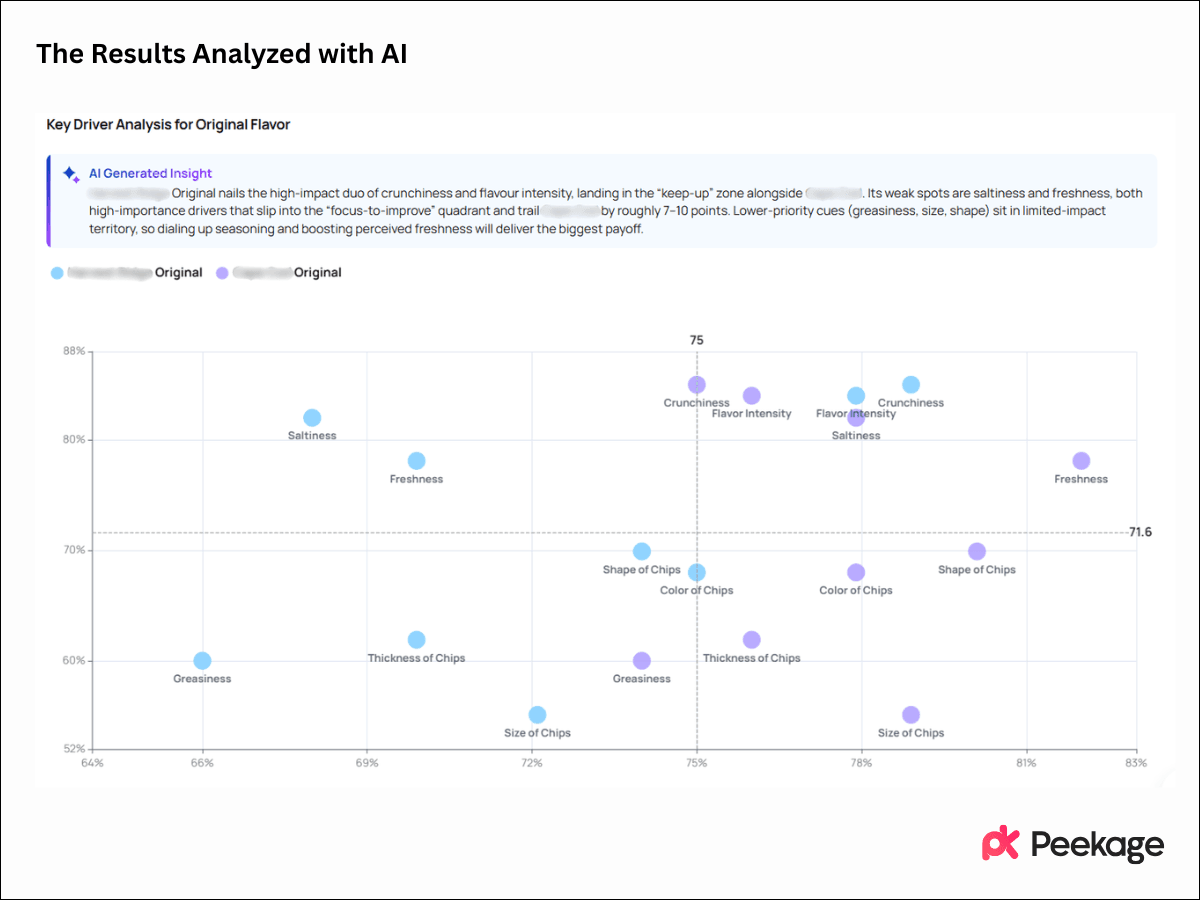
MaxDiff output comes as utility scores and numbers that tell you how much more respondents prefer one item over another, not just the order. Peekage generates these automatically, along with ranked visualizations, segment comparisons, and exportable reports. Our AI assistant analyzes the data for you and surfaces suggestions based on what it finds, which items to prioritize, which to cut, and where segment differences are worth a second look.
We turn the complex stuff into formats everyone can understand: clear rankings, priority grids, automatic insights, and reports you can adjust for executives versus product teams versus marketing.
MaxDiff tells you "what matters" but not "why it matters." That's why we suggest you pair it with our in-home testing. Send prototypes to the people who care most about the top features and ask them to explain their thinking. Now you have the complete story.
Real Example: Tea Brand Picks Winners through MaxDiff Analysis
We ran a MaxDiff preference test to understand which product claims matter most to our target audience. Respondents were shown different combinations of claims and asked to choose the most and least appealing in each set.
What we tested: We included a mix of functional benefits (e.g., no added sugar, supports gut health, energy without crash) and ethical/ingredient-based claims (e.g., plant-based, non-GMO, sustainably sourced).
What we found: The results showed a strong preference for functional benefits. Claims like no added sugar, gut health, and energy without crash consistently ranked highest. In contrast, claims like sustainability, plant-based, and non-GMO had low or negative impact on preference.
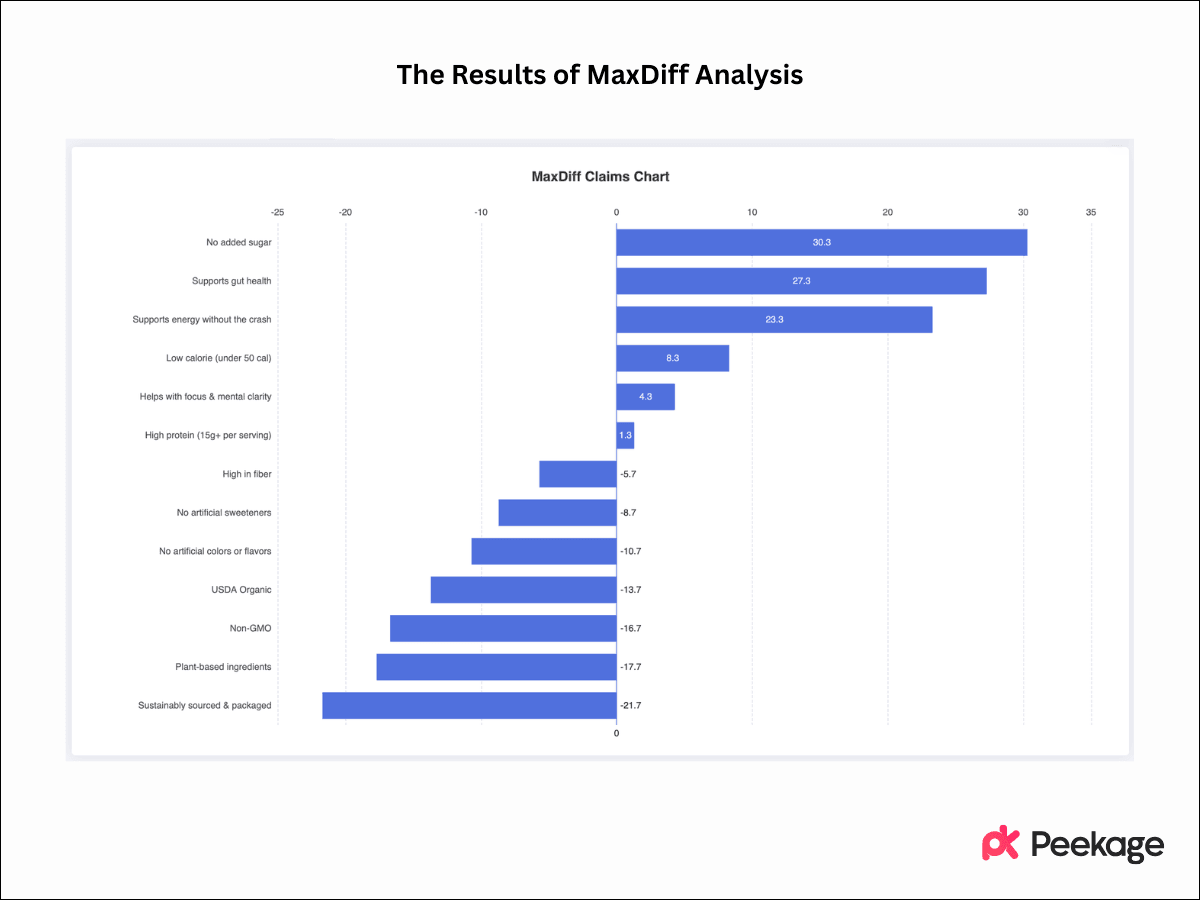
How we used this: Based on these insights, we shifted our messaging strategy:
- Packaging: Highlighted “No Added Sugar” and “Supports Gut Health” on the front
- Ads: Focused on “Clean Energy Without the Crash”
- Positioning: Framed the product as a functional, performance-driven option rather than an ethical or lifestyle product
Conclusion: The test helped us prioritize claims that directly influence purchase decisions, ensuring our messaging aligns with what customers actually value.
Bottom Line
MaxDiff works because it copies how real decisions happen. It's logical that nobody sits around rating products on a 1-to-5 scale in real life, they compare options and pick one. MaxDiff captures that reality in a way that gives you clear and useful rankings.
At Peekage, we've taken a research method that used to require expensive consultants and made it something any brand can use. Our AI-driven platform combines serious math with the speed and precision of our 5-million-person consumer network. We deliver insights quickly and efficiently, often with significantly lower costs and faster turnaround times than traditional market research firms.
Whether you're testing a new idea, figuring out which features matter, or trying to make your current products better, our MaxDiff analysis shows you what consumers actually want. Not what they say they want in a survey.
Want to see how MaxDiff can speed up your product development with our full concept testing services? Talk to our team about running your first study.