
Most marketing and innovation teams think they know what consumers want. We’ve seen that confidence backfire more times than we can count, often ending in launches that never stood a chance.
From years of working closely with consumer insights, we’ve learned one thing clearly: 95% of product failures don’t happen because teams moved too slowly, but because they moved forward without real validation. That’s where concept testing comes in. It shows your ideas to real consumers and gives honest feedback before launch, so you can spot issues early.
In this guide, we break down 9 concept testing tools to help teams get real feedback before launch. We cover options for large product teams with bigger budgets, as well as tools that work just as well for smaller brands testing their first ideas.
What Are Concept Testing Platforms and Why Use Them?
Concept testing tools help product teams see how real people react to an idea before money, time, and teams are locked into building it. Instead of guessing, brands use these platforms to show concepts to the right audience, collect feedback through surveys or at-home testing, and understand what actually works and what doesn’t.
As consumer preferences change fast (much faster than they did a few years ago) these tools have become very important. People discover products through social media, switch brands easier, and expect new ideas to feel relevant right away. That makes launching without testing a much bigger risk than it used to be.
For CPG teams, testing early is even more important. Mintel found that only about 35% of global CPG launches were actually new products, while 65% were line extensions or reformulations. Testing helps us see if a small change or a new idea will actually work with consumers before we spend on production or marketing.
Using concept testing platforms gives your team confidence, because instead of guessing, you can make decisions based on real feedback, spot problems early, and improve your ideas before launch.
9 Best Concept Testing Platforms in 2026
| Tool | Best For | Product Type | Speed | Ease of Use | Cost Level |
|---|---|---|---|---|---|
| Peekage | SMB to mid-market CPG teams needing fast user testing without research knowledge | Physical products (IHUT), concepts & prototypes | Hours to days (physical testing) | Very easy (no research background needed) | Low to mid |
| Suzy | Enterprise teams running mixed quant + qual studies | Digital concepts & user interviews | Hours to days | Medium | High |
| Zappi | Enterprise creative teams screening many ideas fast | Concepts, ads, early innovation | Days | Easy | High |
| Quantilope | Enterprises needing advanced statistical analysis | Pricing, trade-offs, feature testing | Days to weeks | Harder | High |
| Attest | Teams running quick digital surveys | Digital concepts only | Hours to days | Easy | High |
| SightX | Marketers wanting agency-free survey research | Digital concepts, packaging | Days | Easy | Mid |
| MESH01 | Brands needing deep usage and behavior tracking | Physical products with complex interaction | Weeks | Harder | High |
| The Product Hub (MMR) | Brands wanting structured product testing services | Physical products (IHUT, CLT) | Days to weeks | Medium | High |
1. Peekage
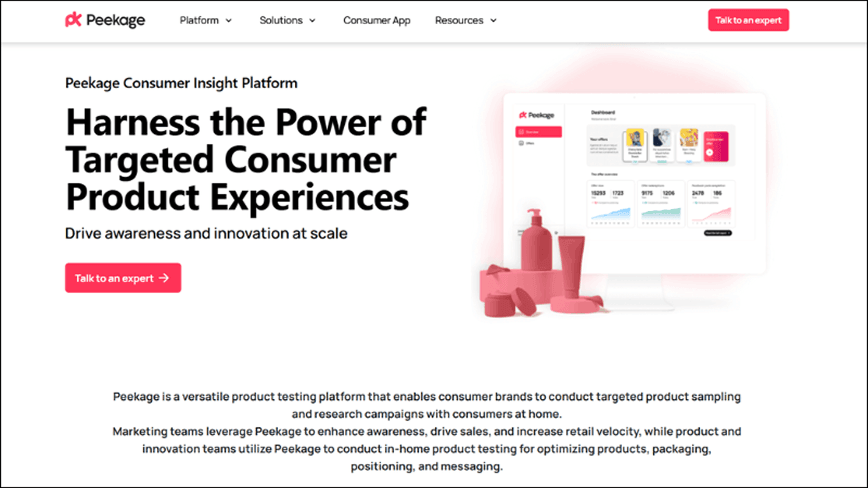
Peekage is an AI-driven consumer insights platform built for fast, easy product and concept testing. We streamline user testing and consumer research with AI, giving CPG brands real feedback from consumers in days instead of weeks.
Peekage is ideal for teams without research experience or bandwidth. Our AI-guided study setup walks you through every step, while CPG-trained agents analyze results automatically and give actionable insights. With a community of over 5+ million consumers, you can recruit the right participants quickly across all demographics.
Key Features:
- AI-guided automated study design, launch, and analysis
- In-home product testing for all product types (shelf-stable, refrigerated, and frozen)
- Concept, sensory, competitive, packaging, and claims testing
- Real-time insights and results
- Built-in advanced methodologies (Conjoint, TURF, MaxDiff, significance analysis
- Capture in-store experiences
Pros:
- Fastest insights for physical product testing(IHUT)
- Affordable for SMBs and mid-market brands
- Easy to use, no research background needed
- Proprietary panel of 5M+ consumers for quick recruitment
- Integrated product fulfillment
Cons:
- Newer platform compared to established enterprise tools
- No digital shelf study option
- Focused mainly on CPG, so less suited for B2B or other consumer categories
Pricing: Subscription pricing based on study needs with a trial option, affordable for brands of all sizes.
Best For: CPG brands with limited bandwidth seeking fast, affordable, frequent testing without research expertise.
2. Suzy
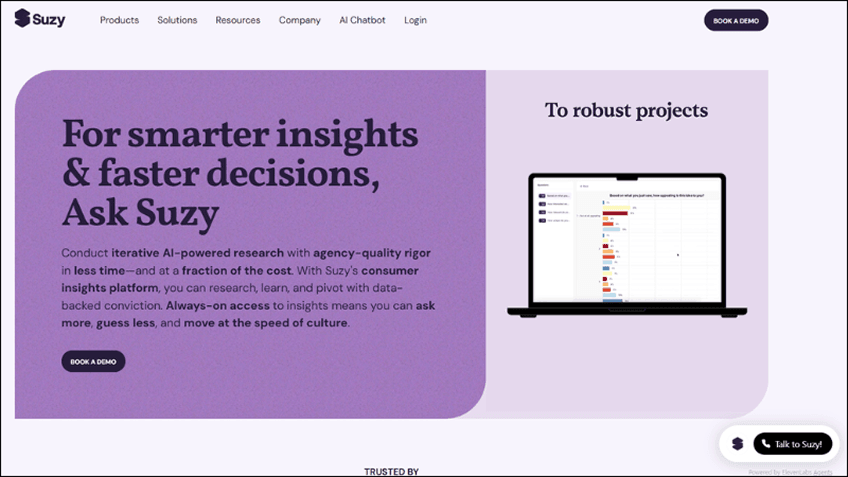
Suzy is a research tool that helps teams run surveys and talk directly with consumers in one place. It supports both numbers-based research, like quick surveys, and open-ended research, like interviews and longer conversations.
Teams use Suzy for different types of studies, from fast check-ins on an idea to deeper research when they need more detailed feedback. The platform gives access to a large pool of verified consumers and lets teams choose specific audiences based on who they want to hear from.
Suzy also includes a built-in chat-style research feature, called Suzy Speaks, where people respond in a conversational way. To protect data quality, the platform uses its own system to filter out fake or low-quality responses.
Key Features:
- On-Demand Consumer Panel
- Suzy Live (Qualitative)
- Suzy Insights (Quantitative)
- BIOTIC Verification
- Expert Support
Pros:
- Fast Turnaround
- User-Friendly Interface
- High-Quality Data
- Versatility in Methodology
Cons:
- Learning Curve
- Limited Audience Diversity for Niche Markets
- Inflexible Survey Structure
- Expensive
- Difficult Analysis Tools
- Screener Maintenance
Pricing: Custom pricing, typically suited for enterprise clients.
Best For: Enterprise brands that need flexible research capabilities across quant, qual, and live methodologies.
3. Zappi
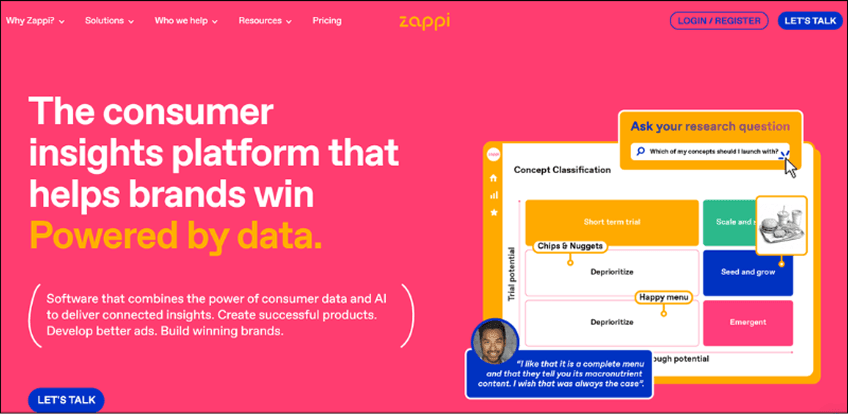
Zappi is a research tool used by large brands to test ideas, ads, and early product concepts. It’s built mainly for creative teams that need fast feedback before making any decisions.
Teams use Zappi to test many ideas at once and see which ones perform better. The platform is often used for early screening, when the goal is to narrow down options rather than run deep research. Results are delivered quickly, which helps teams move forward without long research cycles.
Zappi also includes automated tools that help create, adjust, and summarize concepts. These features speed up the testing process and reduce manual work, while keeping the focus on understanding which ideas are worth developing further.
Key Features:
- Rapid Automated Testing
- Pre-built Methodologies
- AI-Powered Insights
- "Lovers & Haters" Analysis
- Trusted Global Panel
- AI Concept Creation Agents (New)
Pros:
- Speed to Insight
- User-Friendly Interface
- Cost-Effective
- High-Quality Data
- Actionable Reporting
Cons:
- Third-Party Panel Reliance
- Limited Customization
- CPG Focus
- Less Detailed Analytics
- Survey Fatigue
Pricing: Custom enterprise pricing with a tiered system based on the number of stimuli.
Best For: Large enterprise brands with significant innovation and advertising budgets needing validated insights across the product and creative development lifecycle.
4. Quantilope
Quantilope is a research platform focused on advanced testing methods like Choice-Based Conjoint, MaxDiff, and pricing studies. It’s designed for big teams that need detailed insights.
The platform automates these methods, provides real-time dashboards, and includes an AI assistant to support analysis. Quantilope is used by many enterprise brands and has been ranked the #1 market research technology in Greenbook’s GRIT report for two consecutive years.
Key Features:
- AI-Powered "Quinn" Co-Pilot
- Automated Advanced Methods
- inColor Video Research
- Real-time Data & Dashboards
- Panel Agnostic
- Pre-built Templates
Pros:
- High Speed
- Intuitive Interface
- End-to-End Efficiency
- Actionable Insights
- Collaborative Support
Cons:
- Rigid Visualization Tools
- Learning Curve
- Cost for Small Businesses
- Limited Customization in Reporting
Pricing: Custom enterprise pricing.
Best For: Enterprise brands with complex research needs requiring sophisticated statistical analysis, particularly for pricing optimization and feature trade-offs.
5. Attest
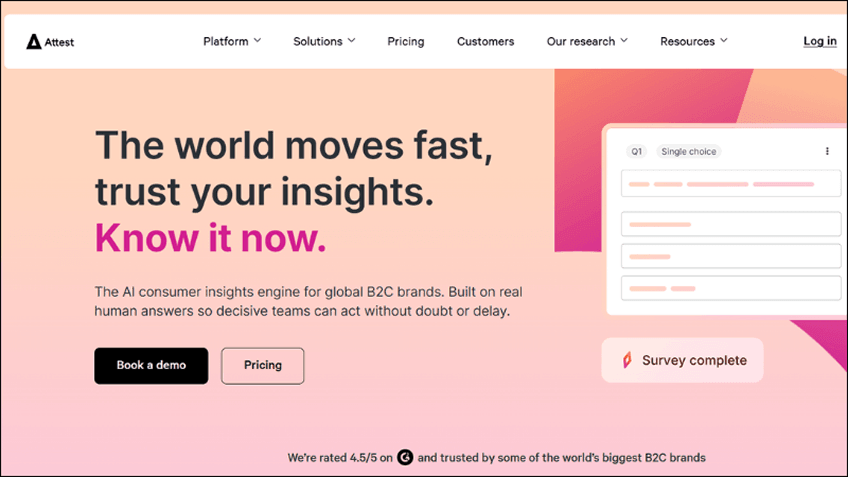
Attest is a self-serve research tool that helps brands test ideas and concepts with real consumers. It’s commonly used by marketers and product teams that need quick feedback without a complex setup.
The platform focuses on fast data collection, making it useful for early product ideas, creative testing, and other decisions where speed matters.
Key Features:
- Rapid Consumer Testing & Insights
- Broad Audience Access
- Survey Builder & Templates
- Targeted Audience Segmentation
- Advanced Analytics & Visualization
- Multi-market Capabilities
- Expert Support
- Hybrid Research
Pros:
- High Speed
- Ease of Use
- Actionable Reporting
- Versatile Use Cases
- Support for over 50 countries
Cons:
- Limited supported study types
- No proprietary consumer panel
- High Costs
- Not suited for in-home usage tests
- Learning Curve
Pricing: Subscription-based model with per-response costs.
Best For: Brand teams running digital surveys for concept validation without physical product components.
6. SightX
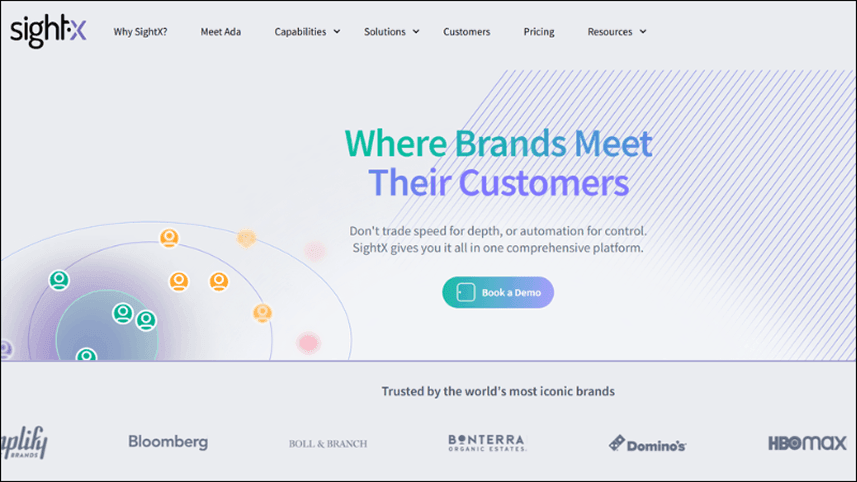
SightX is a consumer research tool that helps teams test product ideas, packaging, and concepts without relying on traditional research agencies. It’s built for marketers and product managers, not just research specialists.
The platform covers the full research process, from setting up studies to reviewing results, and is often used when teams want faster feedback at a lower cost than agency-led research.
Key Features:
- AI-assisted survey design
- Concept & Product Testing Suite
- Heat Mapping
- Advanced Methodologies
- Instant Data & Reporting
- Access to Targeted Consumers
Pros:
- Expert Customer Support
- Intuitive & User-Friendly
- Quick Insights
- Cost-Effective
- End-to-End Functionality
Cons:
- Limited Complex Programming
- Occasional Glitches with AI Tools
- Formatting Issues
Pricing: Custom pricing based on usage.
Best For: Teams wanting AI-assisted survey research without physical product testing requirements.
7. MESH01
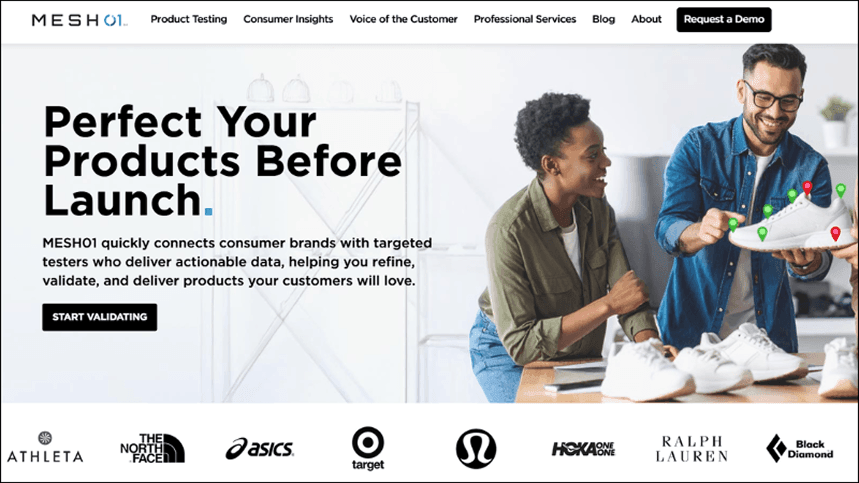
MESH01 specializes in physical product testing where hands-on interaction and detailed behavioral tracking matter. The platform goes beyond traditional surveys by capturing activity data, tracking how consumers actually use products in real-world settings.
Through activity logs, video/image uploads, performance zone heatmaps, and real-time usage data, MESH01 provides granular insights into product experience.
Key Features:
- Detailed activity log tracking
- Image and video upload capabilities
- Performance zone heatmaps showing interaction patterns
- Real-time product usage monitoring
- Qualified tester recruitment
Pros:
- Unique focus on behavioral data and actual product usage
- Heatmap visualization of product interaction
- Comprehensive data beyond surveys (activity logs, videos, images)
- Goes deeper than standard IHUT on physical interaction
Cons:
- Specialized platform may be overkill for simple concepts
- Likely higher cost due to sophisticated tracking
- Less suitable for early-stage concept validation
Pricing: Not publicly disclosed.
Best For: Brands with physical products where understanding actual usage behavior, ergonomics, and tactile experience matters (appliances, tools, complex packaging).
8. The Product Hub
The Product Hub, built by MMR Research, is a product testing platform made for CPG brands. It helps companies run central location tests and in-home usage tests in different markets.
The platform connects brands with consumer panels, manages recruitment, and collects feedback from people who test physical products. It’s mainly used when teams need structured, real-world feedback during product development.
Key Features:
- End-to-End Automated Platform
- CLT & iHUT Support
- MMR Expert Consultancy
- Rapid Quoting & Timings
- Benchmarking & Action Standards
- Versatile Testing Suite
Pros:
- Speed and Efficiency
- High-Quality Insights
- Flexibility
- Global Reach
- Comprehensive Data
Cons:
- Cost for High-Level Customization
- Specialized Focus
- Uncontrolled Variables in iHUTs
Pricing: Custom project-based pricing.
Best For: Brands seeking straightforward product testing services without extensive platform features.
What to Consider When Choosing a Concept Testing Tool
Budget and business size
Some tools are built for large enterprise budgets, while others are more flexible. Smaller teams and growing brands often start with Peekage because it doesn’t require large upfront commitments. As teams scale, they may explore broader platforms, but many still prefer tools that offer flexible subscription based on their need.
Speed requirements
Some platforms focus on same-day screening, while others take longer due to setup or logistics. Peekage typically returns insights within days, which works well for teams that want fast feedback without rushing decisions or oversimplifying the research.
Product type
The kind of product you’re testing matters a lot. Physical products that involve taste, scent, texture, or real usage usually require in-home testing. Tools like Peekage, and MESH01 support this type of feedback. Digital products or services don’t need hands-on testing and work well with survey-based tools such as Peekage, Suzy, Attest, or SightX.
Internal expertise
Some platforms are easier to use than others. Teams without a research background often prefer Peekage for its AI guided workflow or Suzy for its ready-made templates. More advanced platforms like Quantilope offer deeper analysis, but they deliver the most value when someone on the team is comfortable working with complex research methods.
| Your Priority | Recommended Platforms |
|---|---|
| Speed + Affordability | Peekage, Suzy |
| Advanced Methods | Peekage, Zappi |
| Physical Products + Logistics | Peekage |
| Enterprise Scale | Suzy, Zappi, Quantilope |
| Small Team Budget | Peekage |
Wrapping Up
The concept testing market has changed from when six-figure agency contracts and months-long timelines were the only options. Today, platforms range from enterprise solutions to accessible options made for frequent testing without research expertise.
No single platform works for everyone. The right choice depends on budget, speed needs, product type, and team capabilities. What matters most is validating with consumers before committing significant resources to development and launch.