Up to 80% of new CPG product launches fail, and from what we've seen, a big chunk of that comes down to picking the wrong research method at the wrong time. Brands run a concept test when they actually need a usability test. Or they skip one entirely.
Concept testing and usability testing both collect consumer feedback, but they answer completely different questions at completely different stages. It's worth noting upfront: concept testing is made for physical products, like CPG goods, while usability testing is a method used in software and digital product development, though CPG brands can draw useful parallels when evaluating digital touchpoints like apps or e-commerce experiences. This article walks through how to run each one, what separates them, and when each method makes sense for your next launch.
What Is Concept Testing and How to Conduct It for CPG Brands?
Concept testing services help you evaluate a product idea before you invest in production. It helps you understand if your idea has real market potential.
For CPG brands, the core question is simple. Will consumers want this? To answer this question, you need to:
1. Define your testing objectives. Start by clarifying what you want to learn. You may want to measure purchase intent, compare different concepts, test packaging appeal, or evaluate price perception. A clear objective keeps the research focused.
2. Develop the concepts. Create clear visuals or descriptions. This can include mock ups, renders, packaging designs, or written product summaries. You don’t need a finished product at this stage. A strong visual or description is enough.
3. Choose your concept testing method.
- Monadic: One concept per participant group. You get unbiased and focused feedback.
- Sequential monadic: Each participant evaluates multiple concepts one after another. Useful when comparing directions.
- A/B testing: Two variants shown side by side. Good for packaging design comparisons.
- MaxDiff analysis: Participants choose the most and least appealing options from a set.
4. Create your survey or discussion guide. Use a mix of question types for concept testing. Include quantitative ratings such as purchase intent, appeal, or uniqueness. Add open ended questions to understand why people feel the way they do. Both numbers and written feedback are important.
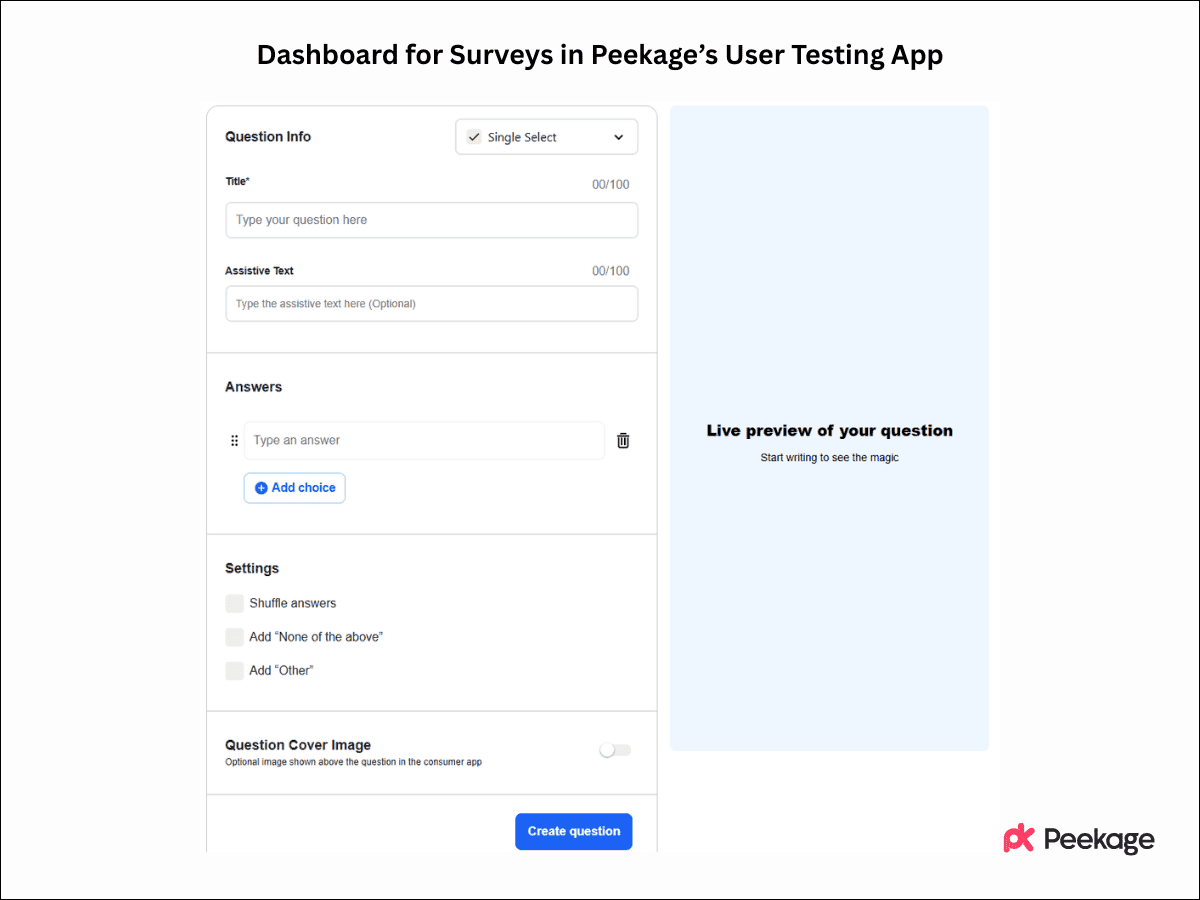
Peekage has a dedicated dashboard for creating your survey questions by yourself or with the help of our team once we understand your goal. If you need support, we guide you through the entire process, from designing the questions to running the survey and analyzing results.
5. Recruit participants and run the test. Work with participants who match your target audience. Platforms like Peekage help connect you with CPG consumers based on demographics and buying behavior.
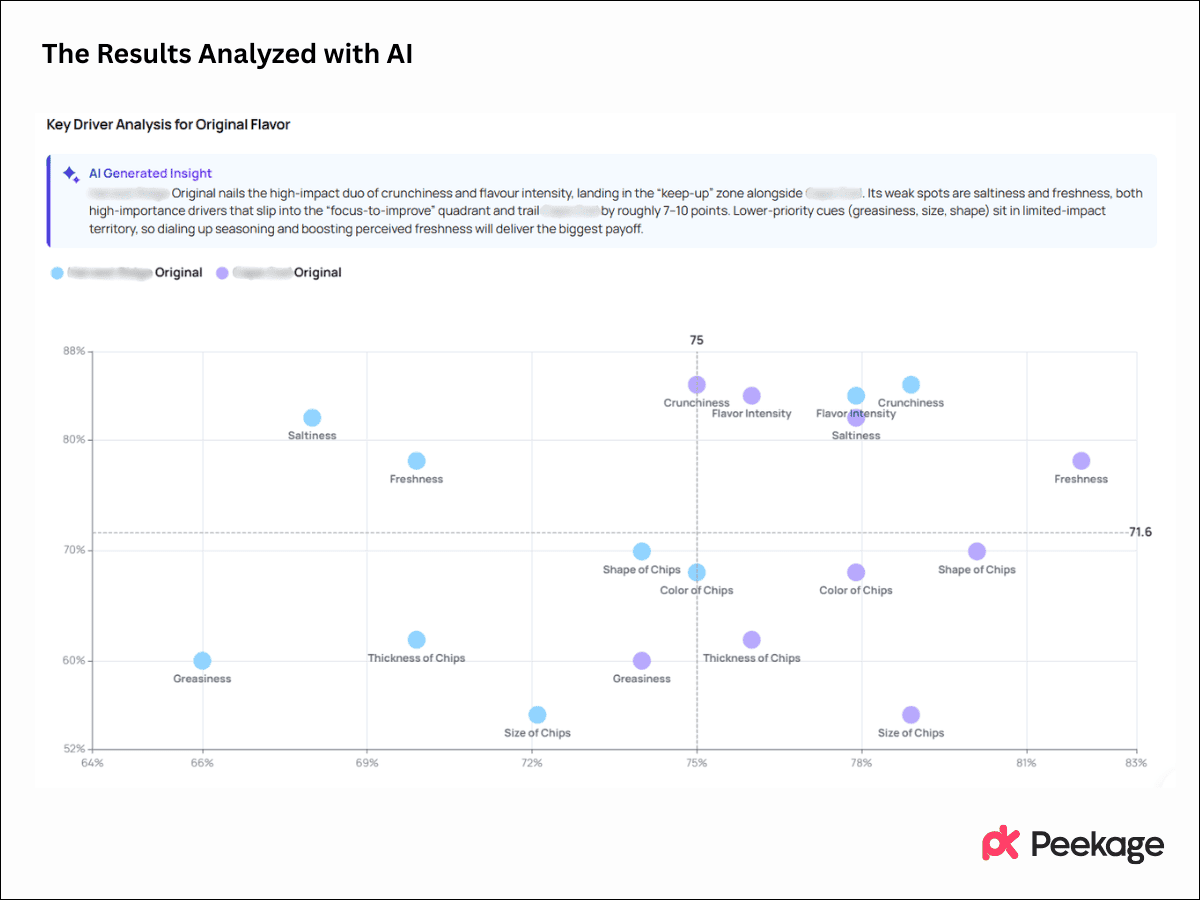
6. Analyze results. Look beyond overall scores. A concept can perform well on average but show different results with your most important segment. With Peekage, we do more than just show the numbers. We analyze the data with our AI assistant and provide clear recommendations based on what we find. You’ll see which segments react differently, why it is happening, and what actions to take next.
The report combines scores with open-ended feedback so you can make decisions confidently, whether that is refining messaging, adjusting pricing, narrowing your target audience, or choosing the concept that is ready to move forward.
7. Refine and test again. Use the results to improve, adjust, or remove concepts. Concept testing process is not a one time step. It can be used during early idea development, before production, before launch, and even for future line extensions.
Brands that test more often make stronger launch decisions because their choices are supported by data at every stage.
For a broader view of where concept testing fits into your product testing workflow, it's worth looking at the full development timeline.
What Is Usability Testing and How Does It Differ for CPG?
Usability testing is a research method built for software and digital products. It evaluates how easily users can complete tasks within an interface, navigating an app, checking out on a website, or using a digital tool. If your CPG brand has a companion app, a subscription portal, or an e-commerce experience, usability testing is the right method for those touchpoints.
For physical CPG products, the closest equivalent is In-Home Usage Testing (IHUT). Participants receive the product and use it in their normal environment over several days or weeks. This reveals how the product performs under real conditions, how easy it is to open, whether the instructions make sense, how it fits into a daily routine. Unlike usability testing, which focuses on digital interaction, IHUT is about physical interaction with a tangible product.
Concept Testing vs Usability Testing: What Are the Key Differences?
For CPG brands, concept testing is the primary research tool for physical products. Usability testing applies when there is a digital product involved. Here is how the two methods compare.
| Dimension | Concept Testing | Usability Testing |
|---|---|---|
| Best suited for | Physical CPG products | Software and digital products |
| Purpose | Validates whether an idea resonates with target consumers | Evaluates how easily users interact with a digital interface |
| Core Question | "Does this idea have market potential?" | "Can users complete tasks as intended?" |
| Focus | Appeal, viability, messaging, market fit | Interface functionality, ease of navigation, digital UX |
| Timing | Early in development, before production | During or after digital product development |
| Input / Stimuli | Descriptions, renders, mock-ups, concept boards | Digital prototype, live app, or website |
| Output | Go/no-go decision, concept refinements, positioning direction | UX improvements, interface fixes, friction removal |
| Metrics | Purchase intent, appeal score, uniqueness, relevance, brand fit | Task completion rate, time-on-task, error rate, satisfaction score |
Concept Testing vs Usability Testing: When to Use Each Method
The choice between concept testing and usability testing is not really a choice as they are built for different product types and different stages. For CPG brands launching physical products, the right sequence is concept testing first, In-Home Usage Testing second. Usability testing applies separately if your brand also has a digital product. Here is when each method makes sense.
Use concept testing when:
- You are exploring multiple ideas and need to choose a direction
- You have not invested in production yet
- You want to validate a new flavor, line extension, or packaging redesign
- You are testing messaging, naming, or positioning
- You need data to support internal approval or investor discussions
- You are evaluating whether your price fits the target audience
Use In-Home Usage Testing (IHUT) when:
- You have a working prototype or near-final physical product
- You want to observe real behavior in home environments
- You are testing packaging functionality such as opening, closing, or dispensing
- You need to validate product claims with real usage
- You are making final improvements before production
- You want post-launch feedback and repeat purchase signals
Use usability testing when:
- Your CPG brand has a companion app or digital tool that needs to be evaluated
- You are testing the checkout or subscription flow on your e-commerce platform
- You want to identify friction points in a digital experience before launch
For most CPG launches, the ideal sequence looks like this:
Concept Test → Refine the idea → Build the product → In-Home Usage Test → Refine execution → Launch
If your brand also has a digital product, usability testing runs separately alongside that development cycle, not as part of the physical product launch sequence.
Teams that skip concept testing often build something consumers never wanted in the first place. That is the more costly mistake, and the one that concept testing directly prevents.
Start With the Right Question
Concept testing and usability testing answer different questions at different stages, and for CPG brands, getting that sequence right is what separates a confident launch from an expensive guess. Concept testing validates the idea before production. In-Home Usage Testing confirms the product works in real life. Usability testing covers your digital touchpoints.
When you are ready to test your next concept, Peekage gives you the tools, the audience, and the analysis to move forward with clarity.