
Concept testing often gets reduced to a single question: Would someone buy this? That narrow view is where many product teams go wrong. Research shows that about 37% of products are stopped during concept testing. That may seem harsh, but it prevents bigger losses later. These are the products that would have failed in the market.
Concept testing helps you understand how people react to a product idea before you invest in development. A concept can take many forms, such as a short description, a visual mockup, a name, a price, or a package design. The goal is to test interest and understanding while changes are still easy and affordable to make.
This approach is different from general market research. Market research asks what customers want in broad terms. Concept testing focuses on whether they want the specific idea you plan to build. Because concepts are early versions of an idea, they allow you to learn before committing to production, packaging, or marketing.
| Aspect | Market Research | Concept Testing |
|---|---|---|
| Purpose | Understand broad customer needs | Evaluate a specific product idea |
| Key Question | What do people want? | Will they want this? |
| Scope | Exploratory and wide | Focused and decision-driven |
| Timing | Early discovery | Before major investment |
| Output | General insights | Clear go or adjust decisions |
In this article, we walk through nine practical concept testing examples, explain how to run them step by step, and highlight common mistakes that lead teams to waste time and budget.
What Concept Testing Examples Should You Know?
Here, let’s talk about 5 examples that show different ways to use concept testing. Each one answers a specific question and uses different methods depending on what you need to learn. We’ve organized them from big-picture brand decisions down to smaller marketing choices.
| Test Type | Primary Question It Answers |
|---|---|
| IHUT | Does the product perform as expected in real-life use over time? |
| Positioning and Messaging | Which message connects best? |
| Taste and Formula Testing | Does the product perform in real use? |
| Pricing Testing | What price feels acceptable and credible? |
| Package Testing | Does the packaging drive attention and usability? |
In-Home Usage Testing (IHUT)
IHUT lets you see how your product performs in the environments where consumers actually use it. Instead of only asking for opinions, you observe real behavio. This method captures insights on product usage, satisfaction, and barriers, showing whether your concept works in practice.
IHUT goes beyond lab tests or surveys by providing context-rich feedback. It uncovers issues or advantages that only appear during real use, helping you refine messaging, packaging, and even formulation before investing heavily.
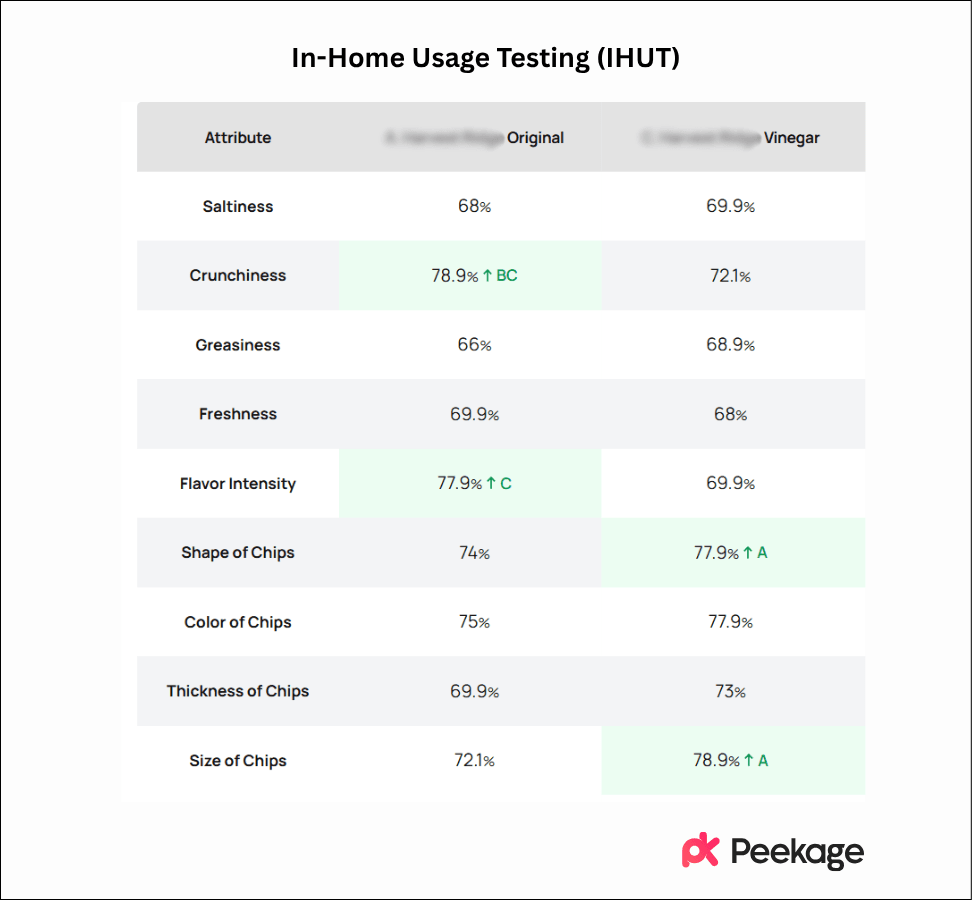
Example: We ran blind in-home usage tests for one of our clients’s crackers, tracking taste, texture, freshness, and other sensory attributes while collecting purchase intent, emotional feedback, and pricing expectations. The tests revealed that the Original flavor scored higher on crunchiness and purchase intent compared to Vinegar.
Positioning & Messaging
Positioning and messaging tests help find the product description that connects best with your audience that you select to target, whether they are or are not your consumers. How you describe a product affects whether people see it as relevant and valuable.
Participants review different versions of the messaging while researchers measure understanding, relevance, believability, and uniqueness. The goal is to identify the message that communicates your value clearly and sets your product apart.
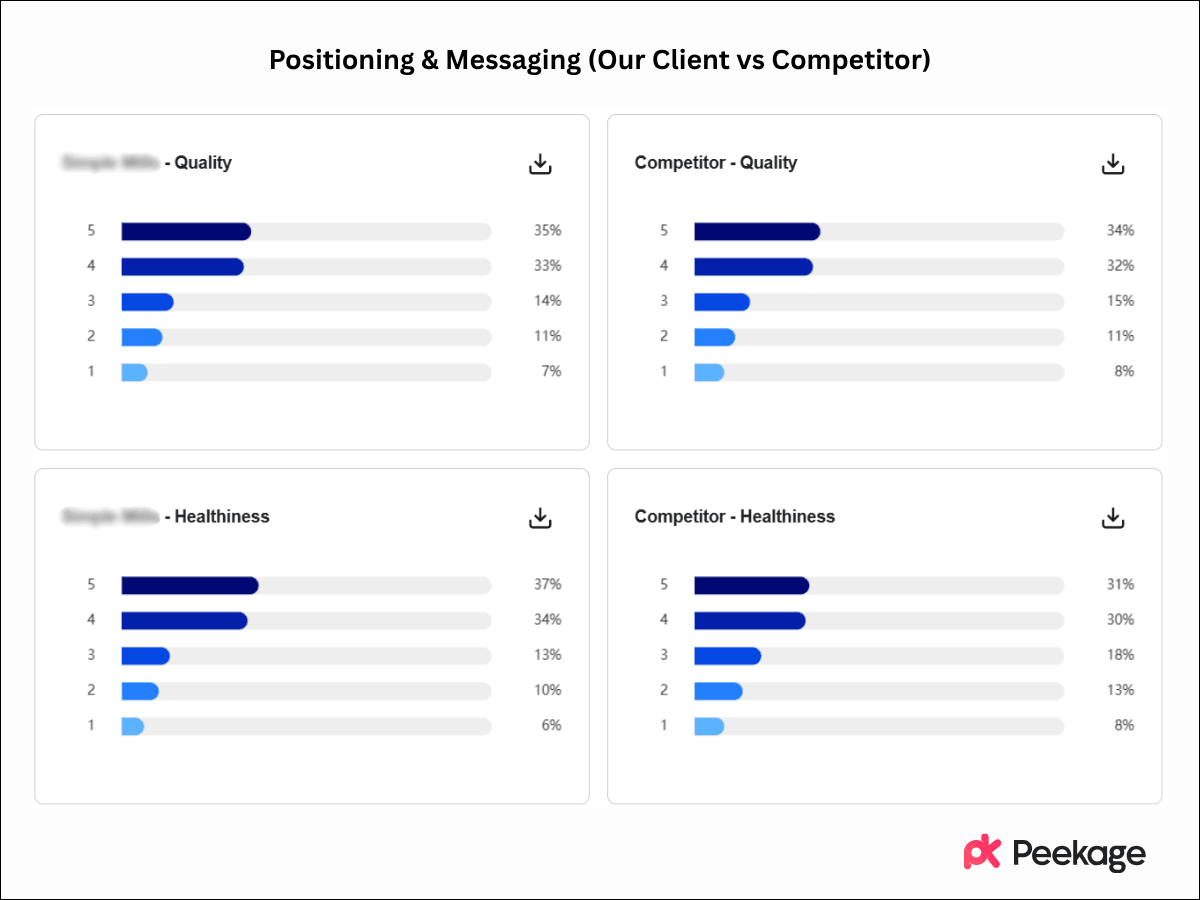
Example: One of our clients wanted to test their messaging with their target audience and see which messages worked best. We tested descriptions that highlighted health benefits, taste, and premium quality. Our findings showed that messages, such as "clean ingredients, high-quality nutrients," and "natural flavors," connected most strongly with consumers and helped the product stand out among other well-known competitors.
Taste & Formula Testing
Taste and formula testing looks at how people experience food, beverage, or personal care products. In these categories, you need to see and feel the product, because descriptions alone cannot predict reactions.
Testing can happen in controlled settings, where participants try products at home, where they use them over several days in real life.
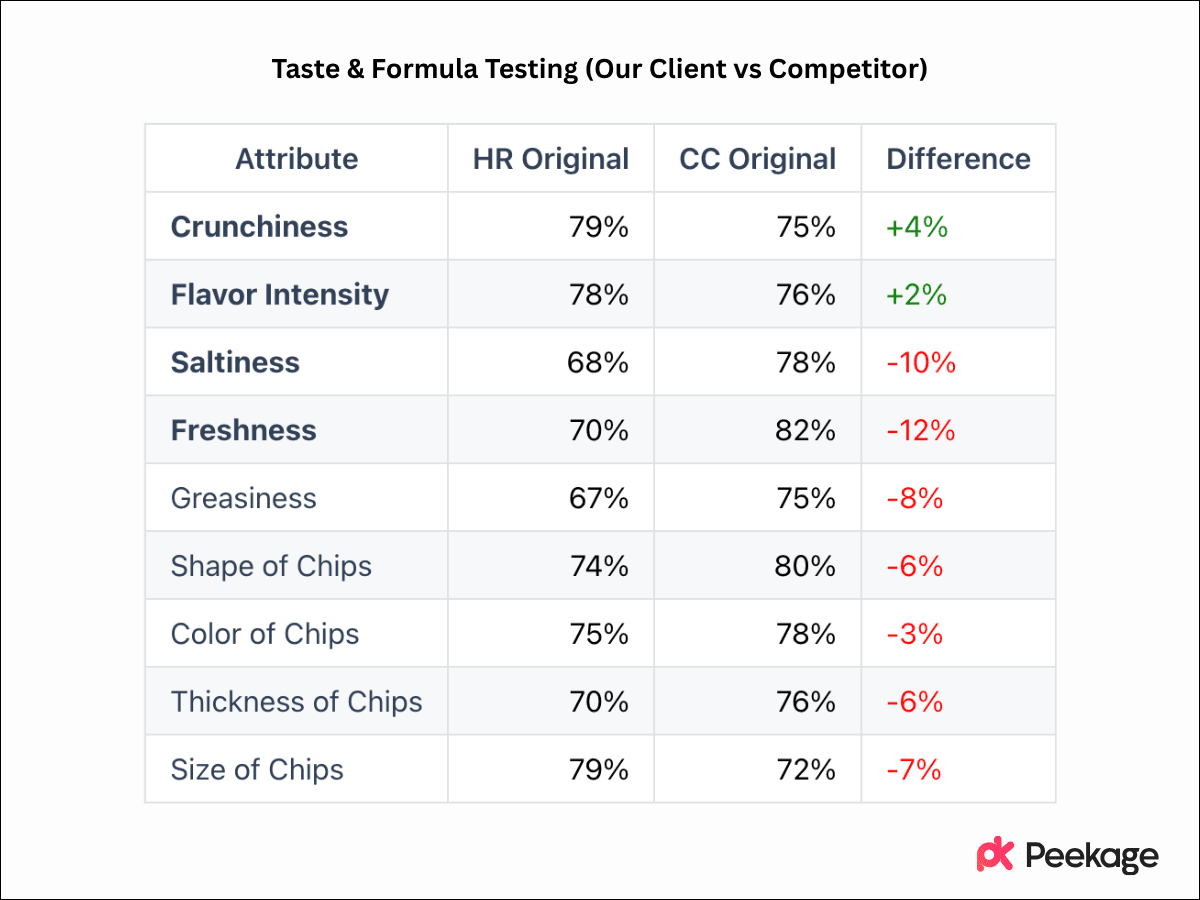
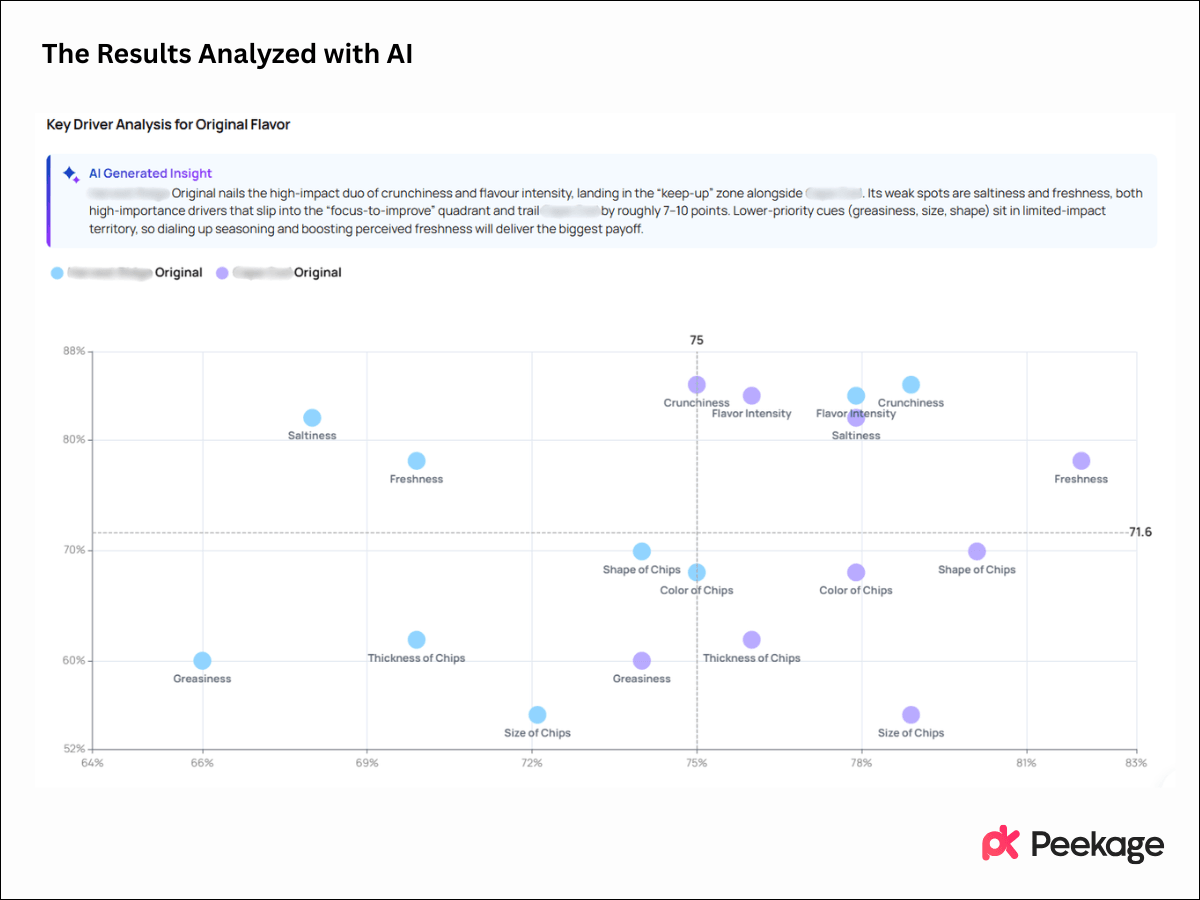
Example: A client wanted to see how their crackers performed in real use compared to competitors. We ran in-home taste tests, tracking reactions to flavor, texture, and freshness, and collected open-ended feedback. Results showed the product stood out for crunch and texture, while freshness and seasoning held it back, giving the team clear direction on what to improve before launch.
Pricing Testing
Pricing testing looks at how much people are willing to pay and how price affects the way they see your product. Too high prices can limit sales, while too low can reduce perceived quality or leave money on the table.
Common methods include asking consumers at what price a product feels too cheap, a good value, expensive, or too expensive. Other methods show how price compares to other product features when people make choices.
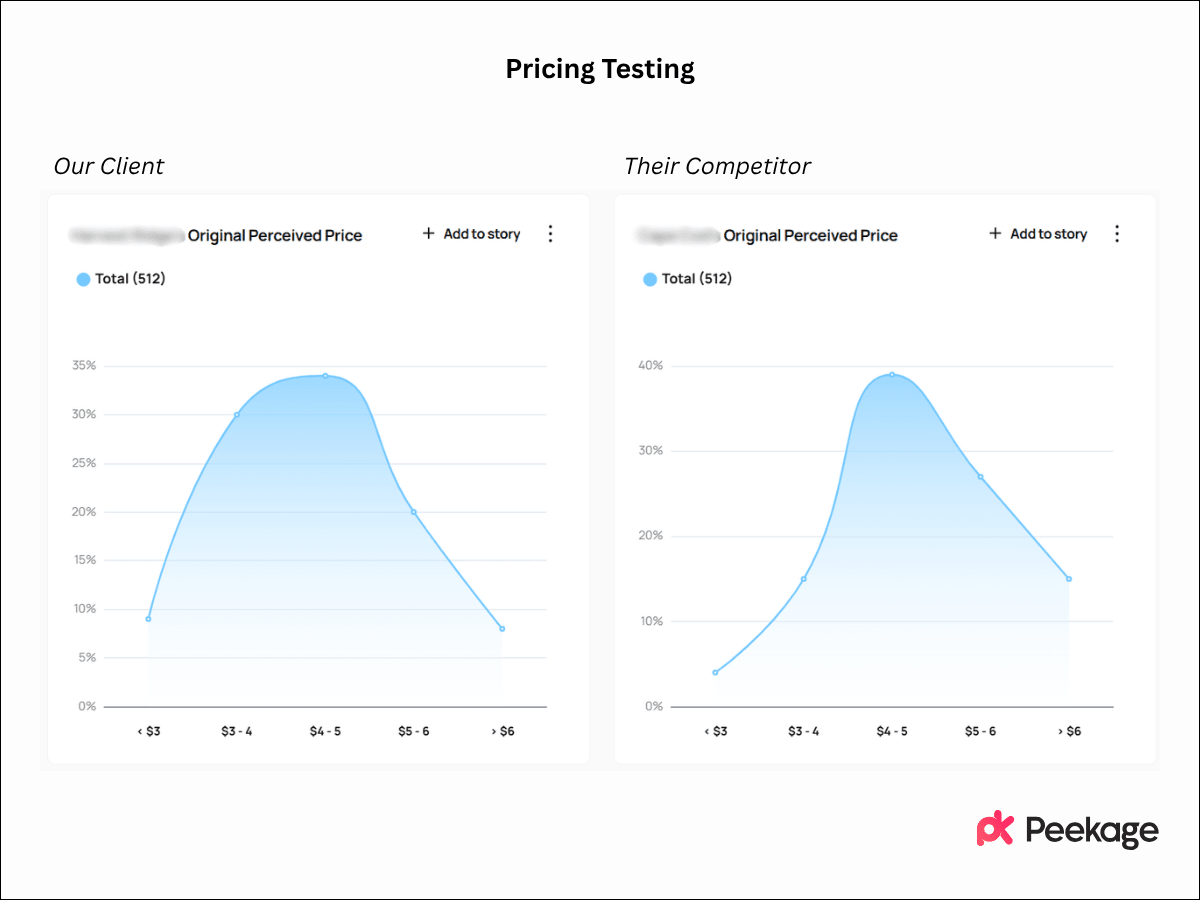
Example: A client wanted to see how consumers perceived their premium snack pricing. We measured expected price points versus competitors during in-home tests. The pricing test showed that the original product supported a higher price with premium brand buyers and family snackers, especially in warehouse and mass retail channels, while the vinegar variant struggled to justify the same price and showed weaker intent across segments.
Package Testing
Package testing explores how design affects buying decisions, brand perception, and ease of use. Packaging needs to attract attention, communicate benefits, and protect the product.
Tests can include checking how quickly people notice your package, comprehension checks to make sure key information is clear, and usability tests to see if the product is easy to open, use, and store.
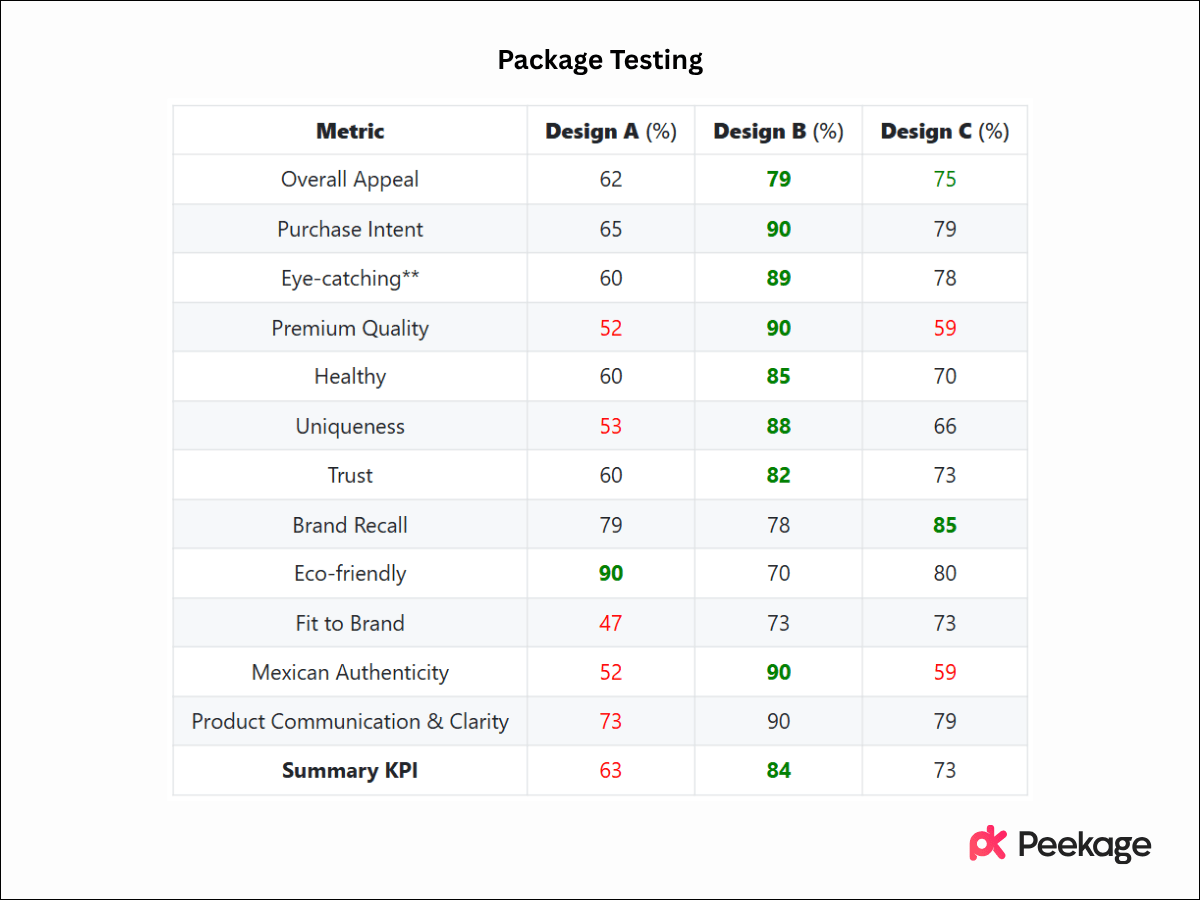
Example: Our client needed to evaluate whether Design B or Design C should replace the current packaging (Design A) and which option would perform best in terms of consumer appeal, purchase intent, and brand perception. We conducted an online packaging test where target consumers reviewed Designs A, B, and C side-by-side and rated each across key metrics such as overall appeal, eye-catching ability, perceived quality, trust, and purchase intent. The results showed that Design B clearly outperformed both Design A and Design C, driven by its stronger premium perception, clearer communication, and significantly higher purchase intent, making it the recommended packaging direction.
How to Conduct a Successful Concept Test with Peekage
Concept testing works best when you follow a clear process. Rushing or skipping steps can produce results that feel conclusive but actually mislead your decisions.
| Stage | What Happens | Key Output |
|---|---|---|
| Business question | Clarify the decision that needs to be made | Clear test objective |
| Concept creation | Define the idea, value proposition, and basic visuals | Testable concepts |
| Test design | Select method, audience, and success metrics | Research plan |
| Data collection | Gather feedback through surveys or interviews | Raw responses |
| Analysis | Review scores, patterns, and segment differences | Insights and tradeoffs |
| Decision | Refine, compare, or move forward with a concept | Informed action |
Define Your Objectives
Before anything else, get specific about what decision this test needs to support. "Learn what consumers think" is too vague to be useful. Something like "determine whether Concept A or Concept B drives higher purchase intent among women 25–44" gives you a real target to work toward.
A focused objective shapes everything that follows, your sample size, methodology, survey questions, and how you'll analyze the results.
Identify Your Target Audience
The people you test must represent your real customers. Testing a premium pet food concept with general consumers will give very different results than testing with people who already buy high-end products. Define your audience using demographics, behavior (how they use the category), and attitudes or values.
Develop Your Concepts
Aim for concepts that are clear enough to react to, but not so polished they can't be changed. A short description, a visual mockup, and a key benefit statement usually do the job. If you're testing multiple concepts side by side, make sure they're developed to the same level, comparing a finished design against a rough sketch can quietly skew your results.
Choose Your Testing Method
There are three common structures, and the right one depends on what you're trying to learn: Monadic testing shows one concept to each participant and measures reactions. Comparative testing shows multiple concepts and measures preferences. Sequential monadic shows each concept to the same participant, one at a time, with questions after each. The method you choose should match your goal. Use monadic if you want to know if a concept is good enough, and comparative if you want to know which concept is better.
Peekage supports these testing structures within a single system. This allows your teams to run monadic, comparative, or sequential tests without rebuilding studies from scratch.
| Method | When to Use It | What It Tells You |
|---|---|---|
| Monadic | When testing a single concept | Whether the concept is strong enough on its own |
| Comparative | When choosing between options | Which concept performs better |
| Sequential Monadic | When controlling order bias | Relative strength across concepts |
Create Your Survey or Discussion Guide
Write clear and neutral questions. For example, “How likely are you to purchase this?” on a scale, and “What, if anything, would make you more interested?” Open-ended questions help uncover improvement opportunities. Avoid wording that suggests the “right” answer.
Survey design matters more than most people realize, it directly affects the quality of your insights. Peekage's AI-supported dashboard helps generate and optimize questions so your results are structured to actually be actionable.
Recruit Participants
Your sample should be large enough to detect meaningful differences. For detailed comparisons, plan for at least 250-400 respondents per group. Smaller samples can give directional guidance. Make sure your recruitment source provides quality participants. With Peekage, you don’t have to worry about this step, we’ll find and recruit participants for you, so you get one step closer to testing your product.
Conduct the Test
Run the test according to plan. Avoid changing the process midway. Watch for technical problems or low-quality responses.
Analyze the Results
Don't stop at overall scores. A concept might average well but perform very differently with your most important customer segment, and that difference is often where the real insight lives.
Peekage goes beyond the numbers. Our AI assistant analyzes the data and surfaces clear recommendations: which segments react differently, why that's happening, and what to do next. You'll get a report that combines quantitative scores with open-ended feedback, so you can decide with confidence, whether that means refining your messaging, adjusting pricing, tightening your target audience, or moving forward with the stronger concept.
Make Data-Driven Decisions
Use results to guide your decisions, not to choose automatically. A concept with 45% purchase intent versus one with 42% may not be meaningfully different if your margin of error is give or take 3%. Instead of treating scores as final answers, Peekage will help you interpret results in context and decide what to refine, test again, or move forward with confidence.
Tools and Platforms to Support Concept Testing
Modern concept testing is more accessible than ever thanks to user-friendly platforms. These tools help you deploy surveys, run live tests, and gather qualitative insights without the need for an in-house research team.
Popular tools include:
| Platform | Unique Feature | Best Use Case |
|---|---|---|
| Peekage | Consumer insights with survey follow-up | Physical product testing |
| Google Forms | Free and fast survey tool | Early-stage feedback |
| UsabilityHub | Quick concept testing for visuals/copy | Campaign pre-launch testing |
| PlaybookUX | Remote video interviews | Deep qualitative insights |
Choosing the right platform depends on whether you need scale, speed, or depth of insight. It's often best to combine tools to cover both quantitative metrics and qualitative context.
Concept Testing Mistakes to Avoid
Several common mistakes can make concept testing less useful.
Testing Underdeveloped Concepts
Your concept needs enough detail for people to give meaningful feedback. Vague descriptions lead to vague answers. If participants cannot clearly understand what they would be buying, the test results won’t be helpful.
Misinterpreting Data
Small differences between concepts may not be meaningful. For example, a 3-point difference in purchase intent could fall within the margin of error. Look at confidence intervals before assuming one concept is better than another.
Over-reliance on Purchase Intent
Purchase intent gives some insight but does not perfectly predict actual behavior. A concept may score high on intent but still fail due to price, placement, or competition at the point of sale.
Ignoring Context and Competitive Frame
Testing a concept in isolation can be misleading. Consumers might like your idea until they see competitors’ options. Including real-world context helps show how your concept performs in the market.
Treating Concept Testing as Validation Instead of Learning
Concept testing works best when it helps you learn, not just prove you are right. Ignoring negative feedback or dismissing ideas that challenge assumptions misses opportunities to improve your product.
Bottom Line
Concept testing is most effective when it is tied to a clear decision and used at the right moment in development. The examples in this article show how different tests answer different questions, from early brand choices to final marketing decisions.
The real value comes from how results are used. When teams treat concept testing as a way to learn and adjust, rather than to confirm assumptions, it helps focus effort on ideas that are worth moving forward and avoids costly missteps later.