
Most product teams have no shortage of ideas. What they're short on is a reliable way to tell the good ones apart from the costly ones.
CB Insights found that 35% of startups fail simply because nobody wanted what they built. Not because the team wasn't talented, not because the product wasn't polished, but because no one stopped to ask, "Should we actually build this?" before spending the budget.
That's exactly what the idea screening is for. It is the step between "we have a bunch of ideas" and "we're committing resources to this one." It's how smart product teams avoid the trap of building for 12 months only to launch into silence.
At Peekage, we've helped hundreds of CPG brands run this process using real consumer data, and the difference between teams that properly screen ideas and those that skip it is significant.
Here's how to screen ideas properly, which methods actually work, and the mistakes that cost companies millions.
What is Idea Screening?
Idea screening is the systematic process of evaluating potential product concepts to figure out which ones are actually worth pursuing. It happens right after brainstorming, before prototypes, before development, before any serious money moves.
Think of it as a filter. Your team generated 30 ideas in a workshop. Realistically, 3 to 6 of them have legs. Idea screening is how you find those 3 to 6 without burning time and budget on the other 24.
The goal isn't to kill creativity. It's to focus on it. You're applying critical thinking to ask: does this idea solve a real problem, can we actually build it, and does it align with where we're going as a business?
A few numbers worth keeping in mind:
- MIT research shows 95% of newly launched products fail
- Up to 80% of product costs get locked in at the design stage
- The earlier you catch a bad idea, the cheaper it is to walk away
Idea screening is the checkpoint that catches those problems while changes still cost hundreds, not millions.
One thing to keep clear: idea screening is not the same as concept testing. Screening happens early when you're evaluating raw ideas against criteria, not putting finished prototypes in front of consumers. Concept testing comes later, after you've fleshed out the ideas that survived screening. Both matter, but they serve different purposes at different stages.
What Are the Methods of Idea Screening?
There's no single right way to screen ideas. The best teams use a combination of frameworks depending on what stage they're at and how much data they have.
SWOT Analysis
A classic for a reason. Map out the Strengths, Weaknesses, Opportunities, and Threats for each idea. It's quick, it's familiar, and it forces the team to look at both internal capability and external market conditions. The limitation is depth, SWOT is better for early triage than thorough evaluation.
Weighted Decision Matrix
This is where screening gets rigorous. You define your evaluation criteria (market potential, technical feasibility, strategic fit, cost), assign each a weight based on what matters most to your business, then score every idea against those criteria. Multiply score by weight, add it up, and you have an objective ranking.
It sounds simple, but it works because it removes the "loudest person in the room wins" problem. Everyone scores ideas against the same standards.
| Criteria | Weight | Idea A (Expense App) | Idea B (AI Receipt Scanner) | Idea C (Team Dashboard) |
|---|---|---|---|---|
| User Value | 40% | 8 → 3.2 | 9 → 3.6 | 7 → 2.8 |
| Feasibility | 30% | 7 → 2.1 | 4 → 1.2 | 9 → 2.7 |
| Cost | 30% | 6 → 1.8 | 3 → 0.9 | 8 → 2.4 |
| Total | 7.1 | 5.7 | 7.9 |
Idea B feels exciting, AI-powered, high perceived value. But it scores lowest because nobody can actually build it affordably. The matrix surfaces before anyone wastes time on a roadmap for it.
ICE and RICE Scoring
ICE scores Impact, Confidence, and Ease, fast and useful when you're working with limited data at early stages. RICE adds Reach (how many people does this affect?) for when you have more usage data to work with.
Use ICE when you need to move fast. Use RICE when you have real numbers to back it up.
Kano Model
Categorizes features and concepts by the type of satisfaction they create: must-haves (basic expectations that don't delight but will disappoint if missing), performance features (more is better, linearly), and delighters (unexpected things that genuinely surprise and impress).
This is especially useful for deciding how to position ideas, not just whether to pursue them.
BRIDGeS Framework
A more structured approach that analyzes Benefits, Risks, Issues, Domain Knowledge, Goals, and Solutions across multiple perspectives. More time-intensive, but valuable when you're dealing with complex decisions or multiple stakeholders with different priorities.
Research-Based Methods
Frameworks are only as good as the data behind them. Combining qualitative research (customer interviews, focus groups) with quantitative data (surveys, scoring models, market analysis) gives you the full picture. Qualitative tells you why customers care. Quantitative tells you how many do.
This is where Peekage becomes genuinely useful. Rather than screening ideas based entirely on internal assumptions, you can validate them against real consumer reactions early, before you've committed to a direction. Peekage's platform lets teams run consumer surveys and collect structured feedback as part of the screening process itself, so your scores reflect actual market signals, not just team opinions.
Idea Screening vs Idea Generation
These two processes feel like opposites, because they are.
Idea generation is divergent. No judgment, no filters. The goal is volume and variety. Brainstorm freely, use SCAMPER, mind-map everything, encourage wild ideas. The weirder the better at this stage.
Idea screening is convergent. Now judgment is the entire point. You're applying structure, criteria, and data to eliminate the ideas that won't work so you can focus everything on the ones that will.
They're sequential, not competing. Generation comes first. Screening follows. Together, they form the foundation of a healthy innovation process.
Peekage supports both phases with features that capture ideas from brainstorming sessions, then transition smoothly into evaluation workflows. The platform maintains context across the full ideation stage, linking why ideas emerged to how they scored during screening.
Typical Idea Screening Process for CPG Products: From Defining Your Objectives to Campaign Launch with Peekage
Running an idea screening study helps you quickly identify which ideas are worth developing further. While it might seem like a high-level exercise, the process becomes simple when broken into clear steps. Here's how we approach it.
Step 1: Define Your Research Objectives
Start by clarifying what you're trying to achieve with idea screening. This method is used early in the innovation process to filter a large set of ideas and identify the most promising ones. Are you narrowing down a long list of product ideas? Deciding which directions to invest in? Your objective will determine how you evaluate ideas and what criteria matter most.
Step 2: Build Your List of Ideas
Create a structured list of the ideas you want to test. Each idea should be clearly described, easy to understand, and presented at a similar level of detail. Avoid mixing vague concepts with highly developed ones. Keep descriptions concise but informative enough for respondents to evaluate them fairly.
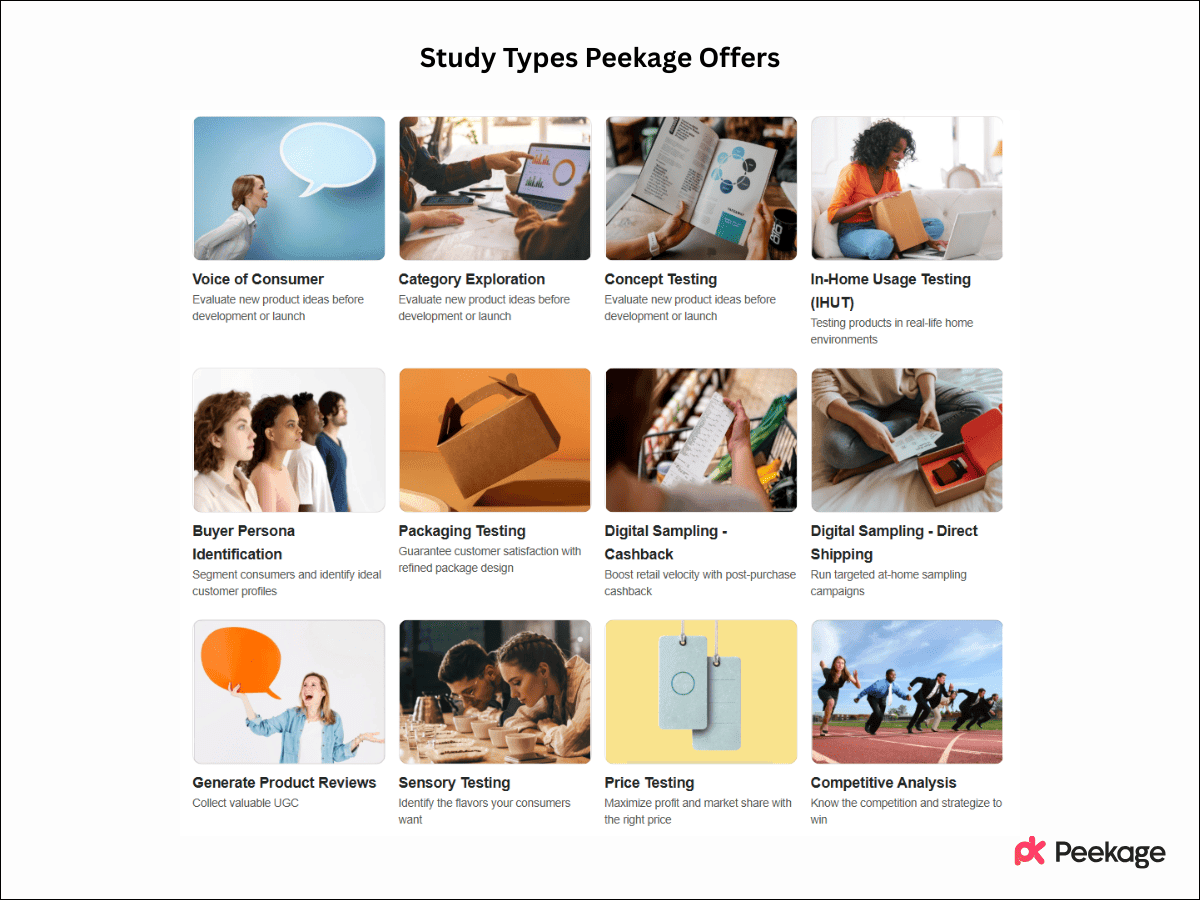
Step 3: Pick Your Study Type in Peekage
Choose the study type that fits your objective (e.g., product testing) then apply idea screening within that framework. The study type provides the context, while idea screening focuses on comparing and filtering options. The way you present each idea and frame your questions will influence how respondents interpret and evaluate them.
Step 4: Build Your Panel Using 200+ Attributes
Use Peekage to define your target audience. You can apply demographic, behavioral, and geographic filters to ensure feedback comes from the right people. Sample size should be large enough to reliably compare multiple ideas and identify clear winners. With over 200 targeting attributes and pre-screening options, you can refine your audience to closely match your ideal customer profile.
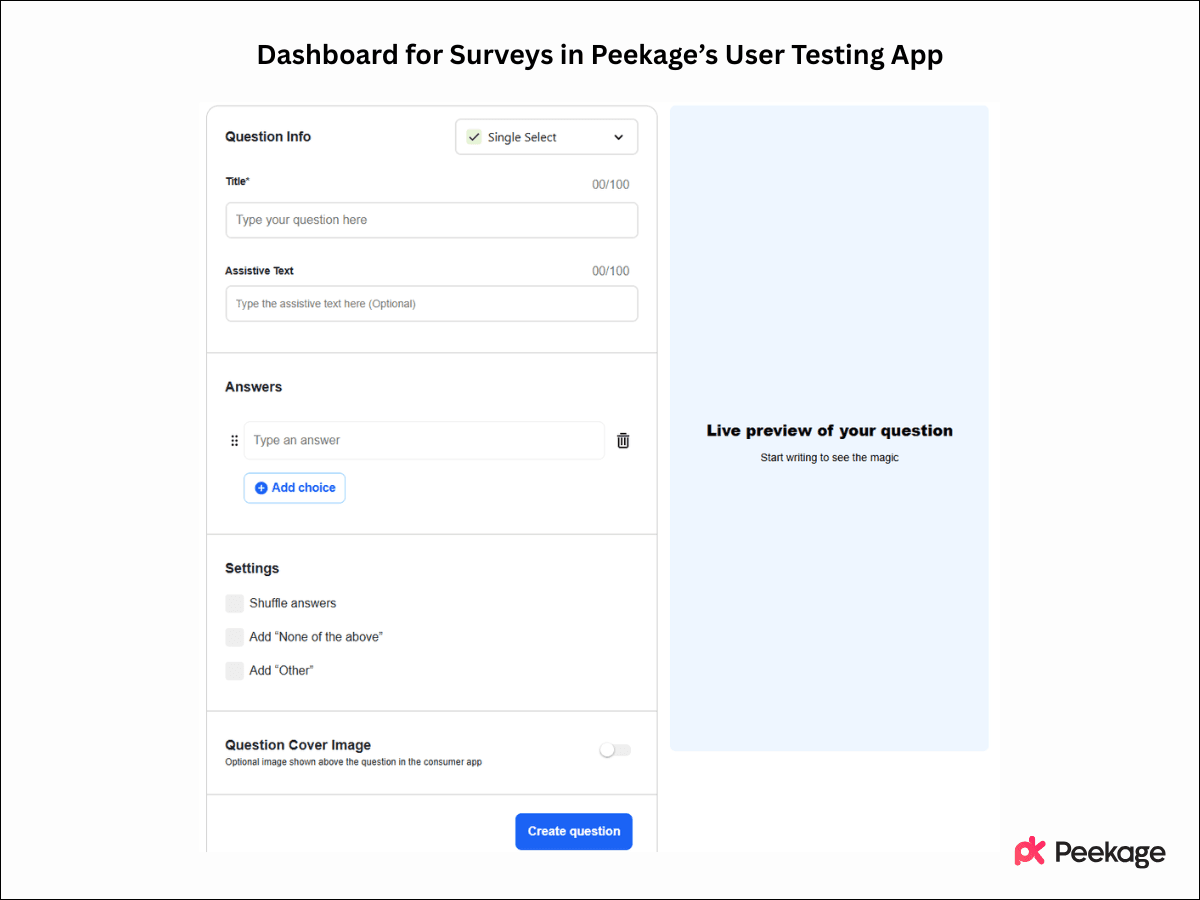
Step 5: Design Your Survey or Review the One Built by AI
Design your survey to capture quick and consistent evaluations across all ideas. This typically includes rating questions and may include a few follow-up questions for context. Keep the survey streamlined, idea screening works best when respondents can move effectively through multiple concepts without fatigue. You can use Peekage predefined templates or use the AI feature to generate one, but always review them to ensure clarity and alignment with your goals.
Step 6: Send for Peekage Review and Launch Your Campaign
Before launching, send your study to Peekage for review. Our team checks that ideas are presented clearly, the survey is well-structured, and everything is set up to produce reliable comparisons. The review process usually takes 1–2 days. Once approved, you can launch. Peekage's execution AI handles participant recruitment and data collection, while the quality agent ensures clean, reliable responses. You can follow progress in real time via the live dashboard, with most studies completed within 2–5 days.
Step 7: Analyze Results and Take Action
Idea screening results highlight which ideas perform best based on your selected criteria. Peekage presents this through rankings, score comparisons, and visual summaries, making it easy to spot top performers and weaker concepts. The AI assistant helps interpret the data, pointing out which ideas to move forward with, which to refine, and which to drop.
The goal is to focus your time and resources on ideas with the highest potential before investing in development.
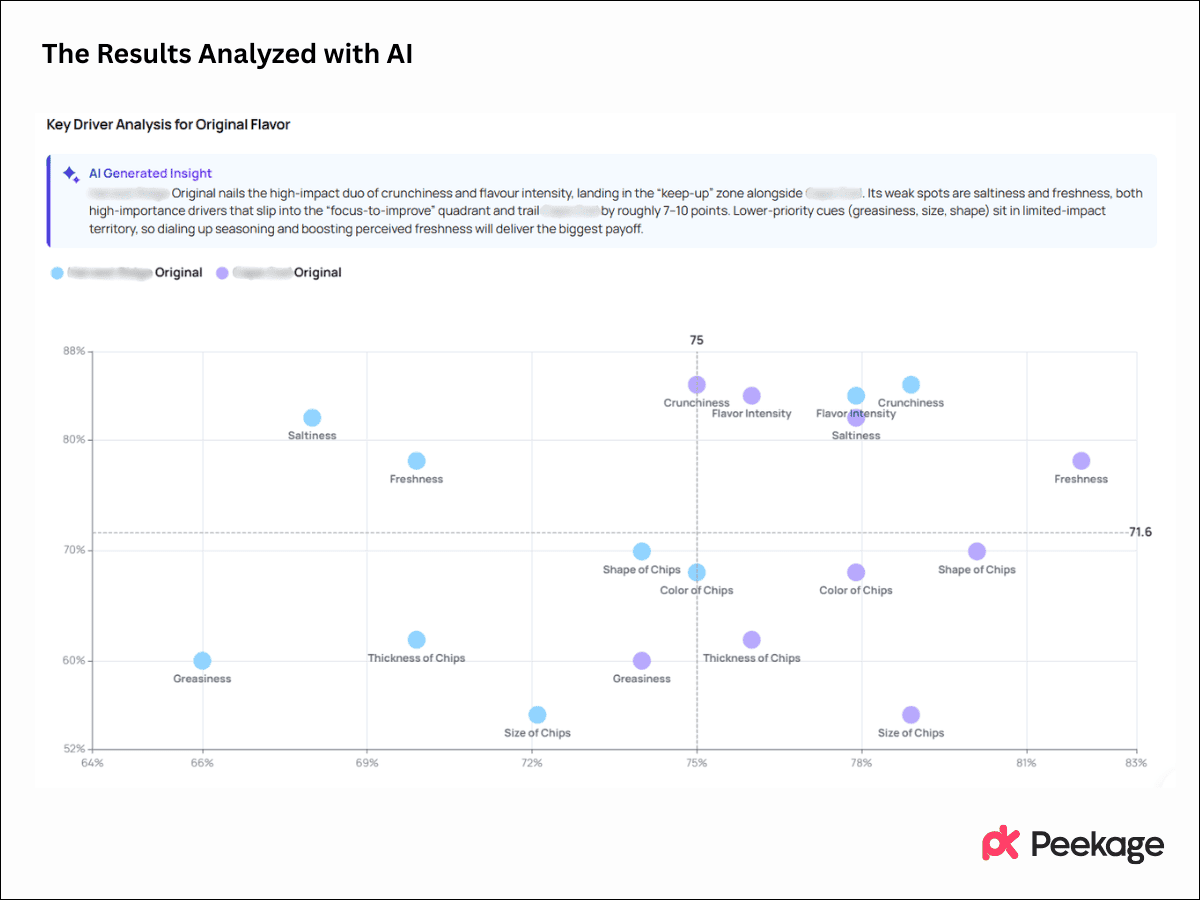
The whole process that used to take weeks compresses to days. And the output is better because it's grounded in consumer data from the start, not just internal intuition.
What Comes After Idea Screening?
Once you have your shortlist, the work shifts from filtering to building.
Concept development takes a screened idea, say, "a supplement designed for post-workout recovery", and turns it into something specific. Ingredient profile, format, packaging direction, value proposition, positioning. You go from a concept to a defined product brief.
Concept testing puts that brief in front of real consumers. This is where Peekage's In-Home Use Testing (IHUT) and concept testing services come in. Instead of asking "would you buy this?" in a survey, you're putting a real product in consumers' hands in their actual homes and collecting structured feedback on performance, taste, packaging, and purchase intent. The insights are richer because the testing environment is real.
Prototype and MVP development follows validation. Proof of concept if you're testing technical feasibility. Prototype for design and UX feedback. MVP when you're ready to test with actual users in market conditions.
Business analysis adds the financial layer, market sizing, resource requirements, competitive positioning, go-to-market planning. Concepts that have survived consumer validation are now ready for commercial rigor.
Peekage connects all of these phases. Screening data flows into concept testing. Concept testing results inform prototyping. The context doesn't get lost between stages.
An Example of Idea Screening for CPG Brands with Peekage
What Our Client Needed
A mid-sized better-for-you snack brand walked out of an innovation workshop with 18 concepts for a line extension and six weeks to recommend a direction. Traditional vendors quoted eight to ten weeks just for screening. The team needed to narrow the list to 3 or 4 concepts worth developing, and they needed real consumer signals from their core shopper, not another internal debate, to get there.
What We Did
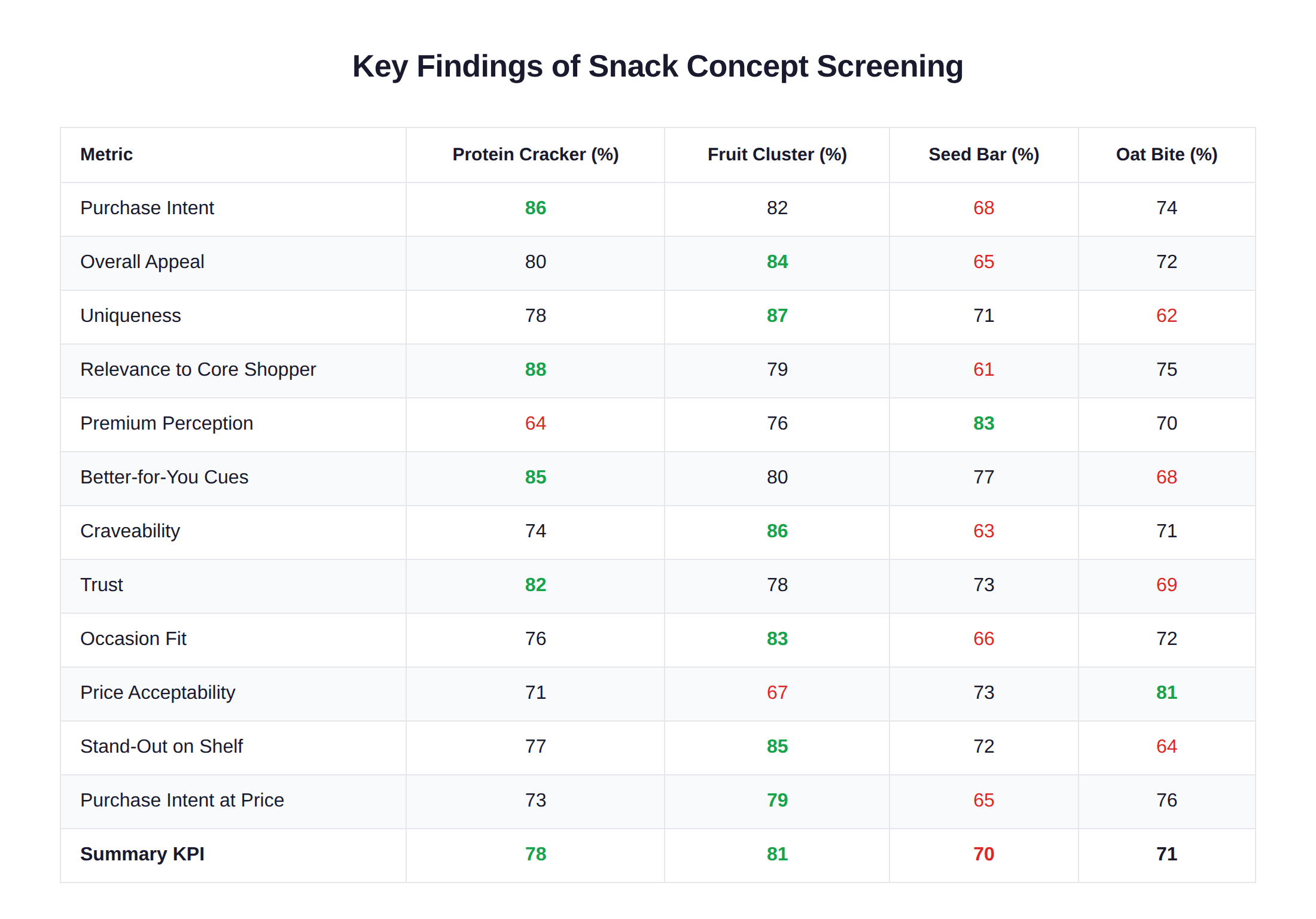
We ran an online concept screening study with a nationally representative sample of better-for-you snack buyers. Participants were shown the 18 line extension concepts in randomized sets, simulating how shoppers evaluate new products against their existing repertoire. The study combined quantitative ratings across key metrics such as purchase intent, uniqueness, relevance, premium perception, and price acceptability, along with forced-choice comparisons and open-ended feedback to capture both measurable preferences and emotional reactions to each concept.
What We Found
The results showed that four concepts clearly outperformed the rest across most key metrics, including purchase intent, uniqueness, and relevance to the core shopper. Consumers responded strongly to the high-protein baked cracker's clear better-for-you messaging and the freeze-dried fruit cluster's snackable format, which reinforced both trust and craveability. While the savory seed bar performed slightly better on premium perception and another concept scored higher on price acceptability, the top four concepts delivered the strongest overall consumer response, making them the most promising directions for final development.
The Mistakes That Kill Good Processes
Even well-intentioned teams make these errors. Most of them are avoidable.
- Trusting gut over data. Everyone's gut is biased. Structured criteria and consumer research exist to correct for that. Use them.
- Ignoring feasibility. Exciting ideas mean nothing if your team can't build them with current resources, technology, or skills. Loop in engineering early.
- Underestimating competition. Unique advantages erode fast. Make competitive analysis part of your screening criteria, not an afterthought.
- Screening without consumers. Internal teams evaluating ideas internally is a closed loop. Real market validation, even lightweight, is far more reliable than conference room consensus. Peekage makes it straightforward to include consumer data at the screening stage, not just later.
- Building before screening. Prototyping is exciting. But if you haven't screened the underlying idea, you might be polishing something nobody wants. Screen first, build second.
- Sunk cost thinking. The money already spent is gone. Evaluate ideas on their future potential, not on how much you've invested so far.
- Skipping documentation. If you can't explain why you killed an idea, you'll revisit it again in six months when someone new joins the team. Document everything. Peekage's audit trail does this automatically.
- Forgetting your parking lot. Market conditions change. Technology advances. An idea that failed the feasibility check last year might pass it today. Keep rejected concepts accessible and review them quarterly.
Start screening your concepts with real consumer data. Sign up for Peekage today.